
Auction houses do not always get it right, as many of my articles have shown. Not getting it right is one thing, but going ahead with a sale after Perezcope alerts you to an obvious Frankenstein watch is foolish. It happened at Sotheby’s New York late last year with a vintage Blancpain Fifty Fathoms made of an antimagnetic alloy, commonly referred to as bronze. The watch, pieced together from parts of different models and periods, ended up in a Taiwanese collection, and the new owner now believes he acquired “a superior and noteworthy example of a vintage Fifty Fathoms”. The modern Blancpain brand deserves its fair share of blame, as it accepted the watch for its Fifty Fathoms exhibition held in conjunction with Blancpain’s imaginary 275th anniversary in 2010. It shows that the resuscitated Blancpain brand not only perpetuates a totally false origin story, falsely claiming to be the oldest watch brand in the world, but also lacks the knowledge and understanding to evaluate the watches made in the past by Rayville, the successor of the original Blancpain brand, which ceased to exist in 1932. A complicated story, I know.
The Blancpain Fifty Fathoms, often incorrectly labeled the first modern dive watch incorporating a rotating time-recording bezel, is without a doubt an iconic timepiece. To give modern iterations of the legendary diving watch a unique selling proposition, Blancpain has been perpetuating a false timeline since the mid-2000s, without any evidence to support its claims. All existing documents, including those from the French Navy, which played an integral part in the development of the watch, point to 1954 as the birth year of the Fifty Fathoms, making the Rolex Submariner, demonstrably born and tested in early 1953, the real pioneer of the deep. But enough of the broken record.
Lot 245 – Blancpain Fifty Fathoms 1000, 3224
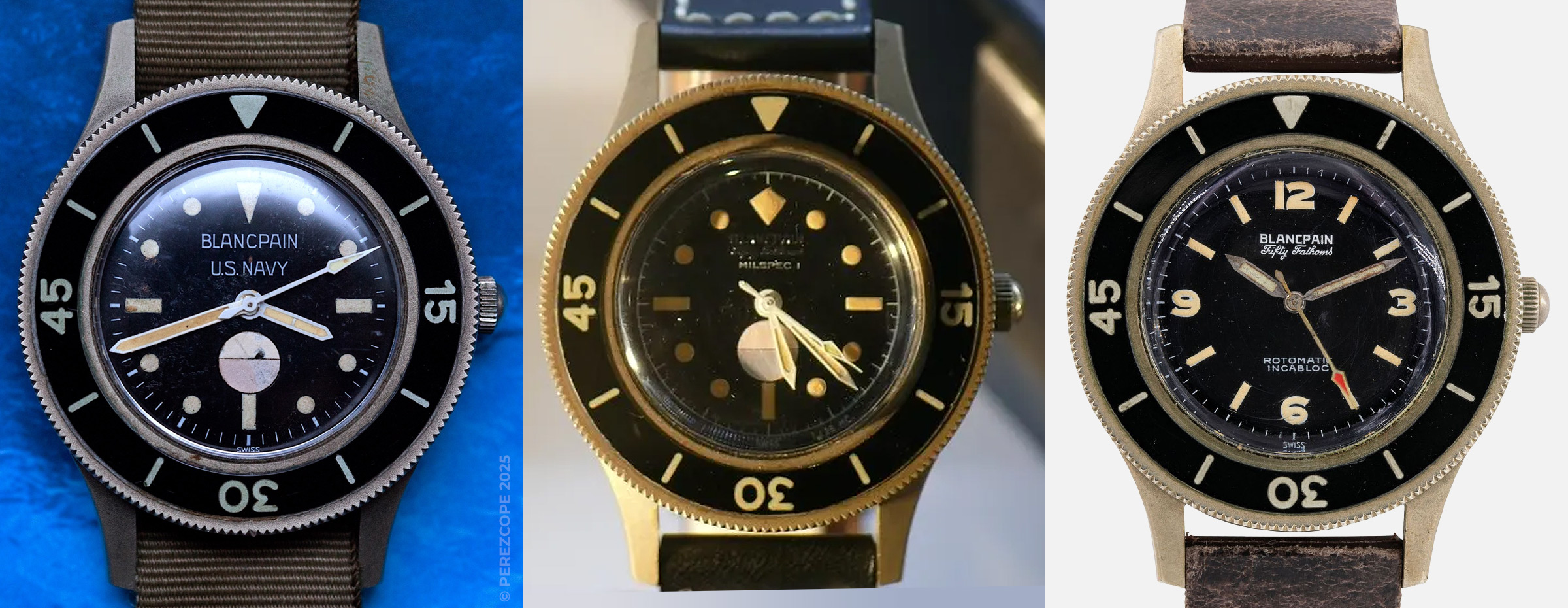
The present watch’s antimagnetic alloy case, often referred to as bronze due to its colour, belongs to a small batch made sometime around the early 1960s with case numbers ranging from 3201 to 3246, and designated ‘Milspec’ on the back. It is believed they were made as a test run for the U.S. Navy. Today, around 20 watches are known. Five of them feature a distinct ‘Blancpain U.S. Navy’ dial, while the rest are equipped either with ‘Milspec’ (military specifications) or so-called 3-6-9-12 dials featuring large luminous numerals at the four cardinal points. By the way, the latter were inspired by Rolex-Panerai watches, which the French Navy tried to obtain in late 1953 before deciding to design their own watch.
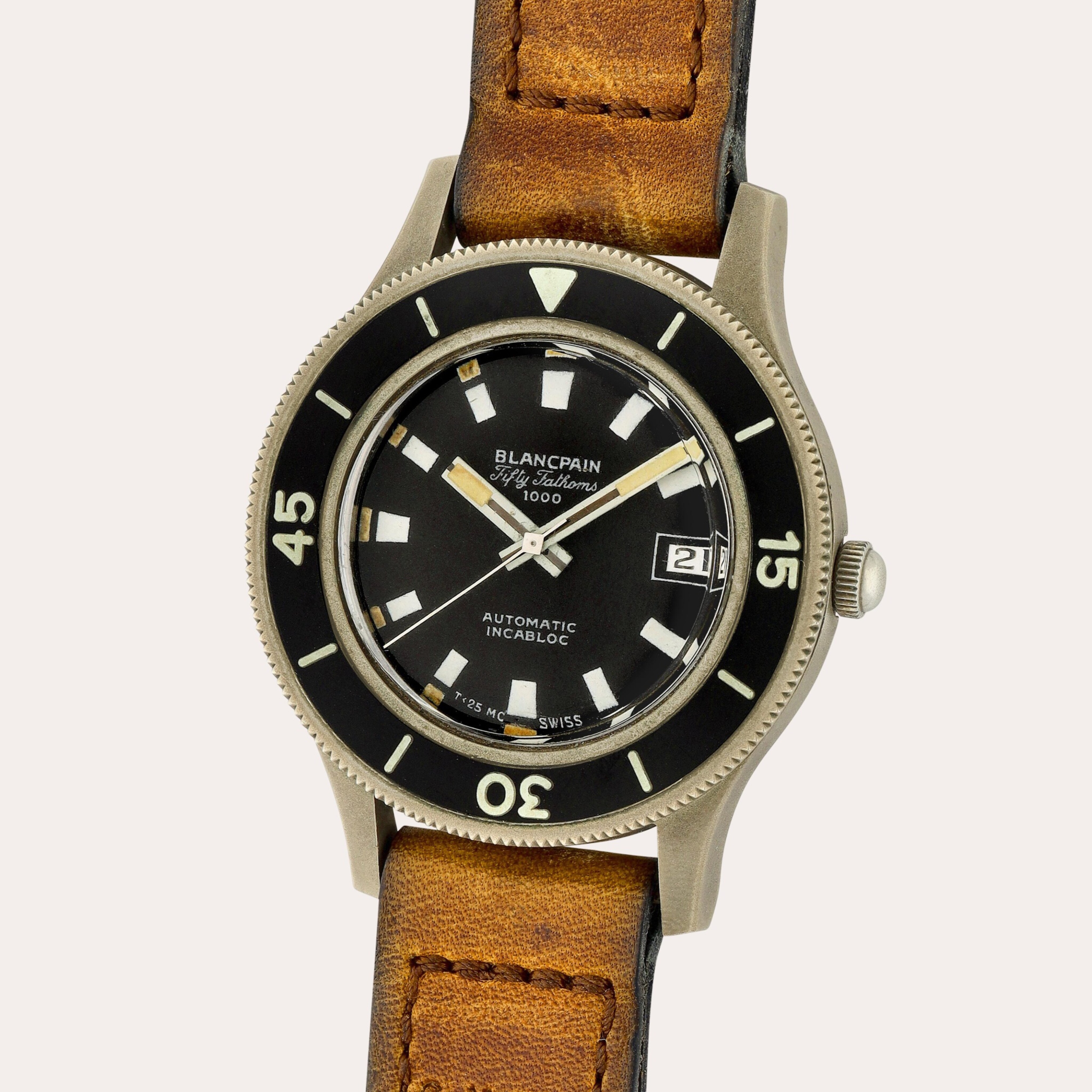
The present watch, as you can see in the picture below, is an entirely different creature.
Auction link: Lot 245 – Blancpain Fifty Fathoms 1000, 3224 (sothebys.com)
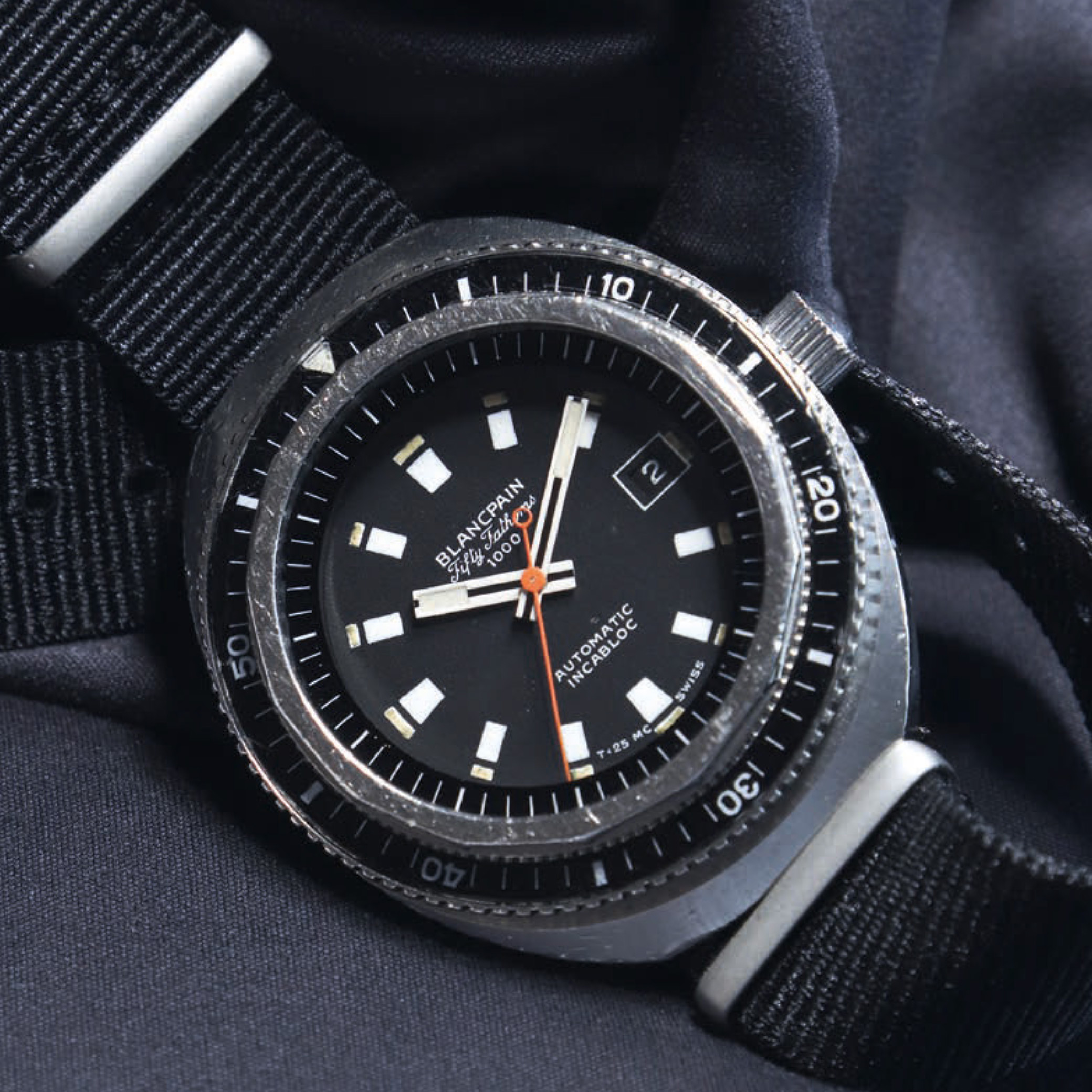
The accepted rule with these is that there was a military version with a ‘U.S. Navy’ dial, and a civilian version with a ‘Milspec’ dial that came into being after the Navy rejected the project. While the former feature AS 1361N calibers with hacking seconds, the latter are powered by AS 1700 movements. However, there is no clear pattern. Watches with regular ‘Explorer’ dials are not considered original, as the dials were likely replaced due to water damage or because the watches were assembled from loose parts. While the case of the present watch is indeed part of the known bronze batch and, as such, quite rare, its contents—namely the dial, the hands, and the movement—belong to a Fifty Fathoms model with a water resistance of 3,280 ft/1,000 m made in the 1970s, as depicted below.
And here is another one with the same white date wheel as the present watch.
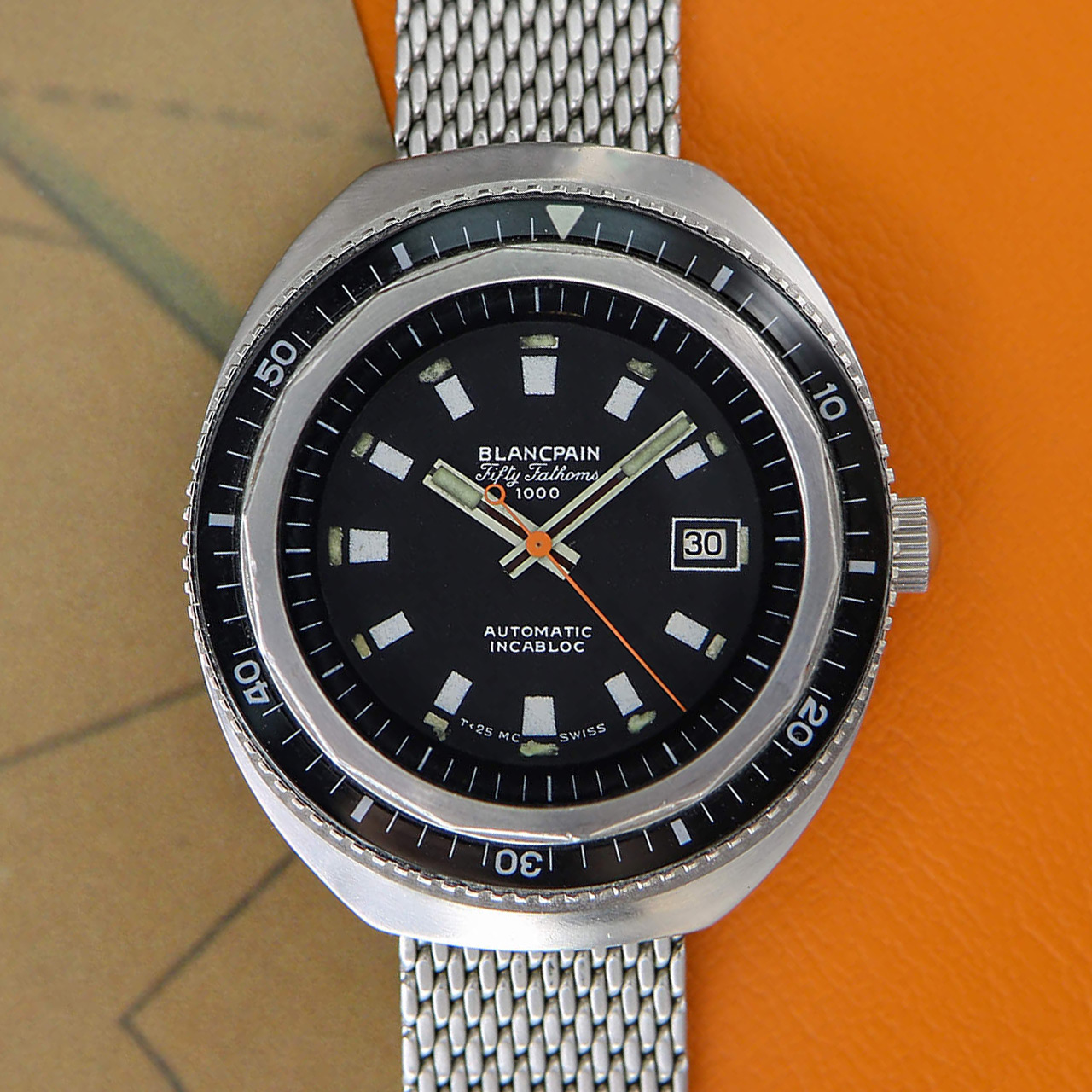
These watches had a glass that was screwed down to prevent it from popping out during decompression after prolonged helium-saturation diving. Dial and hands, except for the seconds hand, are exactly the same. They belong, without a doubt, to this later Fifty Fathoms model with a screw-down crown, which was much more waterproof than the case in which these parts are installed today. Since the original Fifty Fathoms case with an unscrewed double-seal crown had a water resistance of around 1,000 ft/300 m, it is doubtful that Blancpain ever performed this ‘marriage’.
The present watch once belonged to Mr. Konrad Knirim, a German military watch expert. He published it in his 2002 book ‘Military Timepieces’. I have been in sporadic contact with Knirim since 2015, as we both love vintage Panerai. He told me that he bought the Fifty Fathoms at the Munich Watch Fair in 1998. There was no story or provenance attached to it – only the strap with ‘C.V.W.8 Nimitz US Navy’ embossing, as seen in the photo below from a recent Phillips catalogue. That is right, the present watch was auctioned by Phillips in November 2023, fetching a whopping CHF 88,900, incl. premium. I had noticed this peculiar lot at the time, but was under injunction from the Republic and Canton of Geneva, prohibiting me from claiming or implying that Phillips would engage in fraudulent behaviour, offer for sale counterfeit watches, or watches of dubious provenance.

Now, ‘C.V.W.8 Nimitz US Navy’ appears to refer to Carrier Air Wing Eight, a United States Navy aircraft carrier air wing consisting of multiple squadrons based at Naval Air Station Oceana, Virginia. Between 1975 and 1987, Carrier Air Wing Eight was assigned to the nuclear-powered aircraft carrier USS Nimitz. Accordingly, Knirim placed a photo of the USS Nimitz next to the watch on page 716 of his book to illustrate the watch’s story, as suggested by the strap it came with when he acquired it.
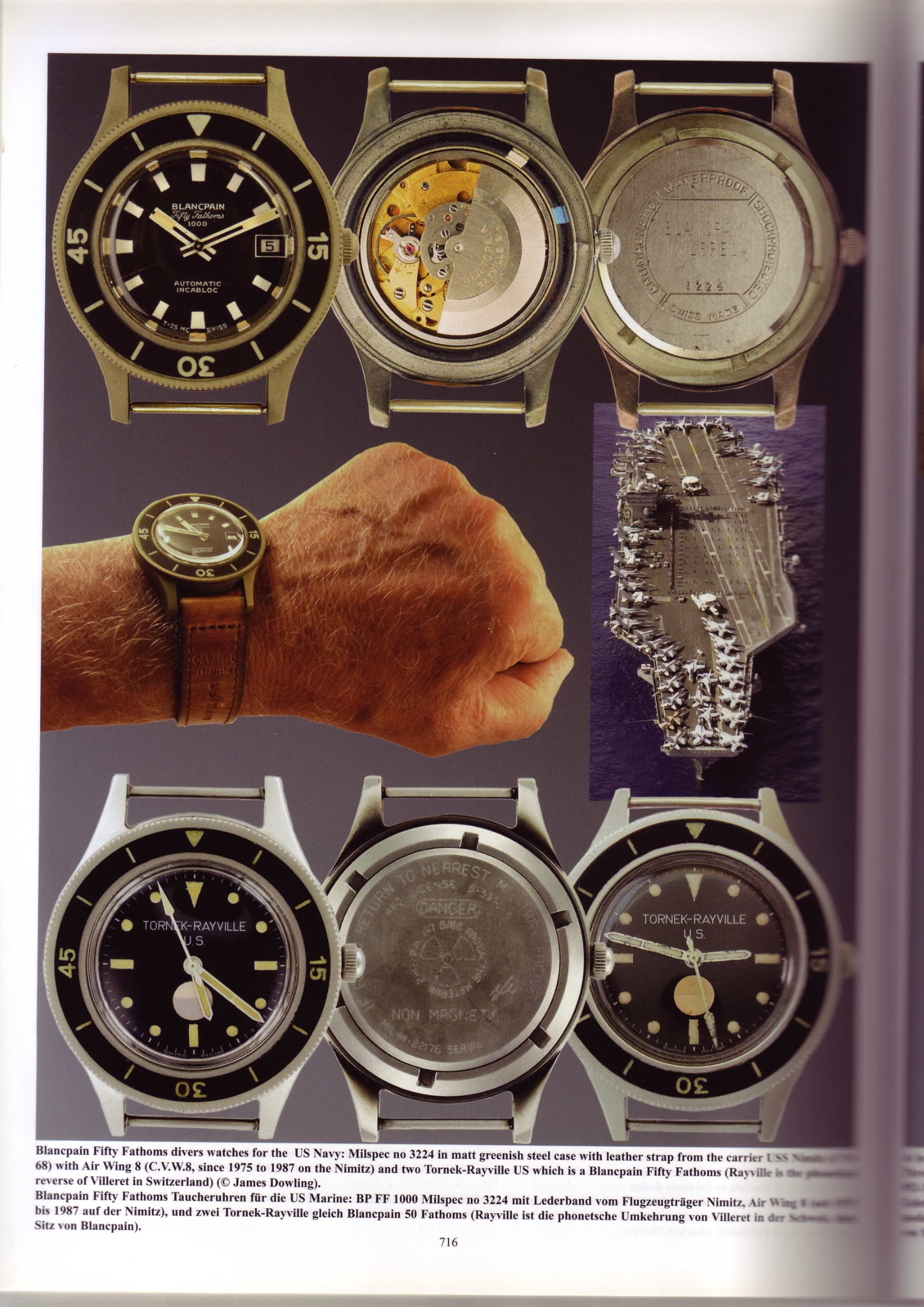
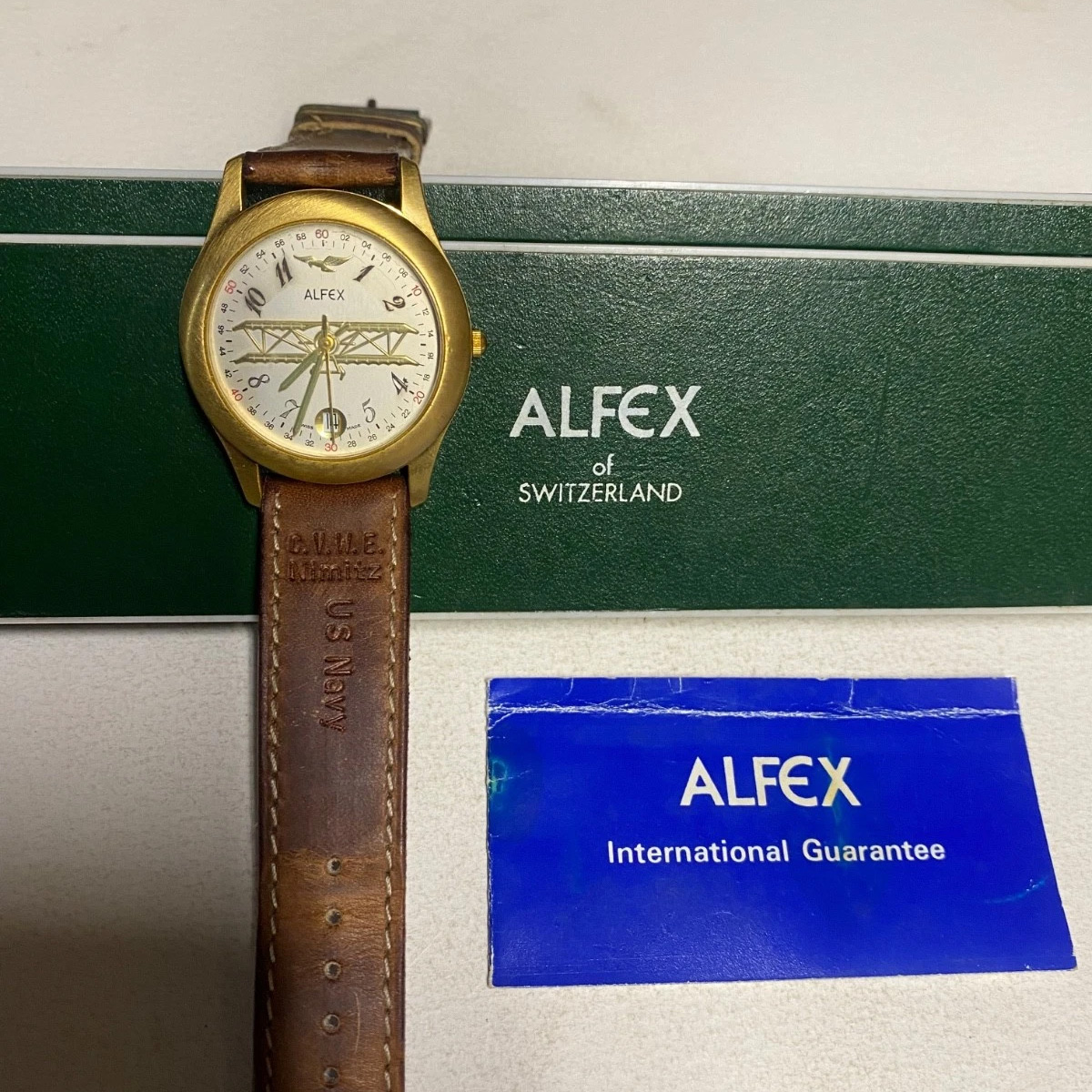
It is interesting to note that the acronym for Carrier Air Wing Eight is not, nor ever was, ‘C.V.W.8’ but has always been, since it was redesignated from Carrier Air Group 8 (CVG-8) in 1963, ‘CVW-8’. I searched the web high and low, but aside from a German strapmaker named Jürgens, who started making straps with the same embossing around 15 years ago, probably inspired by Knirim’s book, I could find no further information. Also, what is this strap actually suggesting? Did a fighter jet pilot wear the watch? Or maybe a Navy aviation rescue swimmer operating on the Nimitz?
The strap, which, according to Knirim, is the only thing telling a story about the mysterious pieced-together Fifty Fathoms, is the key to understanding what this watch is all about. Interestingly, a strap with an almost identical embossing was used by the Swiss watch brand ‘Alfex’ in the 1980s for their ‘Biplane’ and ‘Zeppelin’ quartz watches. However, the spelling on these was ‘C.V.W.E. Nimitz US Navy’, which appears to be a fantasy name. Could this Alfex model from the 1980s have been the inspiration for the present watch’s mysterious strap? It is very probable.
Another important detail is the fact that the movement, a Rayville Cal. R337, based on the AS 1902, is, besides being incorrect for the bronze case, in itself pieced together from parts of different periods. The bridges on early R337 movements had a distinct brass colour. In the 1970s, the bridges were plated. As you can see, the whole automatic assembly is not period-correct to the movement.

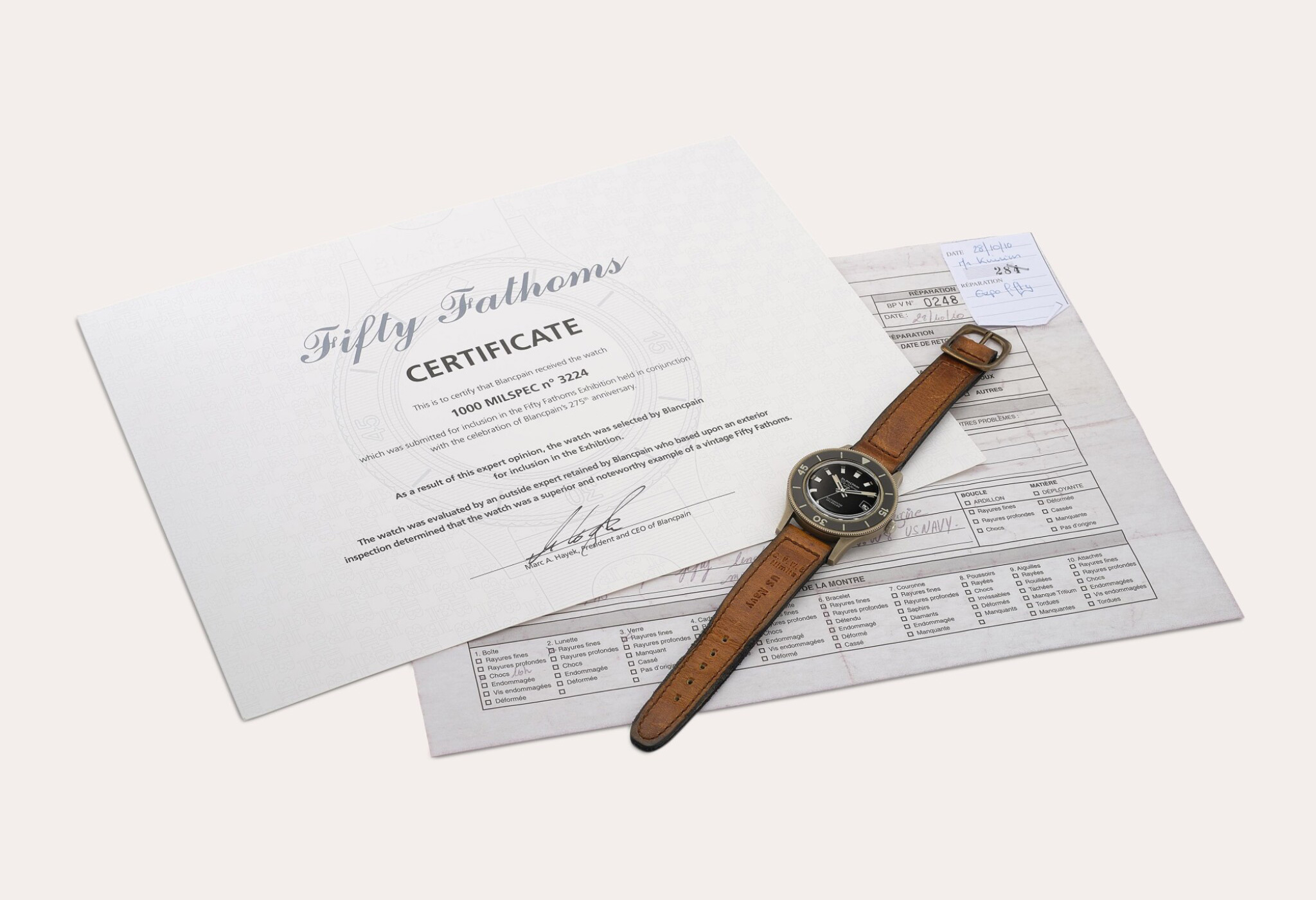
You do not have to be much of an expert to understand that this watch is a pieced-together Frankenstein monster. Sure, back in the day, scholarship was not as advanced as it is today, but a bit of research would have led to the same conclusions. In 2010, the present watch was accepted by Blancpain for the Fifty Fathoms exhibition held in conjunction with the celebration of their 275th anniversary (chuckle, click here for the real history). Apparently, the watch was examined by an outside expert who deemed it a “superior and noteworthy example of a vintage Fifty Fathoms”. Accordingly, the watch comes with a Blancpain certificate. It tells you all you need to know about the level of expertise of the modern Blancpain brand.
To conclude, an interesting observation that helps narrow down the production period of these so-called bronze watches is the graphics on the casebacks. As the following comparison shows, the caseback of the present watch (center, case number 3224) features a considerably different layout. The inscription ‘Blancpain Milspec’ is not applied in the same manner as the rest of the text; it is hand-engraved. Note also that ‘Automatic’ is not mentioned.
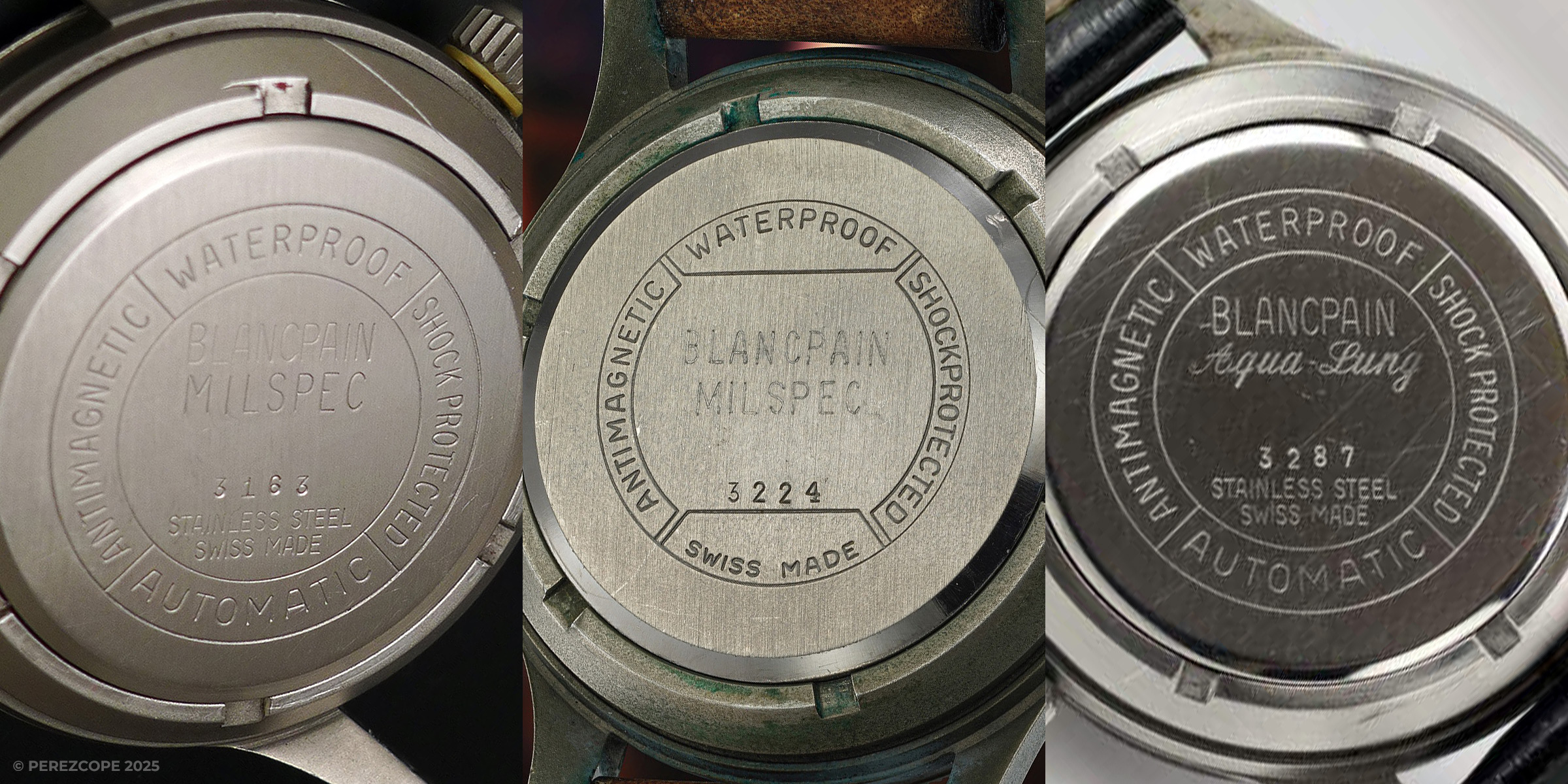
Interestingly, the same caseback graphics can be found on Blancpain Bathyscaphe MC 4 watches produced between 1959 and 1967 (according to online information). The lack of ‘Automatic’ makes sense here, as these watches were powered by AS 1187 manual winding calibers. Note also the words Stainless Steel in the space above Swiss Made. On bronze watches, that space is empty.
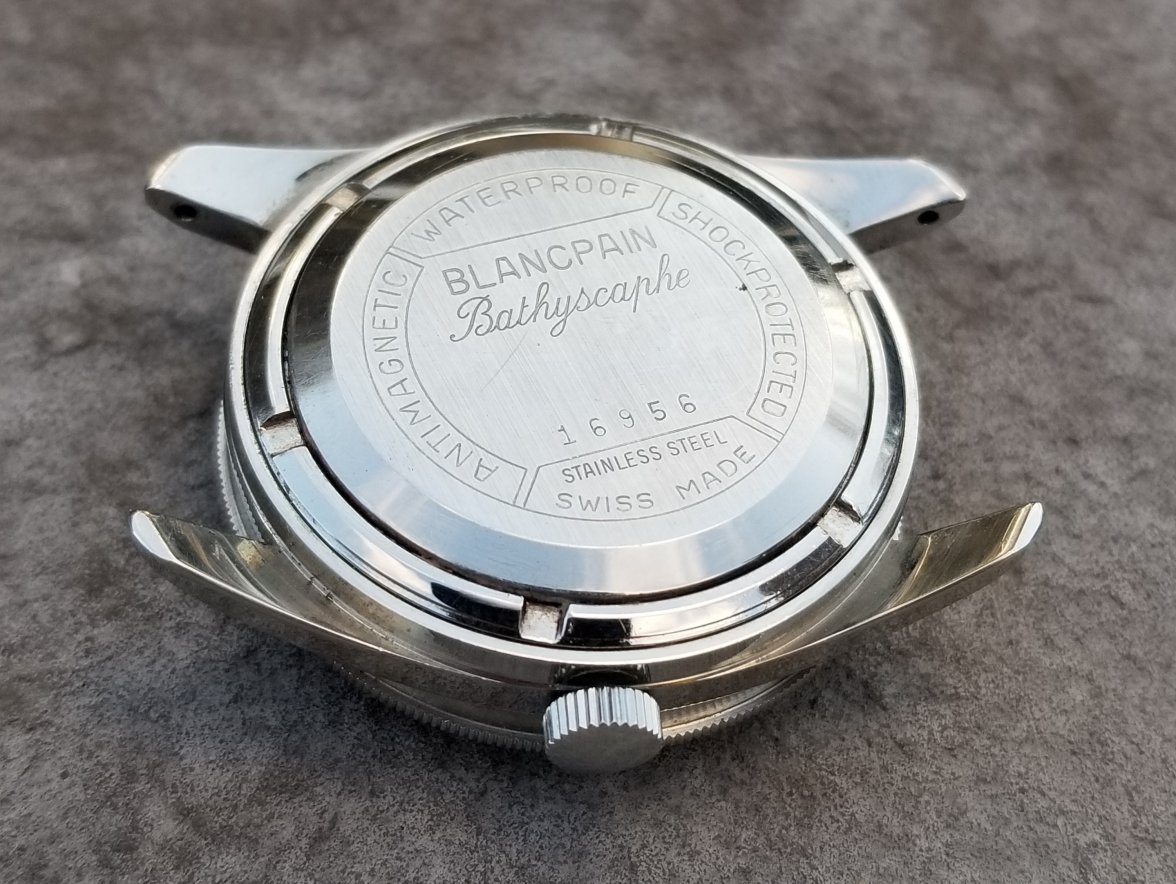
The same caseback style can also be found on Waltham Fifty Fathoms watches produced by Blancpain for the American watch company. Note that here it says ‘Automatic’ where usually the serial number was punched.

I remember reading somewhere that when bronze Fifty Fathoms watches first appeared on the market, some collectors believed they were fake. The non-automatic casebacks are strange to say the least. On the Watchprosite forum, the owner of another undeniably pieced-together example reported issues with oxidation upon contact with seawater. Yup, the son of a gun went diving with his vintage watch. He stated that the anti-magnetic alloy of the case is so soft that it causes the caseback threads to deteriorate quickly, thus compromising the watch’s water resistance. It sure sounds like a failed project that was scrapped due to quality issues. Why would Blancpain have created a civilian version afterwards to try to unload a faulty product onto the civilian market?
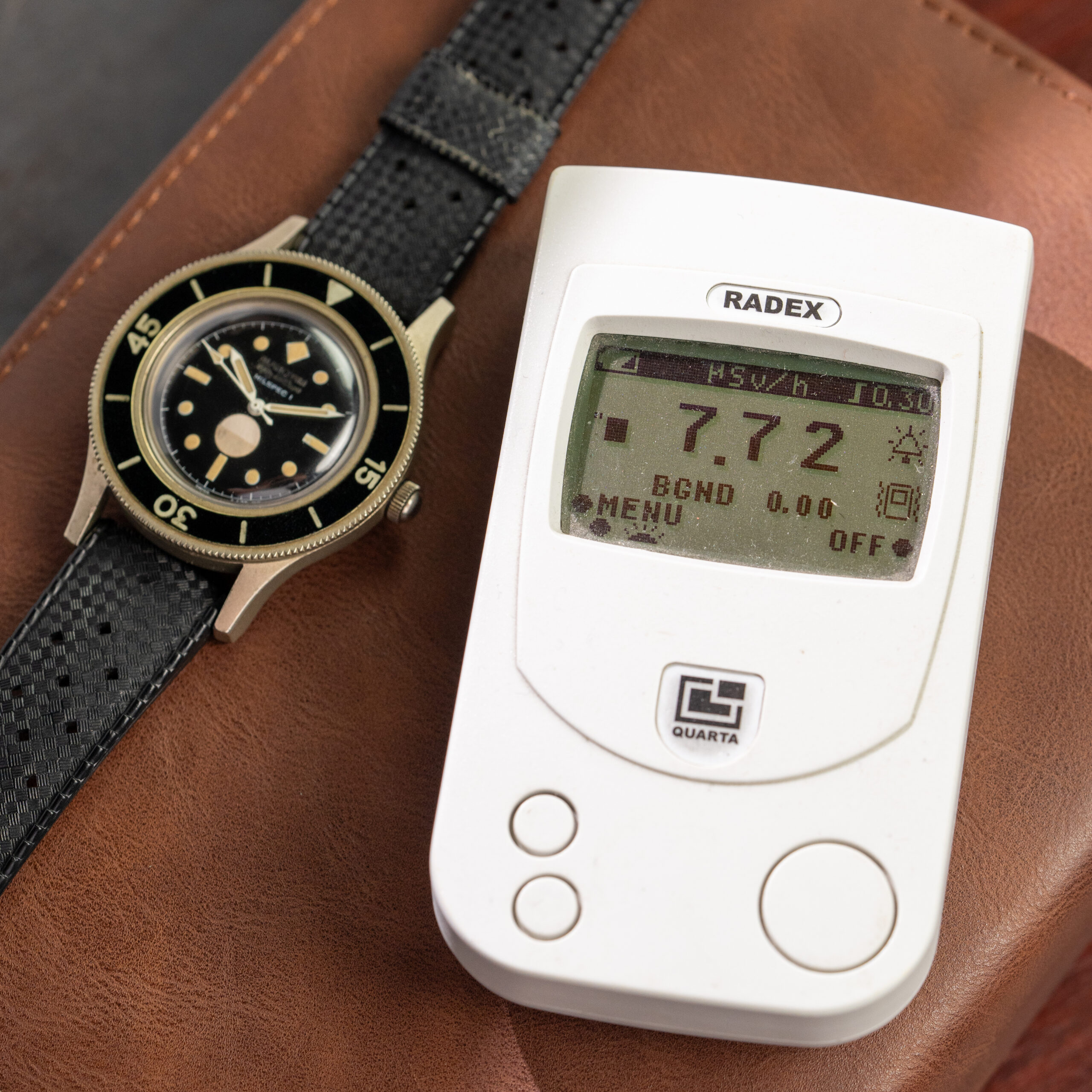
Anyway, when there are so many dial and movement variants within a small batch, as is the case with these bronze watches, it is better to be vigilant. And when you see things like in the following picture, where the bronze example with case number 3229, featuring a supposedly correct Milspec tritium dial (T < 25 MC.), emits high levels of radioactivity—probably because the bezel is still loaded with radium—something does not add up from a logical point of view. If the dial and hands were updated to tritium to replace radium, why keep the hazardous and highly radioactive compound in the bezel?
With vintage Rolex-Panerai Ref. 6154 watches, for instance, where the 20 known examples have six or seven different movement versions, in addition to all kinds of different hands, the reason for the confusing variety was easily explained. Back in the early 1990s, a dealer found a box full of empty cases and dials at the old Panerai premises in Florence and assembled watches from these loose parts with whatever components he could find. The present watch reminds me of that.
Thoughts
When I discovered the present watch in the Sotheby’s New York ‘Important Watches’ catalogue from December 2024, I reached out to Geoff Hess, the current Global Head of Watches at Sotheby’s, to give him a heads-up. I provided all the evidence Sotheby’s needed to conduct their own research. Hess, who has been sweet-talking me since 2020 (Stallone’s Panerai ‘Logo’ sale at Phillips), thanked me and said they would address it the next day. To my total surprise, the lot was not withdrawn, but they added the following factually wrong sentence to the condition report, which is only visible on demand:
“The movement and hands are possibly from a slightly later period that [sic] the case and movement.”
Possibly? Really, Mr. Hess? See how Sotheby’s New York made the statement as ambiguous as possible—plus, what about the movement, is it not from a later period as well? The reality is, these people did no further research—just went ahead with it, devil-may-care. Someone serious about honesty and building trust would have withdrawn this lot after being presented with the evidence. The consignor must have been one of Hess’s friends. One year earlier, at Phillips, the watch generated CHF 88,900, incl. premium (USD 98,723 at the time). At Sotheby’s, it sold for a meager USD 48,000 (CHF 42,182 at the time). Within one year, it lost about half its value. Still a lot of money for a made-up piece of junk no informed collector would touch.
The thing with condition reports is that they are often overlooked. It is a way for auction houses to hide issues in the fine print, and should there ever be a problem, they can always point to the condition report. Read the condition reports, folks. I am sure that the Taiwanese buyer never read the condition report and had no clue that there were issues with the watch; otherwise, he would have stayed away. There is a special place in my heart for Taiwanese collectors, as one of them is a very good friend of mine, so seeing them misled and ripped off by greedy, unscrupulous people is infuriating. Please consider leaving a comment on the Instagram post below to inform the buyer that, if anything, he bought a noteworthy example of a vintage Filthy Farthoms.
Thank you for your interest.
(Shout-out to the good people of the Watchprosite forum, who also noticed the peculiarities of the present watch and discussed it to some extent a while ago. The said forum is the best resource for information on vintage Blancpain Fifty Fathoms.)
 Vintage Rolex and other iconic timepieces under the loupe at Perezcope
The hands and indices on the dial of this watch unmistakably declare, “Hello, we’re from the 1970s!”
LikeLike
..the date is way off 2 imo.
LikeLike
Agree 100%, also im not sure the early models even had a date window.
LikeLike
Another great bit of detective work Jose, i have an opinion on the strap- i recon that the strap placed on this watch is most certainly from the cheap Alflex watch.
If you look closely what the person did (who probably sold it at the Munich watch fair) was to take a strap from an Alflex watch, die the stitching a dark brown (easily done with the correct colour felt tip pen) and has stamped (embossed) over the E to make it an 8, change the buckle, and there you have it, you have made a fairly convincing strap from an existing one.
As for the hands (and to a certain degree the face) they are undeniably from the 1970’s and not from the 1950/60’s.
”The present watch once belonged to Mr. Konrad Knirim, a German military watch expert. He published it in his 2002 book ‘Military Timepieces’.” The question has to be asked if Mr Knirim is an expert-why did he buy the watch as its obviously a franken!? did he sell it on correctly described?!
I have no idea why auction houses overlook these things, they have to remember that they are not only representing the best interests of the seller, but also of the buyer. If i was the buyer i would threaten to sue the auction house unless they take the watch back and refund the monies paid.
LikeLike
They’re trying so hard to create a sort of heritage/history to justify a false exclusivity and their modern prices.
That dial’s design is obviously 20 years younger.
BTW I Love your work
LikeLike