
With over 100,000 meticulously recorded watches in my state of the art databases, few people have processed more data than yours truly. Naturally, the more watches are documented, the easier it gets to see the outliers. The subjects of this article, however, do not require a lot of knowledge to understand that something is wrong with them. Antiquorum in its current form under the leadership of Parisian watch dealer Romain Rea is no stranger to auctioning all kinds of dubious watches, not just in Geneva and Hong Kong but also in highend places like Monaco. This time their top lots consist of a ‘Bull-Gauss’ and a ‘Paul Screwman’ no-step Daytona. The Grimaldis will not be amoused to see all this trash being auctioned on their glamorous ‘rock’.
.
Lot 230 – Ref. 6541, Milgauss, Steel, 412320
The ‘Bull-Gauss’, whose German nickname ‘Müll-Gauss’ (Müll = garbage) makes a much better match, can be traced back to November 2017 when it was auctioned by Antiquorum in Geneva for 81,250 Swiss Francs. At the time, the watch featured a weird Submariner bezel insert. In 2019, the same watch was offered in Luxemburg. According to the Wayback Machine, it was marked as sold in mid 2020.
At first glance, the watch makes an interesting impression thanks to its ‘tropical’ dial. A closer look at the dial, however, reveals it is actually quite damaged, possibly as a result of a water intrusion. A real and collectible ‘tropical’ dial has only changed colour but remains in perfect condition otherwise. This is certainly not it. Anyway, the dial is the only part that seems to be legit in my opinion.
Auction link: Lot 230 – Ref. 6541, Milgauss, Steel, 412320 (Antiquorum)

The value of a Ref. 6541 Milgauss lies to a large extent on the bezel insert as they are extremely rare compared to other Rolex sport models. Anyone who has spent time studying Milgauss inserts will search for the distinct serifs, those little strokes that extend off the end of the characters, in vain. Are no serifs visible, you better run.
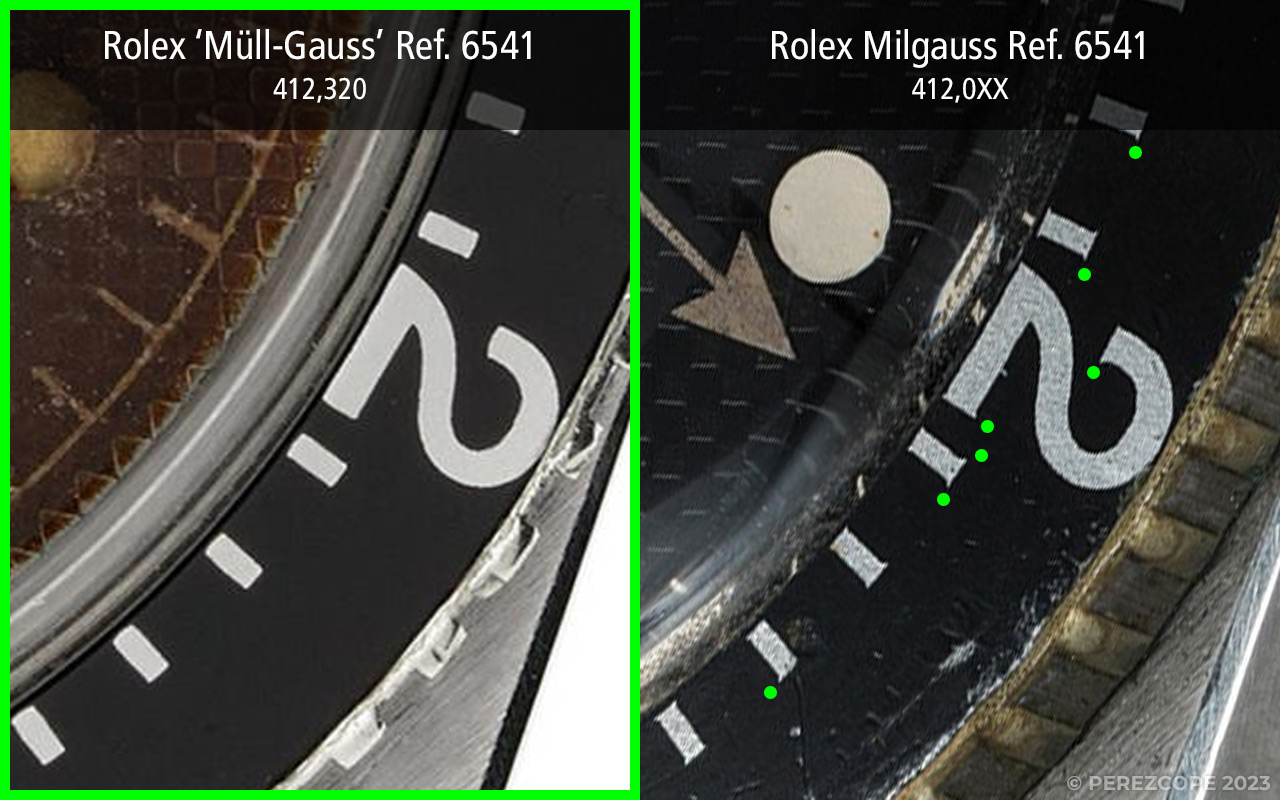
Serifs are not the only characteristic that help determine whether an insert is real or not. There are of course a number of other details which I will not disclose as to not give counterfeiters any hints.
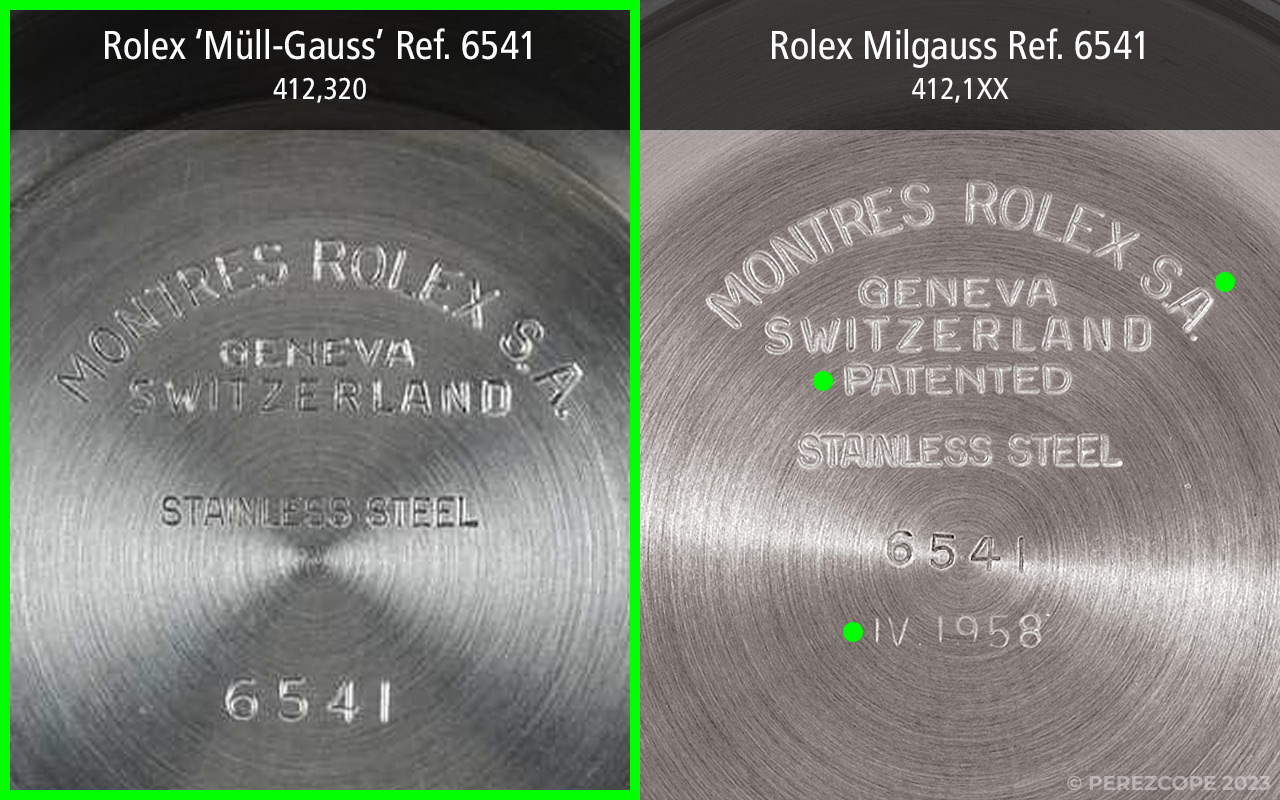
Another detail of the watch that does not add up are the Rolex stamps on the inside of the caseback. As you can see in the comparison below, important details like the ‘patented’ designation and the production date IV.1958 (4th quarter 1958) are missing.
The most hilarious feature of this watch is the faraday cage consisting of a movement ring and a movement cover used to shield the movement from magnetic fields. Both appear to be made of brass, which if true would not provide any protection as brass is known to be a ‘weak’ metal that does not attract magnetism.

Antiquorum’s ‘Müll-Gauss’ is equipped with a real Rolex Cal. 1066, probably bought on eBay. Original Milgauss watches, however, had a very particular version of said caliber. To achieve a full protection against 1000 Gauss (Milgauss) of magnetism, crucial parts of the movement like e.g. the hairspring were made of special antimagnetic material. For this reason, original Milgauss movements bore the suffix ‘M’ underneath the caliber designation (see circle below).

As you can see in the above catalogue picture, Antiquorum covered the area of the caliber designation with the rotor. For good reason. Luckily, I was able to obtain pictures of the watch from when it was offerend in Luxemburg. Not only is the ‘M’ suffix missing underneath the caliber designation 1066, the balance cock is wrong for a Milgauss as well as can be seen in the comparison below.

Caliber 1066M was later replaced with Cal. 1080 which was specifically produced for the Milgauss. The latter can be found on watches that were assembled in later production runs.
A quick Google search for highend Milgauss replicas or so-called homages brought the following picture to light. As you can see, the ring around the movement is almost identical to the one on the ‘Müll-Gauss’. Brass is often used for this type of parts as it is cheap and easy to machine.

Proper Ref. 6541 Milgauss watches feature a ring and a cover made of soft iron, a material that absorbs magnetic fields, leaving the movement unaffacted. Easily magnetized, soft iron releases magnetism quickly once the source of the magnetic field is no longer present. The picture below shows what the original soft iron parts look like (top, right).

The next close-up of the movement ring shows the raw soft iron surface.
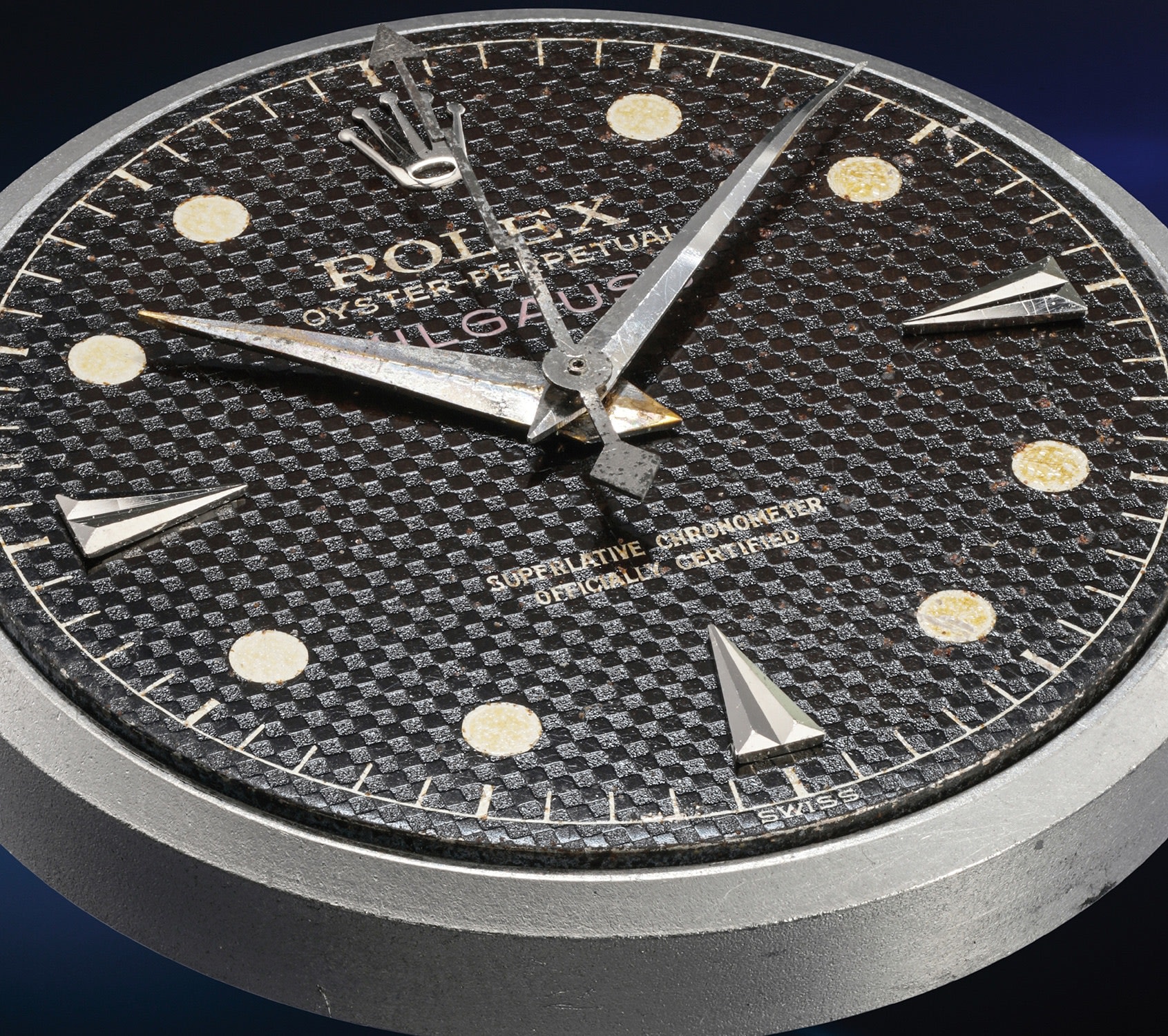
As you can imagine, the ‘Müll-Gauss’ is not a watch I would recommend buying. To me it has all hallmarks of a project or homage watch built around a dial found on its own somewhere in a drawer. Given its condition, I strongly believe the dial was replaced due to water damage at some point. It is inexplicable to me how a watch of this kind can be offered by a major auction house with a straight face – but then again, we are talking about Antiquorum and nothing surprises me anymore.
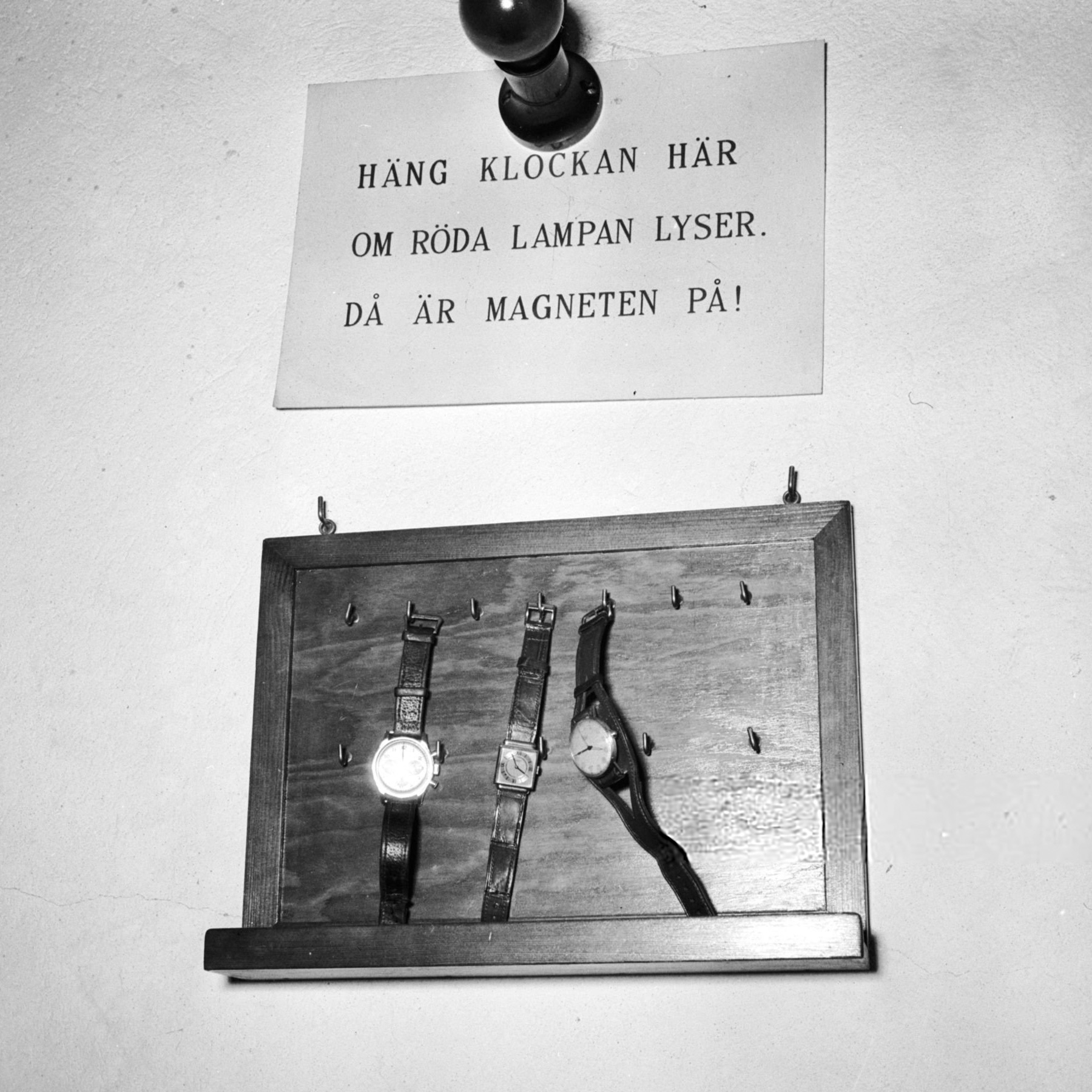
To conclude, I would like to share the following picture from 1955 taken at the Nobel Institute in Stockholm. Due to the strong magnet in one of the rooms, the scientist had to take off their watches to prevent them from getting magnetized. This picture illustrates perfectly why Rolex saw the need for a special watch that could withstand strong magnetic fields. Translated the text reads:
“Hang the watch here if the red light is on. Then the magnet is on!”
.
LOT 58 – Rolex, Ref. 6265, Daytona “Paul Newman” No Step Dial
Lot 58 is another hilarious assemblage. The dial of this watch is not a Paul Newman but rather a ‘Paul Screwman’ since dozens of collectors were ‘fooled’screwed’ by dials of this type in the past. ‘No step’ refers to the missing step between center of the dial and minute track and is actually a term for fake Paul Newman dial. Simple and plain! That no step dials are still being peddled in this day and age is truly mind-boggling.
Auction link: LOT 58 – Rolex, Ref. 6265, Daytona “Paul Newman” No Step Dial (Antiquorum)
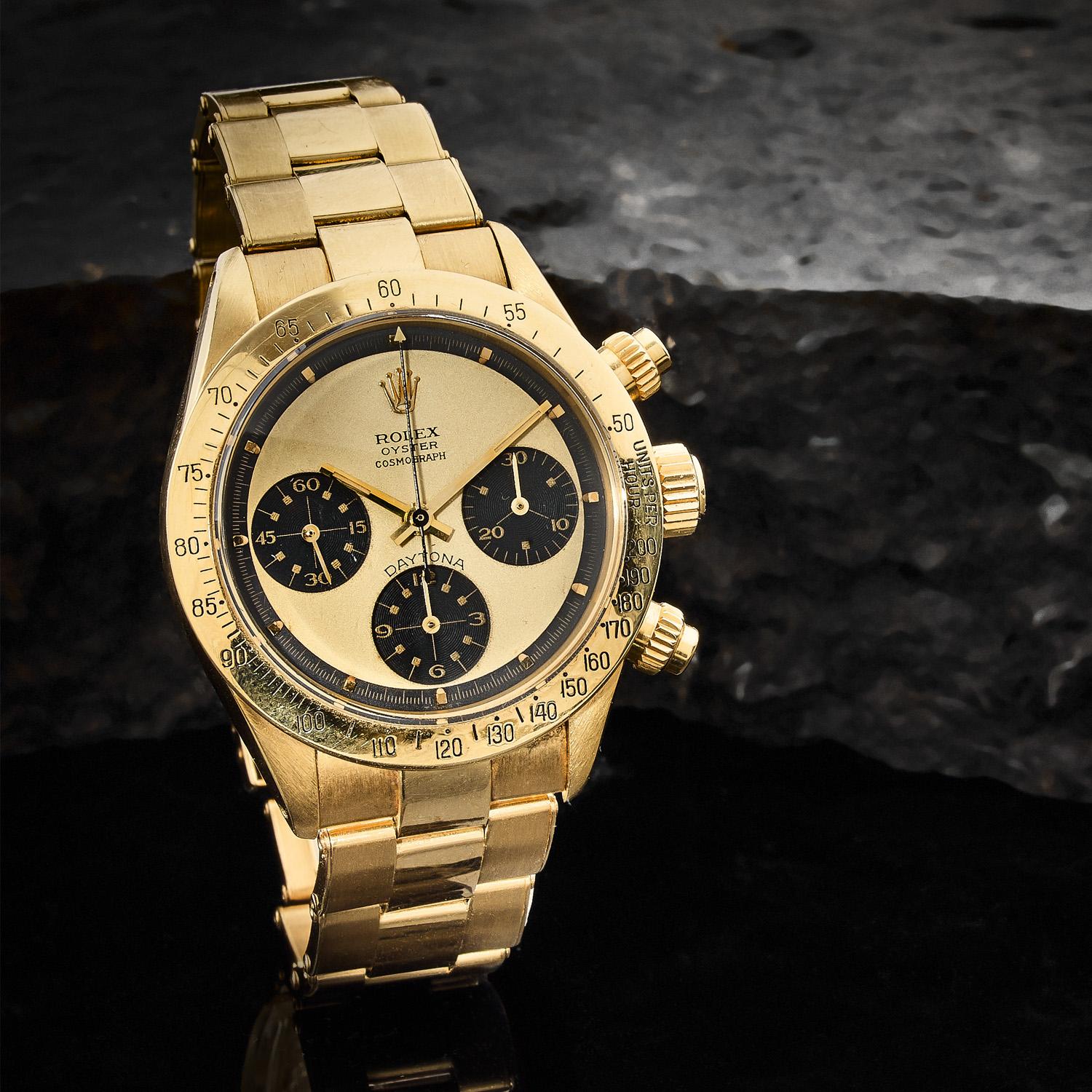
In addition, Rolex never made a dial like this. The only ‘Rolex Oyster Cosmograph’ or ‘ROC’ dial for gold watches of Ref. 6263/6265 is the so-called “Legend” dial, an ‘ROC’ version of the famous Ref. 6264 ‘Lemon’ dial. Another thing to consider is that the very last batch of Paul Newman dials was installed in the 3.048 million case number range. With case number 5035071, the present watch was way beyond Paul Newman.
No step dials are also known as ‘Texas dials’ since hundreds of them appear to have originated from a Rolex dealer named DeMesy in Texas, United States. Now, to be very clear, DeMesy did not make them. Around 200 dials were offered to him in the 1990s and he simply acquired them believing they were real and this would be the deal of his lifetime. The person who facilitated the deal has now become one of the go-to sources when it comes to Patek scholarship. That person went to jail for misappropriation of funds, namely gambling on the currency market with money that did not belong to him, ultimatelly losing everything. When the Swiss government seized his assets to pay for damages, they found another 200 no step dials which were later auctioned off through Sotheby’s. Around the year 2010 it was discovered that these dials were fake. All of this is part of new investigation in typical Perezcope fashion that will hopefully once and for all bring to light who is really responsible for the production of all of these fake dials.
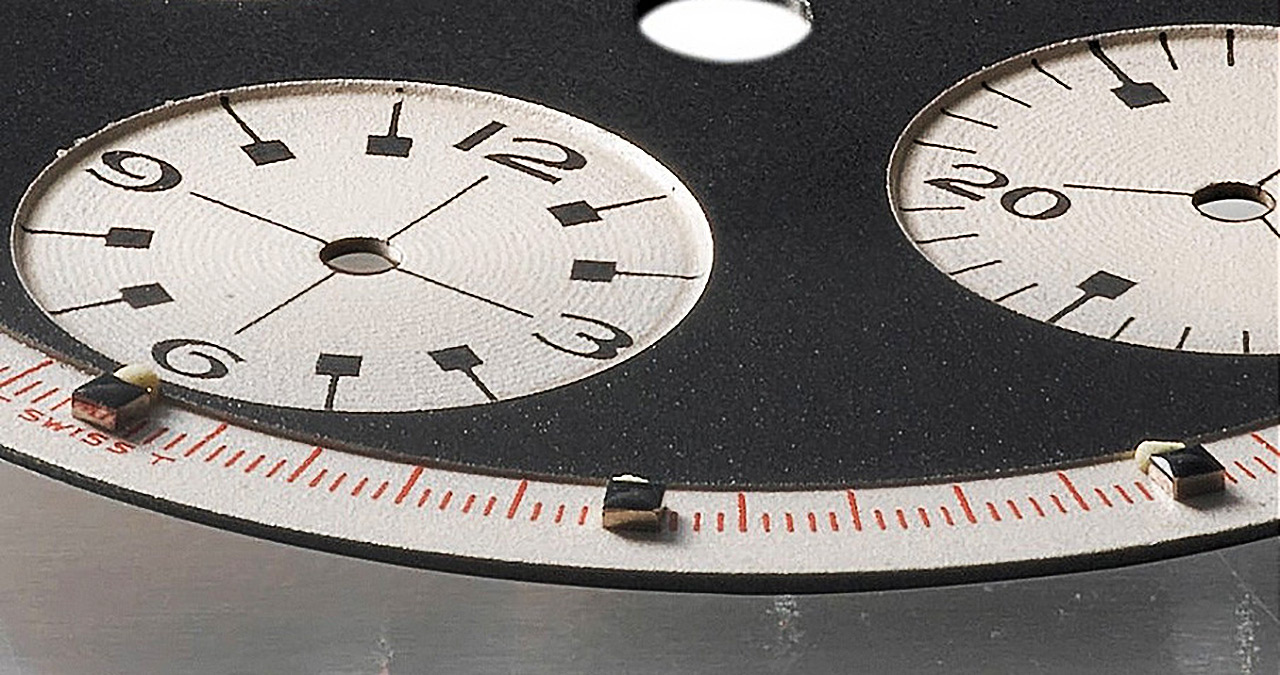
The next pictures gives you an idea what the step on a real Paul Newman dial looks like. The minute track is slightly lower, giving the dial a very subtle 3D effect.
.
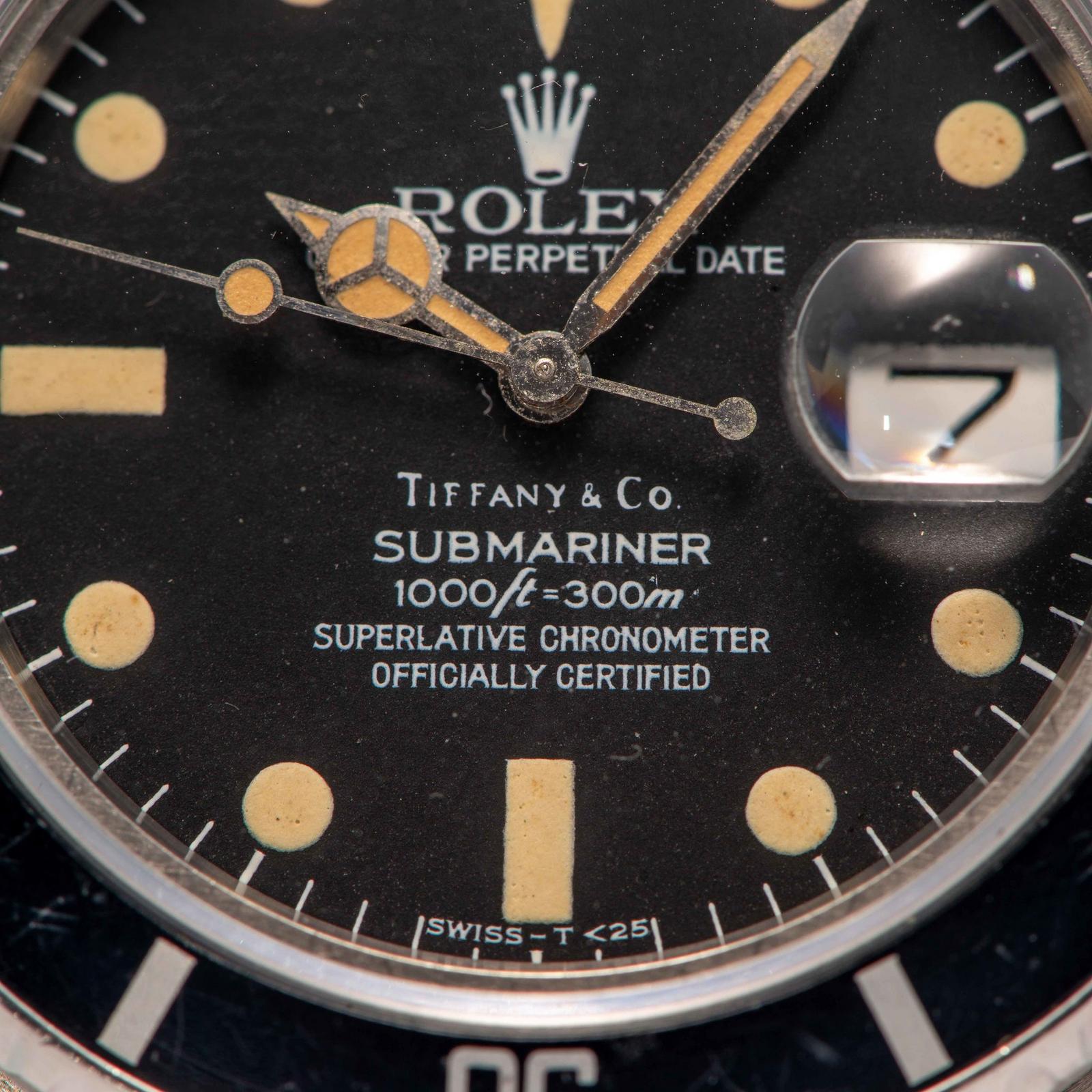
Lot 111 – Rolex / Tiffany & Co., Ref. 16800, Submariner
Having case number 7299428, this Ref. 16800 Submariner Date features a Mk4 dial which is commonly found in the 8.2/8.3 million case number range. Another no go for me.
.
Thoughts
This article will go online barely one hour before the auction starts. Unfortunately it was not possible to publish earlier. I hope it will be nevertheless on time to help possible buyers make the right investment decisions. Please help spread the word. Thank you!
.
Related articles
Read more: Planet Of The Fakes: A Rinaldi “Big Crown” 5510 At Antiquorum Hong Kong
Read more: Return To The Planet Of The Fakes: “Albino” Daytona Made In Tuscany
Read more: Escape From The Planet Of The Fakes: The French Foreign Legion Explorer
 Vintage Rolex and other iconic timepieces under the loupe at Perezcope
I really appreciate your work for us collectors who don’t know where the minefields are.
I’m in the vintage car world and the same nonsense is prevalent there. Gotta be careful all the time.
On another note I had a bunch of watches stolen from house a few years ago and lost two 6265 pieces. Since you have a big database, could you see if they have resurfaced. I know it’s a long shot but I thought I’d ask.
Keep up the great work!
LikeLike
Thank you for your kind feedback. Sure, send me the case numbers via email or IG.
LikeLike
Amazing work, as always my friend. Thank you for your dedication and time Jose. You’re the hero we need more of in this shifty world.
LikeLike
i’ll never be able to buy one of these things, but it’s amazing to see your content.
LikeLike
As always, excellent read…!
LikeLike
Complimenti!!!
LikeLike
Another excellent example, quite frankly a don’t know why collectors purchase from auctions, we may as well pack up go home and keep our purchases to new models from AD’s!
LikeLike
Oh my, someone paid 120K for the fake Daytona. How are these auction houses getting away with such blatant fraud? Again, a great article nonetheless!
LikeLike
Dear Jose,
Thank you so much for the many articles you have provided the watch-loving community with.
I have read them with great pleasure and interest, although I am not a great fan of Panerai and Rolex. Both companies have never really fascinated me. Panerai, because they were not really around when I started getting interested in watches and have since produced some of the dumbest and cheapest watches the world has ever seen at very high prices; Rolex, because I grew up when pimps, members of the mafia and other low-lives – so really obnoxious people – wore them. At least Rolex produce some kind of quality when it comes to durability.
More complex watches interest me. Companies that have produced real gems of ingenuity and art.
Anyway, what I wanted to offer you (for free) is to read your articles before you publish them. The English in them is fine, though there are some mistakes that you should eliminate before publishing them.
Just get in touch with me if you are interested, and please continue your good work.
With best wishes from Switzerland,
Yves
LikeLike
As always with Jose, another case of well structured and professional detective work. The real scandal is not so much the widespread counterfeiters as the fact that allegedly trustworthy auction houses do not protect the bidders from becoming their victims. The idea that Antiquorums business is far more important than preventing its participation in illegal activities is obvious.
LikeLike
And the watch got passed at auction ! It seems that not a single bidder dared to bet on this lot, congrats !
LikeLike
keep up the great investigative work
LikeLike
Fantastic work Jose. I stumbled upon your site by accident and am really glad that i did so. Please keep up the good work
LikeLike
Wow! Great work there Jose, feel sorry for anyone that may have bought one of these duds..
LikeLike
Looks like it’s back up for sale again:
https://www.sothebys.com/en/buy/auction/2024/fine-watches/milgauss-reference-6541-montre-bracelet-en-acier?locale=en
LikeLike