
The existence of the elusive Rolex ‘Single’ Red Sea-Dweller was a riddle for many decades. Bearing the earliest Sea-Dweller case numbers, a handful watches featured a helium release valve while others did not. After collecting all available data, personally meeting legendary U.S. Navy SEALAB ‘Aquanaut’ Bob Barth and conducting the craziest in-depth research ever carried out in the world of watches, the mystery could finally be solved. The watches were made in early 1967 for the ‘Sea Dwellers’ of the upcoming ‘SEALAB 3’ experiment, possibly on special initiative of astronaut-turned-aquanaut Scott Carpenter. Since the issues with exploding watches due to helium build-up had not yet been dealt with at Rolex, the first 40 ‘Sea Dwellers’ were not equipped with what would later become the signature feature of this model, the helium release valve. After having catalogued most known examples, today I have the great pleasure to present a previously unknown watch that comes with its rare original timing certificate, giving us a very clear picture as to when these watches were produced. When found, the watch had a ‘Double Red’ Mk 1 dial, most certainly installed during an early service in 1969/70 but the owner was able to source a flawless ‘Single Red’ dial that was incorrectly installed in a later ‘Patent Pending’ model. With ‘one stone’, two historically important watches could be restored to factory original condition.
.
Rolex ‘Single Red’ Sea-Dweller Ref. 1665, 1602926

1602926 surfaced in 2016 on eBay. I got wind of it in April 2020 while working on the Sea-Dweller Chronicles but for lack of complete data, it was impossible to document properly. What I knew is that the watch had surfaced with a ‘Double Red’ Mk 1 dial from 1969, commonly found on so-called ‘Patent Pending’ Sea-Dwellers. There is another famous early Sea-Dweller that features a later ‘Double Red’ Mk 1 dial, Philippe Cousteau’s experimental ‘SEALAB 3’ Sea-Dweller with case number 1602920 which he received in October 1968. In a picture from 1972, Philippe can be seen wearing the watch already featuring the aforementioned later dial. It can be assumed, the watch was serviced between 1968 and 1972 and received an updated dial.

Insofar, the later dial did not surprise me as these watches were given for testing purposes to hand-picked underwater explorers who often remained in constant communication with Rolex and were instructed to send the watches periodically back for inspection. The ‘Single Red’ Sea-Dweller had a declared depth rating of 500 m/1650 ft on the dial but I believe the watches were good for 2000 ft/610 m and more. Updating the watches with the latest dial appears to have been common practice at the time.

The flawless ‘Single Red’ dial that brought this magnificent piece back to its former glory was incorrectly installed in a later ‘Patent Pending’ Sea-Dweller. It can be assumed it was found on its own somewhere at a watchmaker and put into the wrong watch to pretend it was a super rare ‘Single Red’ Sea-Dweller. Given the rarity of these pieces, it is within the realms of possibility that this is indeed the original dial of 1602926 that was replaced during a service in 1969/70 but of course, we will never know for sure. In any case patience pays off. The owner of this watch had to wait several years until a proper dial became available.
The real beauty of this piece, however, is the fact that the original timing certificate survived with the watch. To this date, no other ‘Single Red’ Sea-Dweller has this feature, making the present watch the only ‘full set’ among the now 13 pieces known.

The timing certificate issued by the Swiss Institutes for official Chronometer tests (pre COSC) was issued on April 25, 1967. The casebacks of these early Sea-Dwellers are stamped II.67 which translates to a production date in the second quarter of 1967. This is absolutely consistent with the date on the timing certificate. Since the ‘Single Red’ Sea-Dweller batch consisted of only about 40 pieces, it can be assumed the movements were sent for certification just prior to the assembly of the watches.

For a long time, the existence of the ‘Single Red’ Sea-Dwellers was an unsolved mystery. Thanks to countless hours of in-depth research, it became clear the first 40 pieces were produced for the upcoming ‘SEALAB 3’ saturation diving experiment originally scheduled for late 1967. Knowing the people involved, I have a hunch that astronaut-turned-aquanaut Scott Carpenter was the main driving force behind the ‘Sea-Dweller’ project in the same way he was for the first Swiss wristwatch in Space, the Breitling Cosmonaute from 1962. With a planned maximum depth of 600 ft/183 m, the ‘SEALAB 3’ experiment was already at the limit for a regular Rolex Submariner (660 ft/200m) as used in ‘SEALAB 2’. The Rolex ‘Sea-Dweller’ was originally conceived as an Uber Submariner with more than double the depth rating of a Submariner.
Saturation diving was a newly developed technique by U.S. Navy physician Dr. George F. Bond which allowed divers to live and work at great depths for unlimited time, provided they had a dry underwater habitat to rest. Instead of air, the divers had to breath a mixture of helium and oxygen (heliox) to prevent a dangerous state of mind known as nitrogen narcosis that kicks in at depths beyond 100 ft/30 m and gets worse with every further inch when breathing air. The great advantage of Dr. Bond’s invention was that once the divers were saturated with the breathing gas, decompression was only necessary when the work was finished and the divers returned to the surface. For the first time in history, useful work could be done underwater.
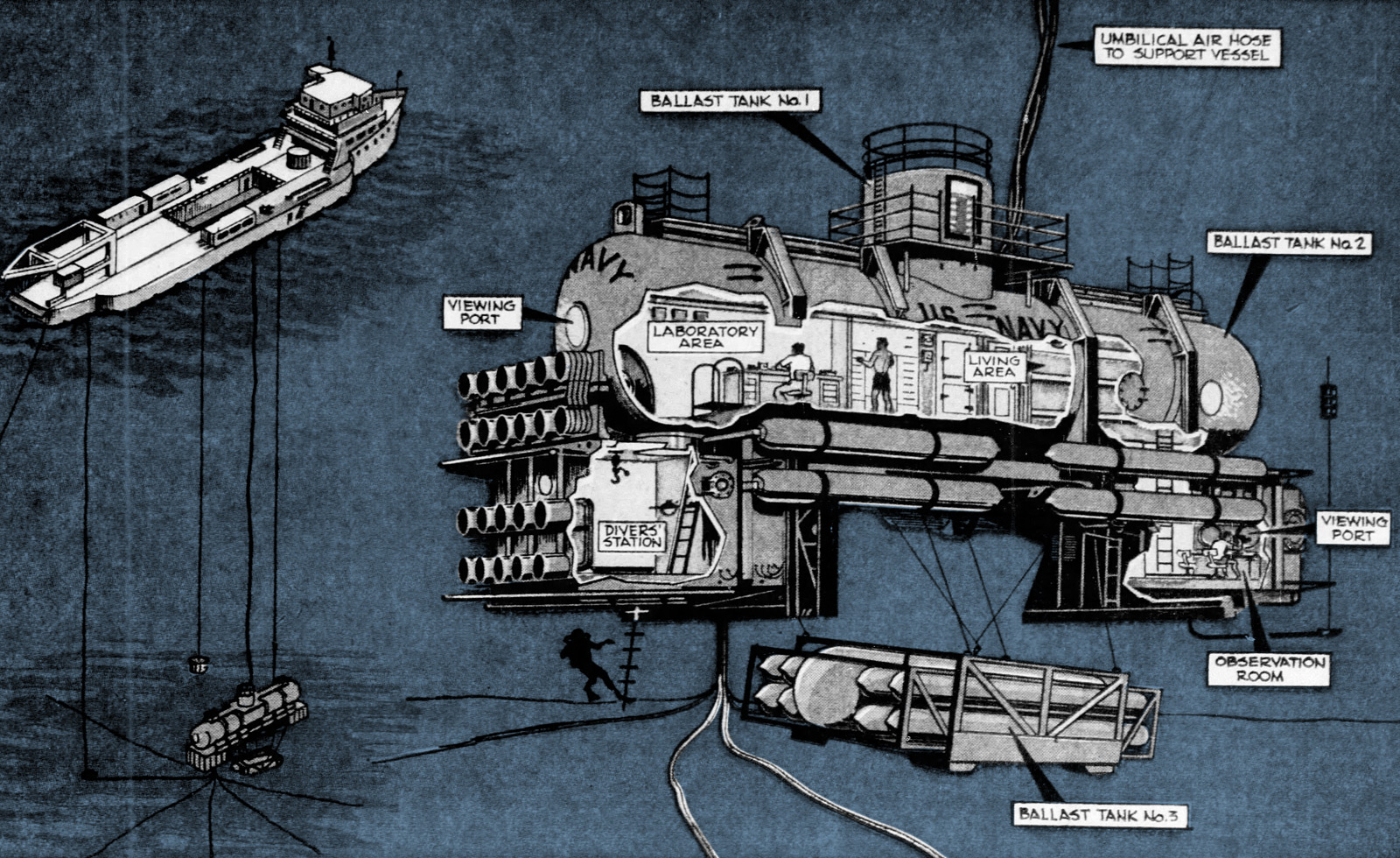
All known ‘Single Red’ Sea-Dweller examples, including the present watch, bear the U.S. import code ‘ROW’ on the balance cock, making clear these watches were meant for export to the United States of America. However, the ‘SEALAB 3’ project ran into problems which led to serious delays. In addition, due to the Vietnam War, the underwater experiment had no priority. As a result, ‘SEALAB 3’ was postponed to October 1968 and then again to February 1969.

During a series of deep hyperbaric saturation dives conducted at the U.S. Navy Experimental Diving Unit in preparation for ‘SEALAB 3’, some divers experienced a peculiar phenomenon. During decompression from long exposure to helium-rich atmospheres, the crystals of their watches popped-off with a loud bang. Helium gas had slowly entered the watches through the crystal and the rubber gaskets and could not escape fast enough. The internal pressure – now much higher than the steadily decreasing pressure in the decompression chamber – caused the weakest part of the watches, the crystals, to pop off.
Rolex was made aware of the helium issue in autumn 1967 by an American diver named T. Walker Lloyd. The crucial information including the idea for the one-way valve as a remedy, both came originally from U.S. Navy ‘Aquanaut’ Bob Barth, earned Mr. Lloyd a job as Oceanographic Consultant at Rolex. The Genevean company moved quickly and filed the patent application for the helium release valve almost immediately on November 6, 1967 as other watch brands had heard of the issue as well and were working on similar solutions. Just nine days later, Doxa tested an early version of the Doxa Sub 300 T Conquistador featuring a helium release valve in a Comex hyperbaric test dive named ‘Ludion 2’.

The 40 ‘Single Red’ Sea-Dwellers made for ‘SEALAB 3’ were no longer suitable for saturation diving. In consequence, T. Walker Lloyd started distributing them among hand-picked underwater explorers not primarily involved in saturation diving, e.g. a champion in free diving, ‘Deepstar 4000’ submersible pilots and ‘Tektite’ underwater habitat crew members. A handful watches were retrofitted with the newly developed helium release valve and given to ‘SEALAB 3’ crew members in late 1968. After an additional delay to February 1969 and the death of an Aquanaut during the setting up of the habitat at depth, the U.S. Navy abandoned the ‘SEALAB’ project. With newly developed capabilities, an underwater habitat was no longer necessary.
It can be assumed the present watch belonged to an interesting figure of the golden age of underwater exploration. As mentioned earlier, the watch surfaced on eBay in 2016, unfortunately without any mention of the provenance. The fact it was offered on eBay is an indication that the seller was not aware of the true value of a historical tool watch of this caliber. Perhaps the seller was a family member of the original owner who could not fathom what an importance the provenance would have with such a watch. The seller could also be completely unrelated to the original owner. As a Deepstar 4000 submersible pilot, Ron Church, who was also well-known for his underwater photography, received a ‘Single Red’ Sea-Dweller as well. When his marriage fell apart, his ex wife sold all of his watches in a garage sale, Ron Church’s daughter told me. The present watch could very well be Mr. Church’s but we will probably never know.

Rolex Geneva has no records about the recipients of these watches. This does not surprise as these watches were distributed by Rolex’s Oceanographic Consultant T. Walker Lloyd through the American Rolex Watch Corporation in New York. If there are any records at all, they would either be in New York or with the family of Mr. Lloyd. Notwithstanding, there is no doubt in my mind that the present watch belonged to a prominent diver.
Overview of all known Rolex ‘Single Red’ Sea-Dwellers
With the present watch, the total of all publicly known ‘Single Red’ Sea-Dwellers amounts to 13 pieces, plus one that is not a real example but a so-called ‘Frankenstein’ watch. Of the 13 known pieces, five have a helium release valve. Philippe Cousteau’s watch (04) lost its original dial between October 1968 and October 1972, probably during to a service. Klick the graphic to zoom in.

.
Thoughts
Rolex ‘Single Red’ Sea-Dwellers were the beginning of an incredibly important chapter in Rolex’s rich history that ultimately led to several depth records still standing today. These tool watches were developed for a very specific purpose and the name they were given – ‘Sea-Dweller’, – was an homage to the ‘Aquanauts’ of the U.S. Navy literally dwelling in underwater habitats for several weeks in a row. Veritable grails, these early professional diving tool watches are the dream of every serious Rolex sports watches collector. With only 14 publicly known examples, they are super rare. The known examples barely ever change hands.
The fact the present watch was found with a ‘Double Red’ Mk1 dial and has now been brought back to its former glory with a stunning dial that was incorrectly installed in another watch gives this watch its very own and interesting recent history. It makes me very happy that the owner wanted to be open about it. Kudos to him! While some might prefer an untouched watch, the present timepiece is as good as it gets and comes its original timing certificate which is the icing on the cake in my opinion. As a matter of fact, I am very excited about this important document.

Thank you for your interest.
Special thanks to Joe Capuano (IG: @havanasun), the owner of the present watch, for his trust and for financing this article.
Related Articles
- The Sea-Dweller Chronicles: Genesis of the decompressing watch
- The Sea-Dweller Chronicles: Dry run and teaming up with COMEX
- Hands-On: The Most Important (Rolex) Dive Watch
- Dr. Joe MacInnis’ ‘Sealab 3’ Rolex Single Red Sea-Dweller
- Rolex Single Red Sea-Dweller Ref. 1665 at Phillips GWA8
- All Single Red Sea-Dwellers, side-by-side
- SEALAB 2 – Rolex Submariners
- The SEALAB Chronicles – A Journey to Panama City
History Of The Rolex Sea-Dweller
The Rolex Sea-Dweller was developed in the late 1960s for the specific purpose of saturation diving. The entire history of saturation diving is visualized in the following infographic. Click the picture to zoom in.
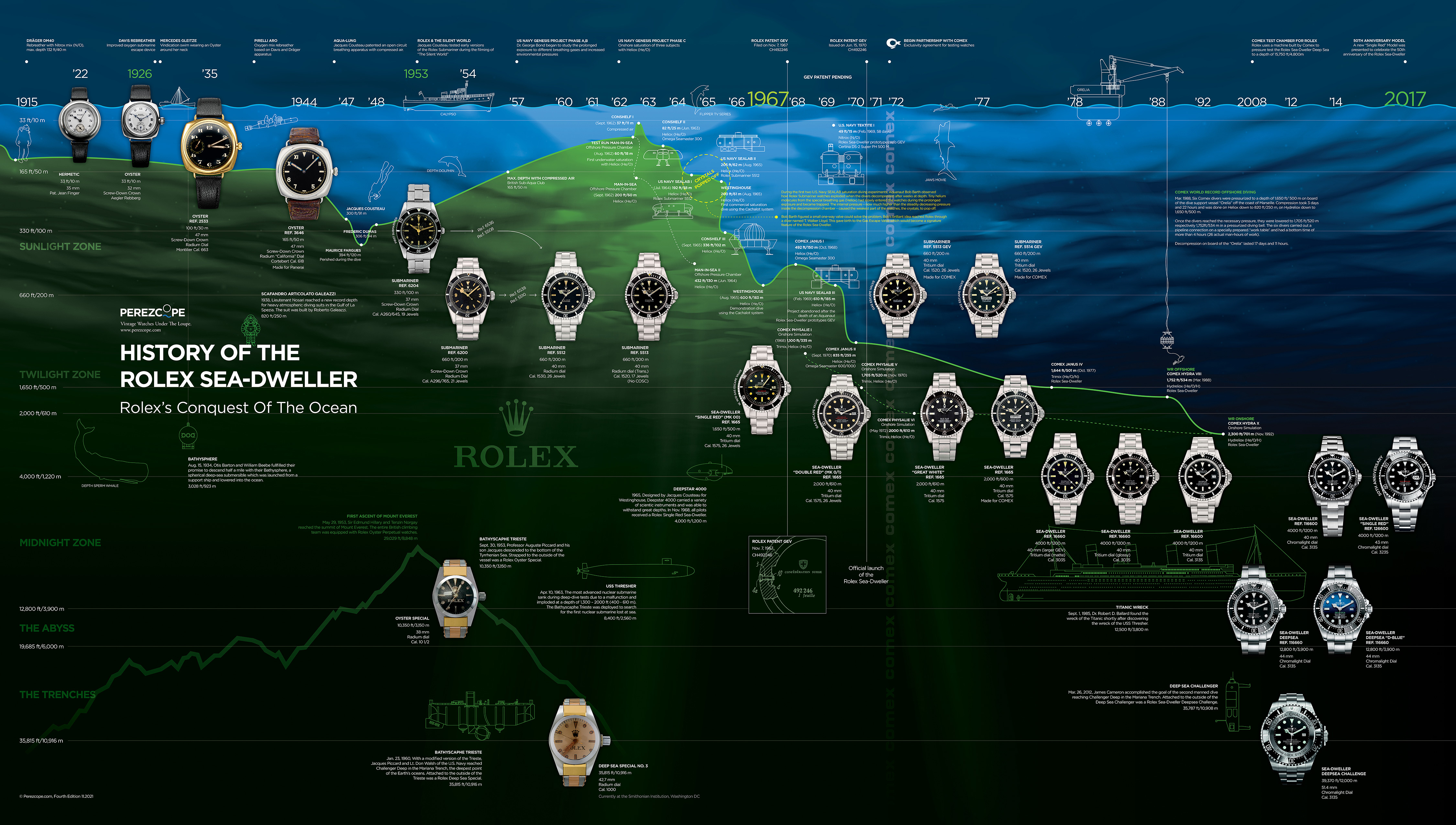
This graphic is available as a high quality print in two sizes:
- Regular small, 120cm x 68cm (47 x 26 inch): EUR 95.00 (plus shipping)
- Regular, 150cm x 85cm (59 x 33 inch): EUR 135.00 (plus shipping)
Limited: 50 pieces, numbered and signed by Bob Barth, the legendary U.S. Navy Aquanaut who pioneered saturation diving during the famous SEALAB missions. Bob developed the idea for the Rolex Gas Escape Valve: Sold out
To order please shoot me a DM on Instagram: @perezcope
 Vintage Rolex and other iconic timepieces under the loupe at Perezcope
Excellent writing style. Excellent research & review of a historic time piece series from a Co (Rolex) known to keep its watch-repair practices information close to the chest.I have a Sea-Dweller without a valve which had it’s pristine original dial changed to a new dial.
LikeLike