
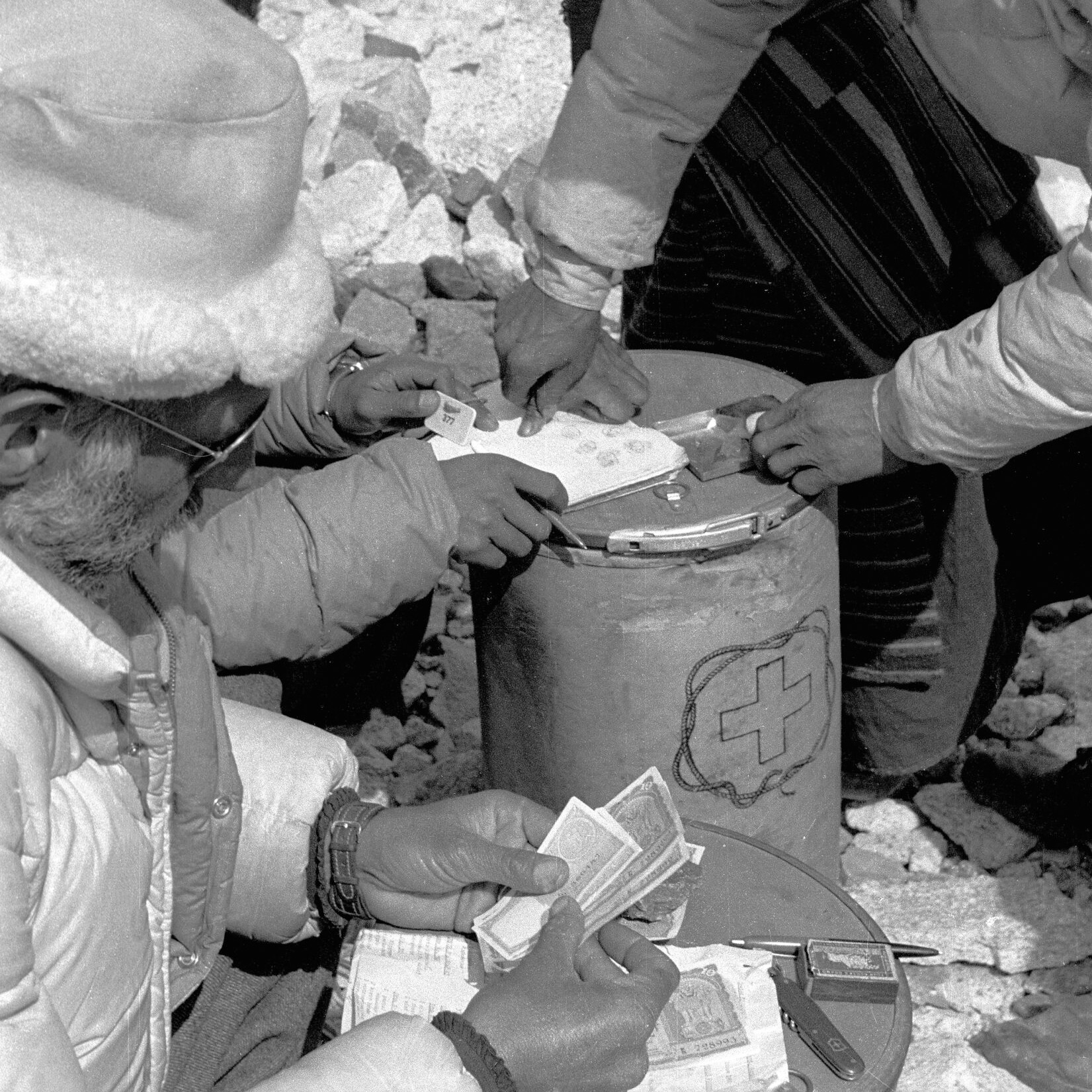
For their upcoming ‘Important Watches’ auction taking place on May 12, 2024 in Geneva, Sotheby’s got their hands on something truly exceptional, a never-before-seen ‘Mystery Cross’ Daytona with impeccable provenance. Readers of Perezcope remember well when I solved the decades-long riddle revolving around the so-called ‘Mystery Cross’ found on a handful vintage Rolex Daytonas Ref. 6265. One of the greatest mysteries in the world of vintages watches, the symbol consisting of a cross surrounded by a rope was hiding in plain sight in pictures taken on Mount Everest during the first successful ascent by Sir Edmund Hillary and Tenzing Norgay in late May 1953. It was the logo of the Swiss Foundation for Alpine Research which had organized the Swiss expedition to the world’s tallest mountain one year earlier that laid the groundwork for the British success. The ‘Mystery Cross’ Daytona at Sotheby’s is closely linked to the foundation. It was consigned by the family of co-founder and chairman Ernst Feuz who was instrumental to the 1952 Swiss expedition that almost made it to the top of Mount Everest on their first attempt. In 1956, Feuz’s efforts put the third, fourth, fifth and sixth man on the Everest summit, including achieving the first ascent of the nearby Lhotse, the fourth highest mountain in the world.
Lot 91 – Rolex Daytona ‘Alpine Research’, Ref. 6265, 2849293
The present watch was a gift from the director of the Swiss Foundation for Alpine Research, Ernst Feuz to his brother Walter Feuz. Made in 1971, Ref. 6265 with a Paul Newman ‘Panda’ dial is in my opinion the best combination as it makes the dial really pop thanks to the contrast between steel bezel, black outer track and white inner dial.

Auction: Lot 91 – Daytona ‘Alpine Research’, Ref. 6265, circa 1971 (sothebys.com)
The Paul Newman Mk2 dial of this watch is in stunnig condition with almost intact lume plots.

The caseback that tells the story and makes the difference. This is the initial logo of the Swiss Foundation for Alpine Research. For more than 20 years, watch enthusiasts around the world were puzzled by this enigmatic symbol.
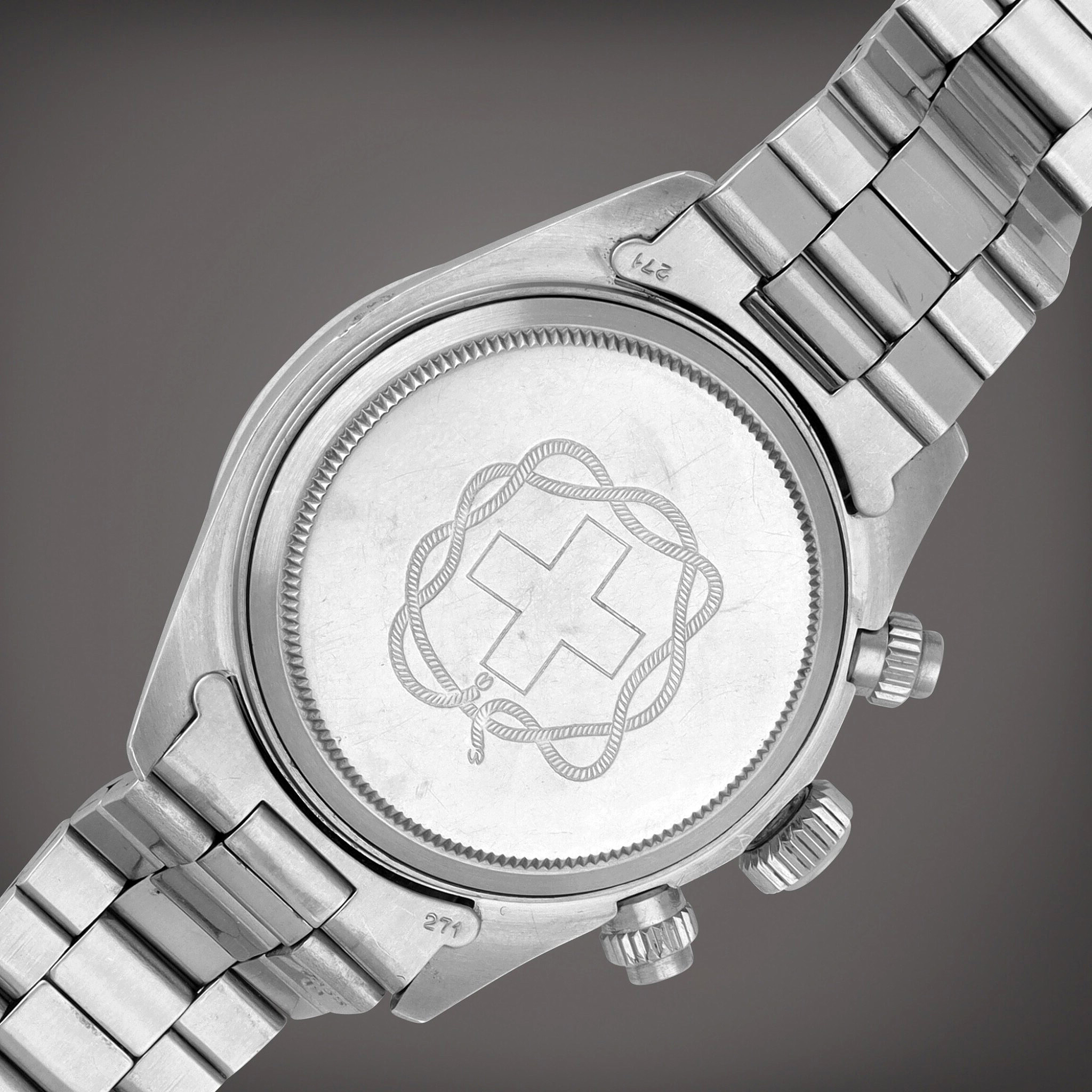
The Ref. 7835/19 bracelet with folded links with a clasp marked 1-71 (1st quarter 1971) appears to be the original one that came with the watch from the factory. The same can be said of the 271 endlinks.
The next picture shows the inside of the caseback where the three last digits of the case number are repeated. Only special production watches had this feature to make sure the unique casebacks were not confused. In addition, there is a Rolex Geneva service center marking from 1981.
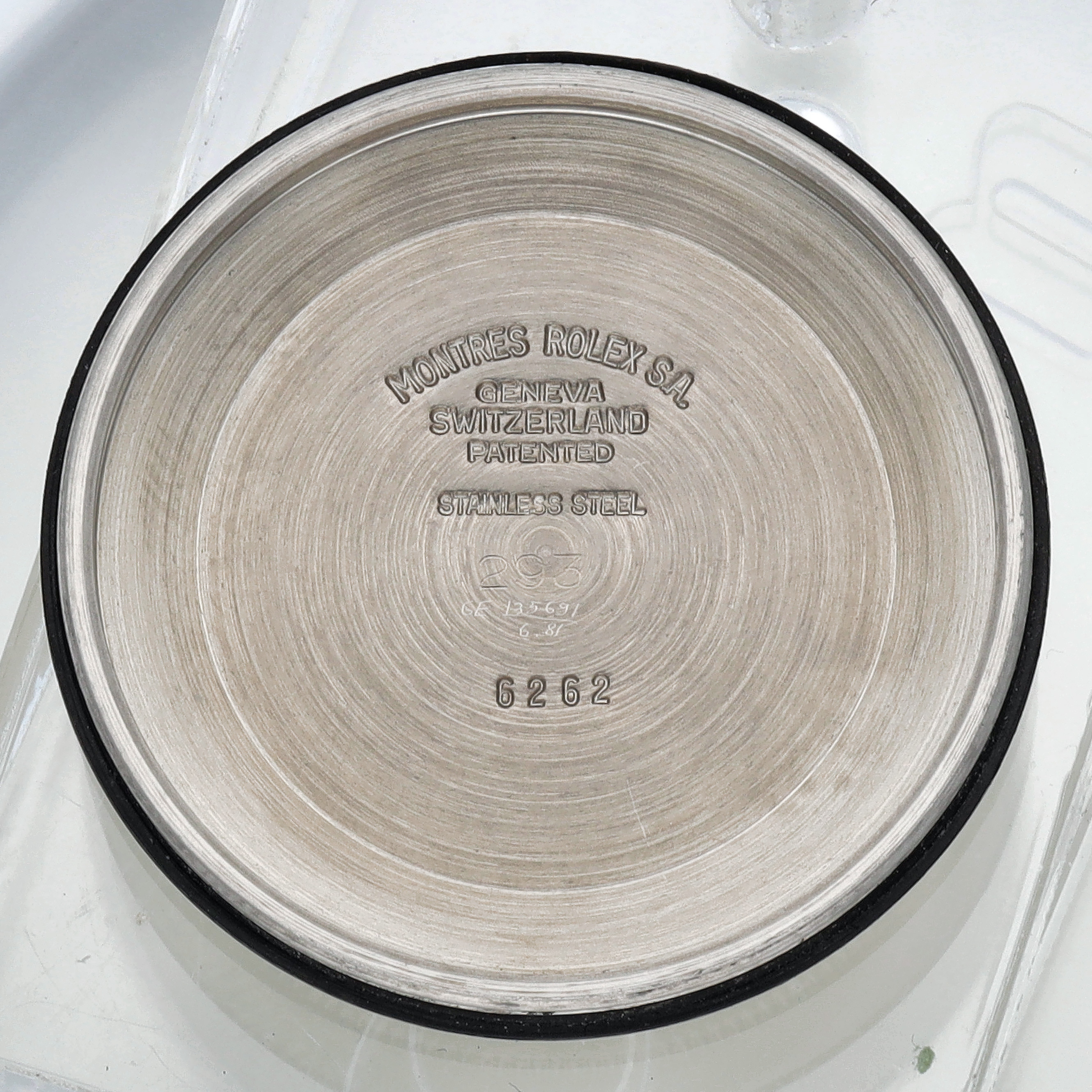
The case of this watch appears to be a service case, possibly replaced during the service in 1981. The original case number was retained and engraved between the lugs of the replacement case. I have seen similar things but not in this exact form. While I am remaining cautious, I am inclined to think it is probably ok, firstly because of the provenance and secondly – and more importantly – due to the fact that this specific Cal. 727 movement with its particular properties was exclusively used in this case number range. It is absolutely consistent with other examples from the 2.849 million Ref. 6265 batch which consists of circa 150 pieces in total. If the case needed replacement for whatever reason, the movement would have been retained if there was nothing wrong with it.

In late April, Sotheby’s sent the present watch to Singapore for a public viewing. Since the city-state is just around the corner from where I live, I took the opportunity to check the watch extensively in the metal.

The watch has clear signs of wear and tear, making clear it was not ‘babied’ but probably worn on a daily basis for all kinds of activities. There is some pitting between the lugs at 6 o’clock which is probably the result of sea water that was never rinsed off with clear water.
Overview of all publicly known ‘Mystery Cross’ Daytonas
With this newly discovered ‘Mystery Cross’ the total count of publicly known examples increases to five. When I wrote about these rarities back in 2021, there was only one known example featuring a Paul Newman ‘Panda’ Mk2 dial (see image below, 04, 2849276). What appeared to be an outlier at first, has in the meantime become the norm. Given the provenance of the present watch there can be little doubt that some watches, perhaps the ones meant for the management of the Swiss Foundation for Alpine Research, left the factory with Paul Newman ‘Panda’ Mk2 dials, while others that were maybe given to mountaineers had regular dials.

| Case number | reference number | Dial type | Provenance |
|---|---|---|---|
| 2788260 | 6265 | ROC Silver | Dainius Makauskas |
| 2849199 | 6265 | ROC Silver | Sotheby’s Nov. 2011 |
| 2849218 | 6265 | Paul Newman ‘Panda’ Mk2 | Private sale |
| 2849240 | 6265 | ROC Silver Sigma | Market in La Chaux-de-Fonds |
| 2849276 | 6265 | Paul Newman ‘Panda’ Mk2 | Christie’s Nov. 2015 |
| 2849293 | 6265 | Paul Newman ‘Panda’ Mk2 | Ernst Feuz/Walter Feuz |
It is further important to note that case number 2849240 (03) features a 2nd generation Sigma dial (3.5 – 3.9 million range) which in my opinion is not original to the watch. Thanks to the present watch which is so far the most important piece of the puzzle, we can now better understand the origins of these elusive pieces.
Ernst Feuz
Born on September 7, 1908 in Mürren, Switerland, at the foot of the Schilthorn mountain, Ernst Feuz was the firstborn of a mountain guide and one of eleven siblings. When he was just nine years old, he started skiing. In 1928, Feuz was part of the Swiss Olimpic team at the Winter Olimpic in St. Moritz where he placed 8th place in ski jumping. After studying banking and working for some time in France and England, he moved to Zurich, Switzerland, where he started working for a large department store company, becoming its director in 1947.

A passionate alpinist known to have done a number of first ascents on the north faces of the Lauterbrunnen Valley and who dreamed of establishing Switzerland as a leader in the field, Feuz co-founded together with Karl Weber, son of Dr. Oscar Weber and one of the richest Swiss at the time, the Swiss Foundation for Alpine Research in 1939 with the goal of financing Swiss expeditions all over the world but with special focus on the Himalaya.
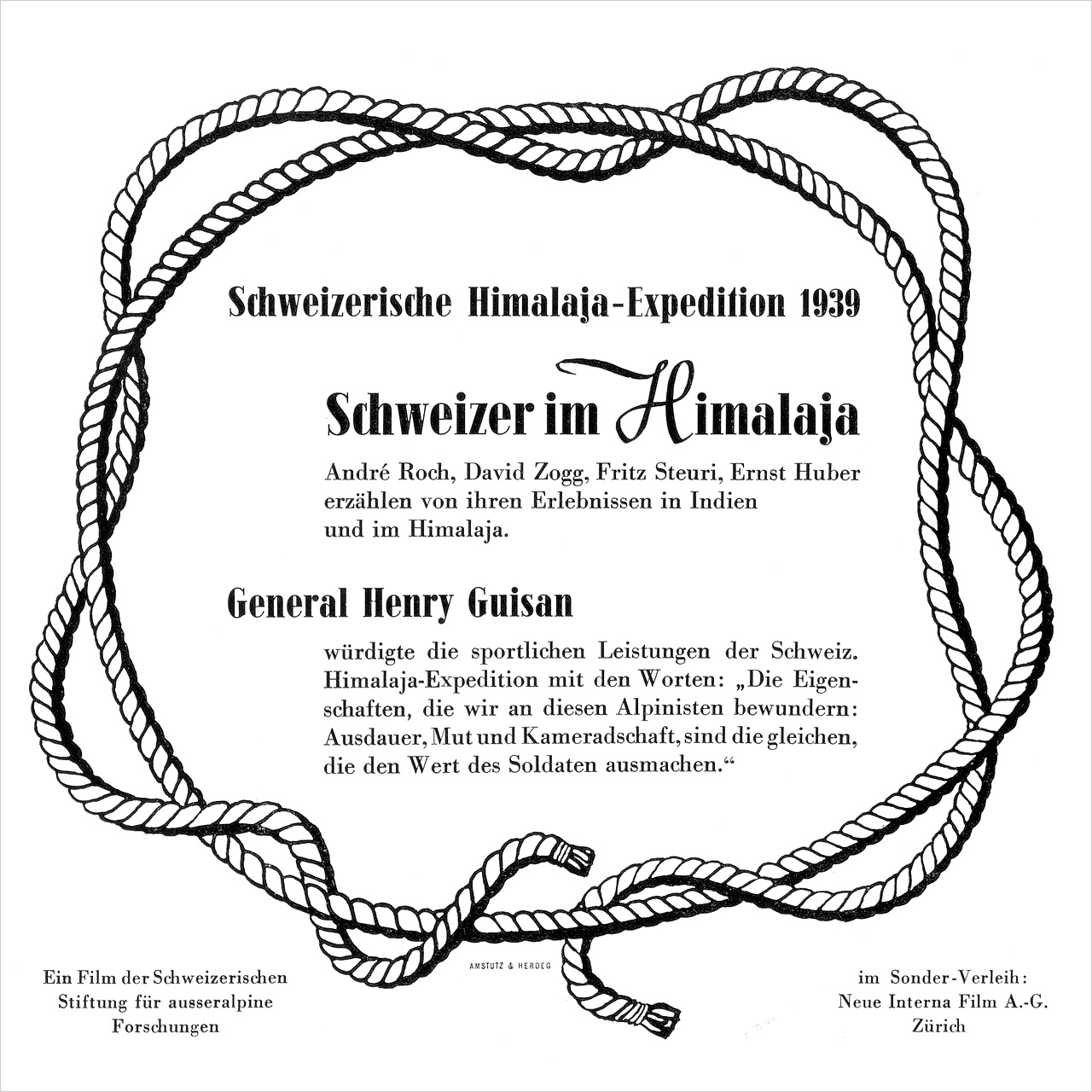
While Karl Weber held the position of president, Ernst Feuz was the managing director. When Weber died in late 1973, Feuz took over the role as president.
Swiss Mount Everest Expeditions
In 1951, the northern route to Mount Everest through Tibet became became inaccessible to noncommunist foreigners as a result of Tibet’s annexation by the People’s Republic of China. One year earlier in 1950, the southern route had become available for the first time after Nepal had dropped their self-imposed ‘splendid isolation’ policy and opened its borders to the world.

A small Anglo-American expedition in 1950 undertook an exploratory expedition to Everest through Nepal along the route which has now become the standard approach to Everest from the south. In 1951, the British received permission for a reconnaissance expedition through Nepal which took place after the monsoon in late 1951. This first British attempt through the South was defeated early on by an insurmountable crevasse, a deep open crack at the top of the Khumbu Icefall. When the Brits requested permission for a new attempt in early 1952, they were shocked to learn that for the entirety of 1952 the mountain had been booked by the Swiss. Already in May 1951, Ernst Feuz had secured an exclusive permission from the Nepalese government. In an act of desperation, the British tried to get the Nepalese to abrogate their deal with the Swiss when a new Nepalese Prime Minister took office in mid November 1951. The Nepalese refused to do so, floating the idea of a joint Anglo-Swiss expedition instead. In total panic mode, Mr. Goodfellow of the Royal Geographical Society and British Apline Club, and Eric Shipton travelled to Zurich on December 29, 1951, to discuss a possible cooperation with Ernst Feuz. Open to the idea, Feuz and the leader of the Swiss climbing party Edouard Wyss-Dunant went to London on January 04, 1952, to discuss the idea further. At the end, they did not reach an agreement. The Royal Geographical Society made the following statement:
“Discussions have been held during the week-end between the Himalayan Committee of the Royal Geographical Society and the Alpine Club, and representatives of the Swiss Foundation for Alpine Research, as to the possibility of launching a British-Swiss expedition to Mount Everest this spring. Much as both organisations welcome the idea of a joint expedition of this kind, they have come to the conclusion that this year, at any rate, it is not practicable to combine the two parties. Swiss plans are on a much larger scale than was anticipated, and both parties feel that to add a British team at this late stage would produce an expedition too unwieldy in the opinion of past Everest climbers to be easily workable. The Himalayan Committee also considered that dual responsibility for leadership on the mountain would probably not be workable in practice. For these reasons and because of the priority of their permission from the Nepalese Government, which dates from May 1951, the Swiss expedition will make the attempt in the coming spring. The Himalayan Committee propose to make application and complete their preparations for a full-scale expedition in 1953.”
On April 20, 1952, the Swiss climbing party established their base camp at the Khumbu Glacier and worked their way up the Khumbu Icefall. Thanks to their excellent ice climbing skills, the deep crevasses which had put an end to the British expedition one year prior were quickly overcome.

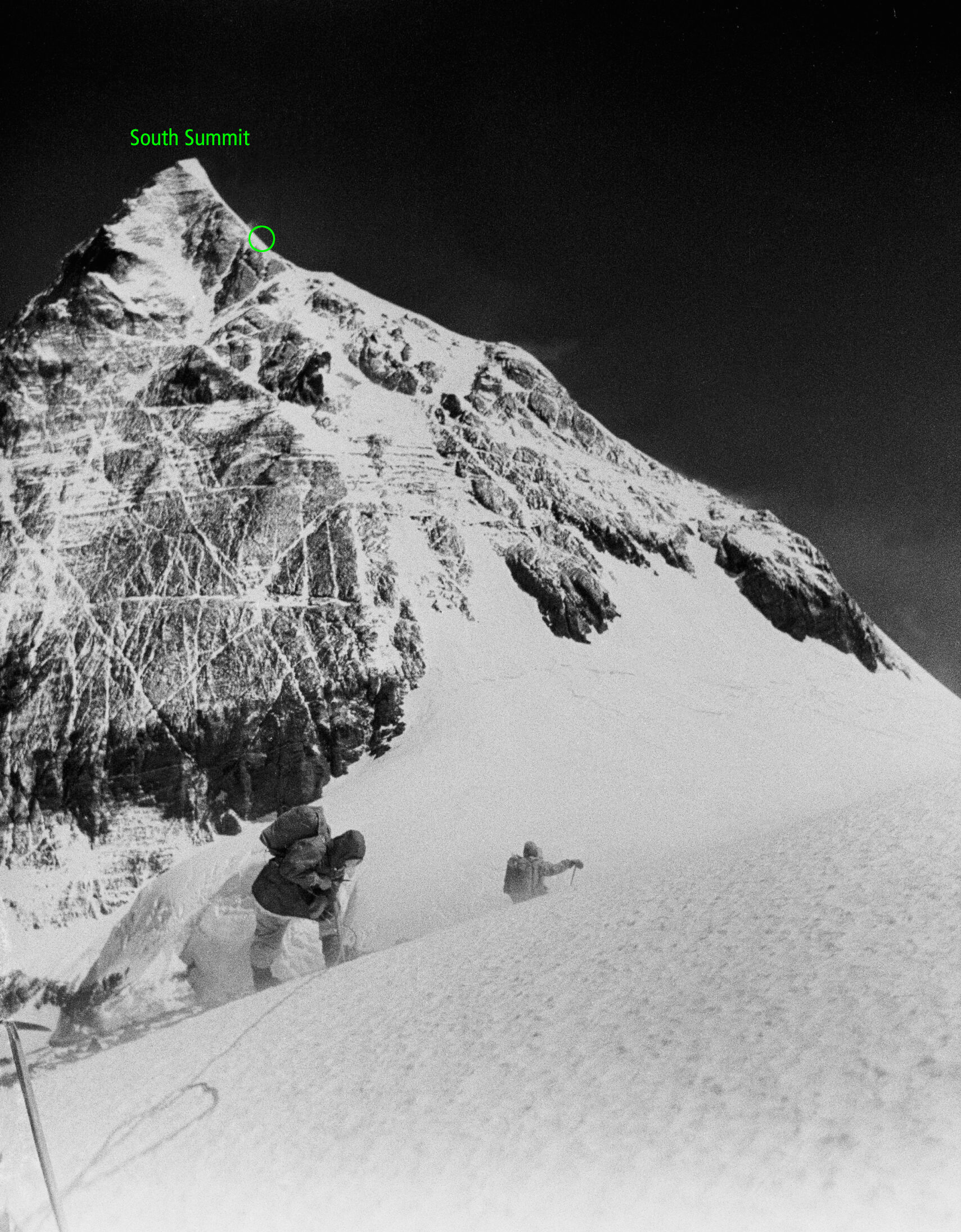
The Swiss moved swiftly up the mountain, soon establishing a camp on the South Col where the ‘death zone’, a term coined by the leader of the expedition, Edouard Wyss-Dunant, begins. The final assault team consisting of Raymond Lambert and Tenzing Norgay came within reach of the summit but had to give up due to a storm at a height of slightly over 28,215 ft/8,600 m, the highest altitude ever reached by humans. A second Swiss expedition after the monsoon season was defeated by a storm at a height of 26,575 ft/8,100 m.
Both Swiss expeditions were supplied with watches by Rolex. The next picture shows Jean Buzio, a member of the second Swiss expedition which took place in the post-monsoon season in autum 1952, wearing two Rolex Perpetual ‘Pre-Explorer’ watches, one on each wrist.

In 1953, following in footsteps of the Swiss expeditions, the British finally fulfilled their decades-long dream of conquering Mount Everest. Tenzing Norgay who had taken part in both prior Swiss attempts, was also hired by British and together with Edmund Hillary, he made it to the top and became a legend.

While Rolex had supplied watches to the British climbing party as well, neither Hillary nor Norgay wore a Rolex watch to the top. The British had also been provided with watches by the British watch company Smiths. In a Smiths advertisement from 1953, Sir Edmund Hillary is quoted saying:
“I carried your watch to the summit. It worked perfectly.”
Mr. R. A. Winter, director of Rolex UK at the time, conceded to Smiths in a reader’s letter published in the British Horological Journal of October 1953, following a heated discussion that had arose as a result of both brands advertising the same feat. From that moment onwards, Rolex never explicitly claimed one of their watches had reached the top, instead it was advertised that the whole team had been supplied with Rolex watches. Un unsolved mystery to this day is the watch Tenzing Norgay was wearing but that is a story on its own.
On their way back to London on July 2, 1953, the British team had a short layover at the airport in Zurich. Several members of the two Swiss Mount Everest expeditions were waiting with Champagne at the airport lounge. Ernst Feuz was present as well and welcomed the guests in a short speech in English in which he congratulated them for their impressive historical achievement. During this event, Feuz invited Tenzing Norgay and his family, who were the centre of attraction at the event, to return to Switzerland after London in order to enjoy a holiday sponsored by the Swiss Foundation for Alpine Research. In late July, Ernst Feuz set up a meeting at the Grand Hotel Dolder in Zurich between Dr. B. C. Roy, at the time Chief Minister of West Bengal, himself and Tenzing Norgay to discuss the idea of a mountaineering institute in Darjeeling, India.
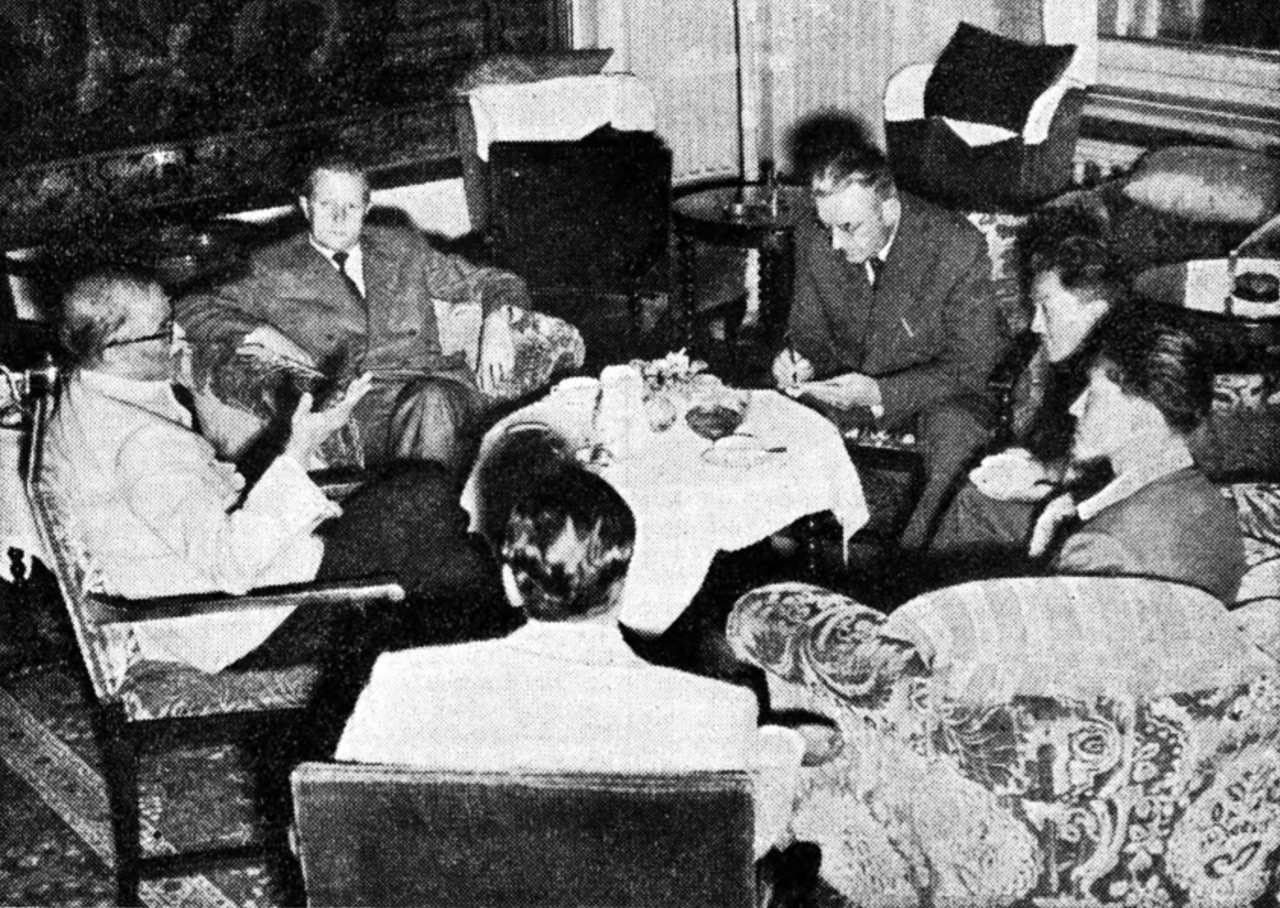
Later in mid 1954, Feuz brought Tenzing Norgay and six sherpas to Switzerland to have them professionally trained at the famous Swiss mountaineering school ‘Rosenlaui’, led by Arnold Glatthard. The goal was to put them in leading positions at the Himalayan Mountaineering Institute which was to be set up in November 1954.

In 1956, Feuz’s efforts came finally to fruition when a new Swiss expedition sponsored by the Swiss Foundation for Alpine Research put the next four climbers on the roof of the world. In addition, they also made the first ascent of the nearby Lhotse (27,940 ft/8,516 m). Always present, the logo of the Swiss Foundation for Alpine Research, as can be seen in the picture below. It is also interesting to note that the 1956 expedition was supplied with watches by Enicar, a model named Ultrasonic Sherpas.
It certainly appears the Mount Everest expeditions were Ernst Feuz’s baby. This led me to believe, the ‘Mystery Cross’ watches were made in 1971 to commemorate the 20th anniversary of the glorious failure of 1952. Another possibility could be that they were ordered to celebrate the 30th anniversary of the Foundation which for some reason could have been commemorated in mid 1972.
Schilthornbahn and James Bond
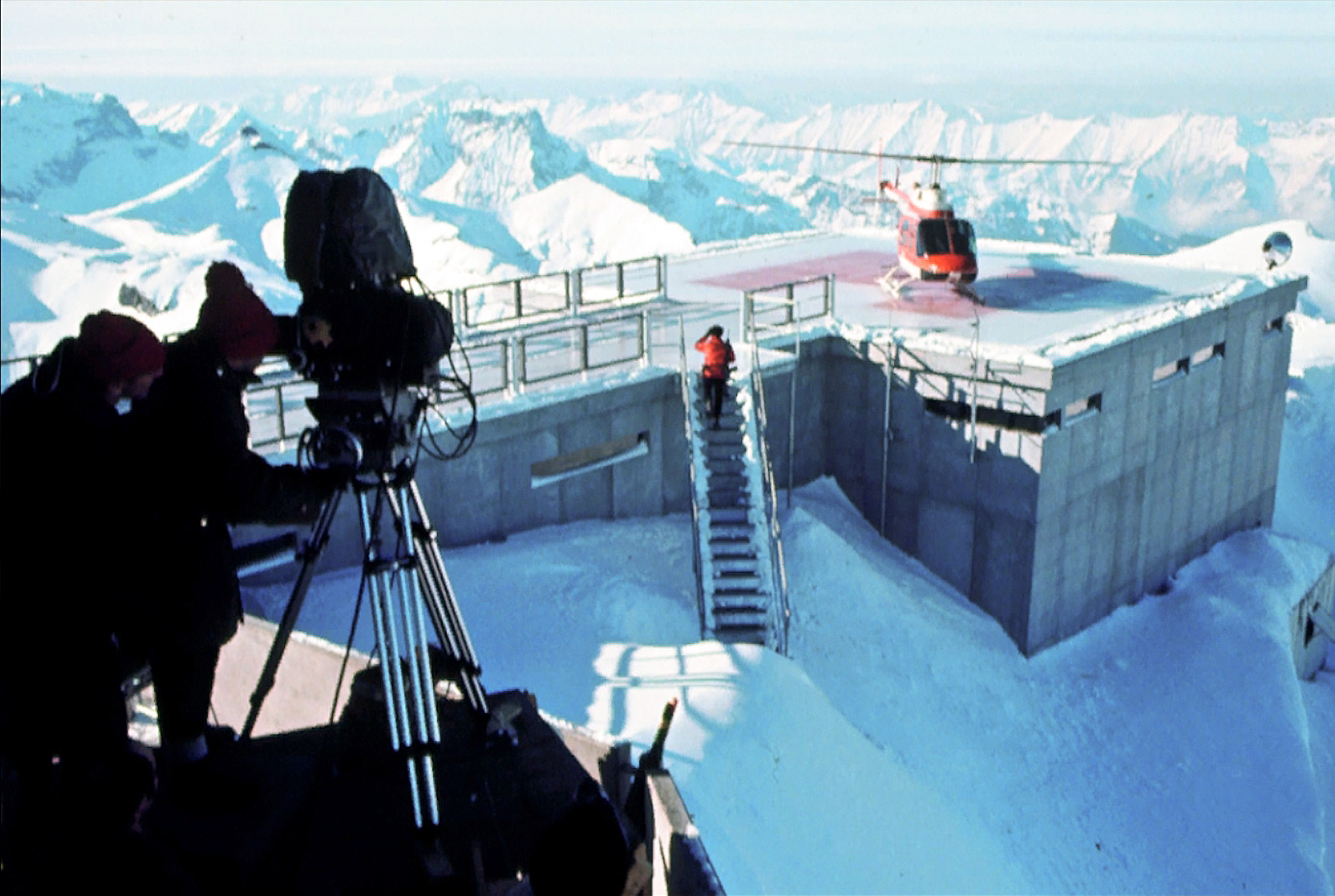
In the late 1950s, Feuz embarked on a new adventure. Being a native from Mürren, Switzerland, Feuz spearheaded the construction of the Schilthornbahn, at the time the longest aerial cableway in the world. In 1969, the unfinished cable car station and revolving restaurant atop the Schilthorn became world famous as Blofeld’s ‘Piz Gloria’ mountain retreat in James Bond’s ‘On Her Majesty’s Secret Service’. Ian Fleming’s fictional name ‘Piz Gloria’ stuck until today.
“Under the leadership of Ernst Feuz from Mürren, a determined group of pioneers finally overcame the considerable financial and technical difficulties, and in 1967 the Schilthorn summit was finally made accessible to the general public. Most people would have been more than satisfied with the achievement of constructing the world’s longest aerial cableway, with all the problems posed in building at that high altitude. But Ernst Feuz was not like most people, he wanted more! He dreamed of creating a unique experience for all visitors, enjoying the breathtaking scenery.
So he developed the revolutionary idea of building the world’s first revolving restaurant at 3000 m altitude. Of course, everyone thought he was mad! But he realised his dream – and that is where James Bond made his entrance!”
Source: History of the Schilthorn cableway (schilthorn.ch)
It is said the James Bond production team was torn between Piz Corwatsch near St. Moritz and Schilthorn based on information provided by their location scouts. When they finally visited the Schilthorn, it was a miserable, cloudy day. Ernst Feuz personally welcomed the important guests, engaging them in serious discussions and offering free Champange until the fog lifted. Once face-to-face with the breathtaking Swiss Alps scenery featuring the three famous Swiss mountains Eiger, Mönch and Jungfrau, film director Peter Hunt reportedly uttered “It’s perfect!”

The helipad wing was specifically built for the movie and paid for by the film production company.
The picture below shows Ernst Feuz (left) sitting at the Birg station of the Schilthorn cableway with view on the Schilthorn peak and the Piz Gloria. Do you know the man next to him?

Ernst Feuz became the Chairman of the Schilthorn cableway and gave his brother Walter a position as Director. Later in 1976, Walter took over the direction of the Hotel Alpenruh in Mürren, right next to the cableway station. Ernst Feuz died on February 15, 1988. Several Swiss newspaper reported on the sad event. His younger brother Walter, the owner of the present watch, died in the year 2000.
Thoughts
For me the present watch is all about provenance. When I learned it came from the family of Ernst Feuz, a name I must admit I had never heard before, I immediately started researching and what I discovered is a truly outstanding character, a man with a strong will who pushed the boundaries of what is possible. At the same time, he appears to have been a very kind man who had great esteem for Tenzing Norgay and tried to help him making a living in the field he loved so much. I wish there were more pictures of Feuz with all the people mentioned in this article. I guess now that the ice is broken, pun intended, we will hopefully see more and more information coming out.
Thank you for your interest.
Special thanks to Sotheby’s for their trust and for financing this article and the countless hours of research that went into it.
Read more: Vintage Rolex Daytona ‘Mystery Cross’ – A mystery no more
 Vintage Rolex and other iconic timepieces under the loupe at Perezcope
Excelente artículo. Eres, como siempre, una fuente de conocimientos y un regalo para los que aman la VERDADERA historia de los relojes. Muchas graciad. ¿Has pensado en publicar un libro recopilatorio de tus artículos? Yo los imprimo y compilo para leerlos en papel…
LikeLike
A superb read. Congratulations on your great piece of detective work.
LikeLike
A read so pleasant, thoughtful and “easy”. Great work
LikeLike
Very well researched, as usual! Question though: this seems to have lived a rough life. Would it diminish its value to replace the crystal and re-ink the numbers in the tachymeter bezel?
LikeLike
Excellent! Numerous spelling errors in last paragraph.
LikeLike
it is always an incommensurable pleasure reading the articles of my favorite Sherlock Holmes of the vintage watch industry. Well done Sotheby’s for financing the article of the best debunker of the false narratives created by other auction houses to sell their watches.
LikeLike
Well done Jose, yet again another professional research article with fascinating conclusions that only your supreme level of expertise, experience and archive data could produce.
It would seem that Southebys are showing the other auction houses how it should be done – working with you, rather than against you.
Do I detect some detente here, and perhaps more of this to come where your expertise is used to enhance their auction pieces ?
If so, bravo. And about time.
Best
Tony
LikeLike