
In my original article on the myth-enshrouded Doxa HRV (helium release valve) published in February 2020, I concluded that the story put forth by Doxa and its many brand enthusiasts regarding the co-development of the helium release valve with Rolex did not sound plausible. After studying all available facts, my belief was that Doxa developed its valve independently from Rolex, but the latter filed the patent first, and Doxa had to concede. Newly discovered evidence not only supports this theory, but suggests Doxa was actually way ahead. In late 2021, horological researcher Nick Gould (IG: @niccoloy) found a Swiss newspaper article from April 17, 1968 stating that a Doxa Sub 300 equipped with a helium valve was tested by the famous Oceanaut Claude Wesly at the Comex hyperbaric center in Marseille. Interestingly, and we became aware of this pivotal fact only more recently, the actual test dive named ‘Ludion 2’ mentioned in the article took place months earlier, on November 15, 1967, just nine days after Rolex had filed the patent application. In essence, Doxa’s prototype passed its first test with flying colours while Rolex had only just hastily sketched out a crude concept nobody knew would work. Doxa enthusiasts will also be happy to hear that the Sub 300 was probably the first dive watch to feature a unidirectional bezel.
Doxa tests During Comex “Ludion 2”
On April 17, 1968, several Swiss newspapers reported that a Doxa Sub 300 equipped with a helium release valve had been sucessfully tested at the Comex hyperbaric center in Marseille. One of the articles, which I found after @niccoloy had informed me about his discovery, was titled “Une montre de plongée révolutionnaire”, or a revolutionary dive watch, and included two pictures, one of Oceanaut Claude Wesly and one of a Doxa Sub with a clearly visible helium valve on the left-hand side of the case. Wesly, who rose to fame as a crew member of Captain Jacques Cousteau’s underwater exploration series, was one of the pioneers in saturation diving. The article describes how Mr. Wesly, after living for six days in a decompression chamber, attempted to make his ‘saturated’ diver watch explode by placing it in an airlock and decompressing it in a fraction of a second from a pressure equivalent to 279 ft/85 m of depth to normal surface pressure.
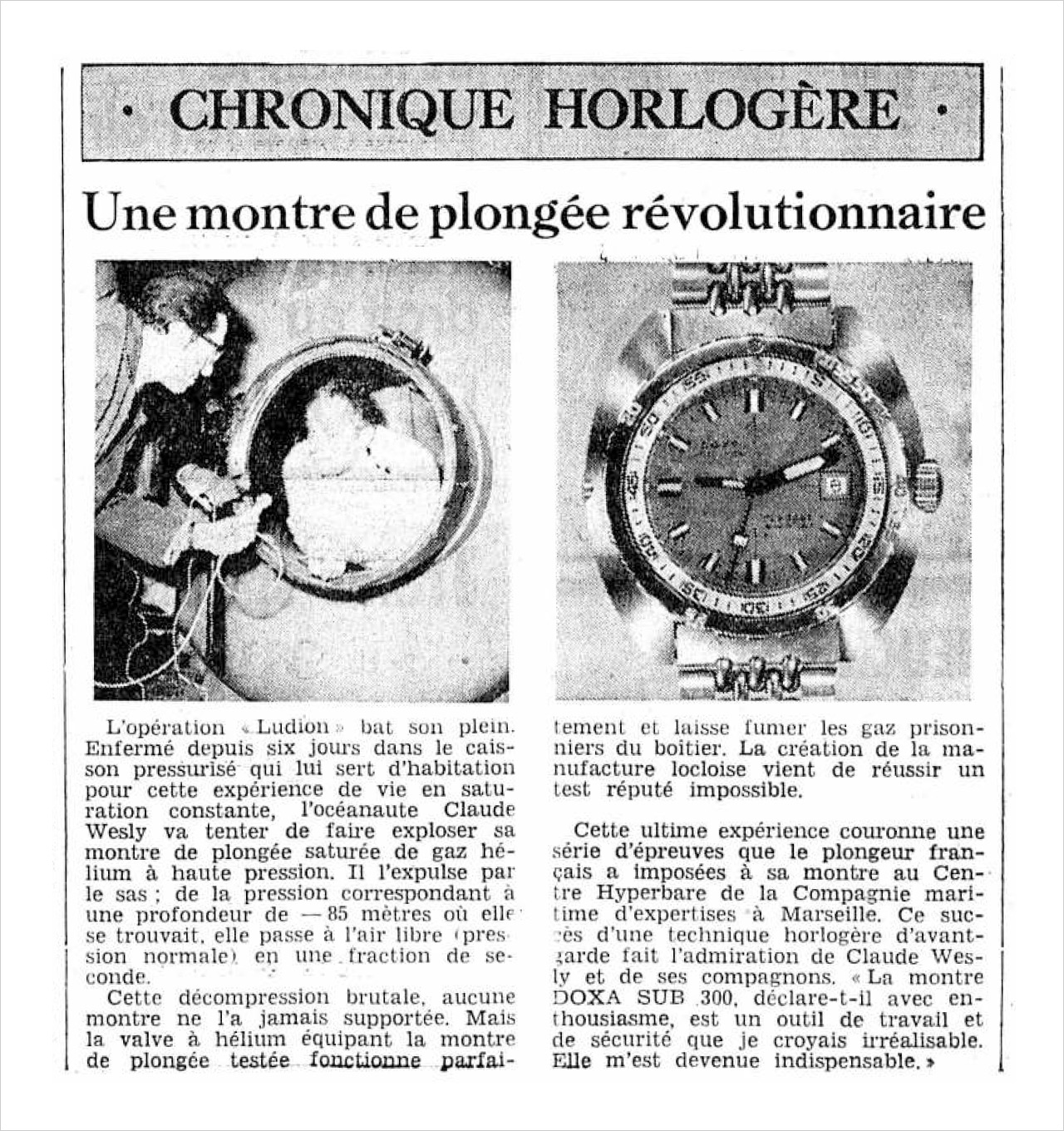
Source: Une montre de plongée révolutionnaire (e-newspaperarchives.com)
The article continues:
“Cette décompression brutale, aucune montre ne l’a jamais supportée. Mais la valve à hélium équipant la montre de plongée testée fonctionne parfaitement et laisse fumer les gaz prisoniers du boitier. La creation de la manufacture locloise vient de éussir un test réputé impossible.”
Translation: No other watch has ever withstood such brutal decompression. The helium valve fitted to the tested diver’s watch worked perfectly and allowed the gases trapped inside the case to vent out. The creation of the manufacture from Le Locle has just passed a test deemed impossible.
When Nick came across this information, we had no idea how groundbreaking this would turn out to be. Sure, April 1968 sounded quite early for testing, and the fact it took place at Comex in Marseille was super interesting, but we knew Rolex had tested earlier. It was only 10 months later, while researching Comex experiments for another article, that I discovered the test in question, called ‘Ludion 2’, had actually taken place between November 15 and 28, 1967. The experiment started just nine days after Rolex filed the patent application, and more than three months before Rolex started testing their first ‘Single Red’ Sea-Dweller prototypes.
‘Ludion 2’ in the French press
• Début de l’expérience Ludion-II : plongées en caisson à 120 mètres (lemonde.fr)
• La plongée fictive “Ludion-2” est terminée (lemonde.fr)
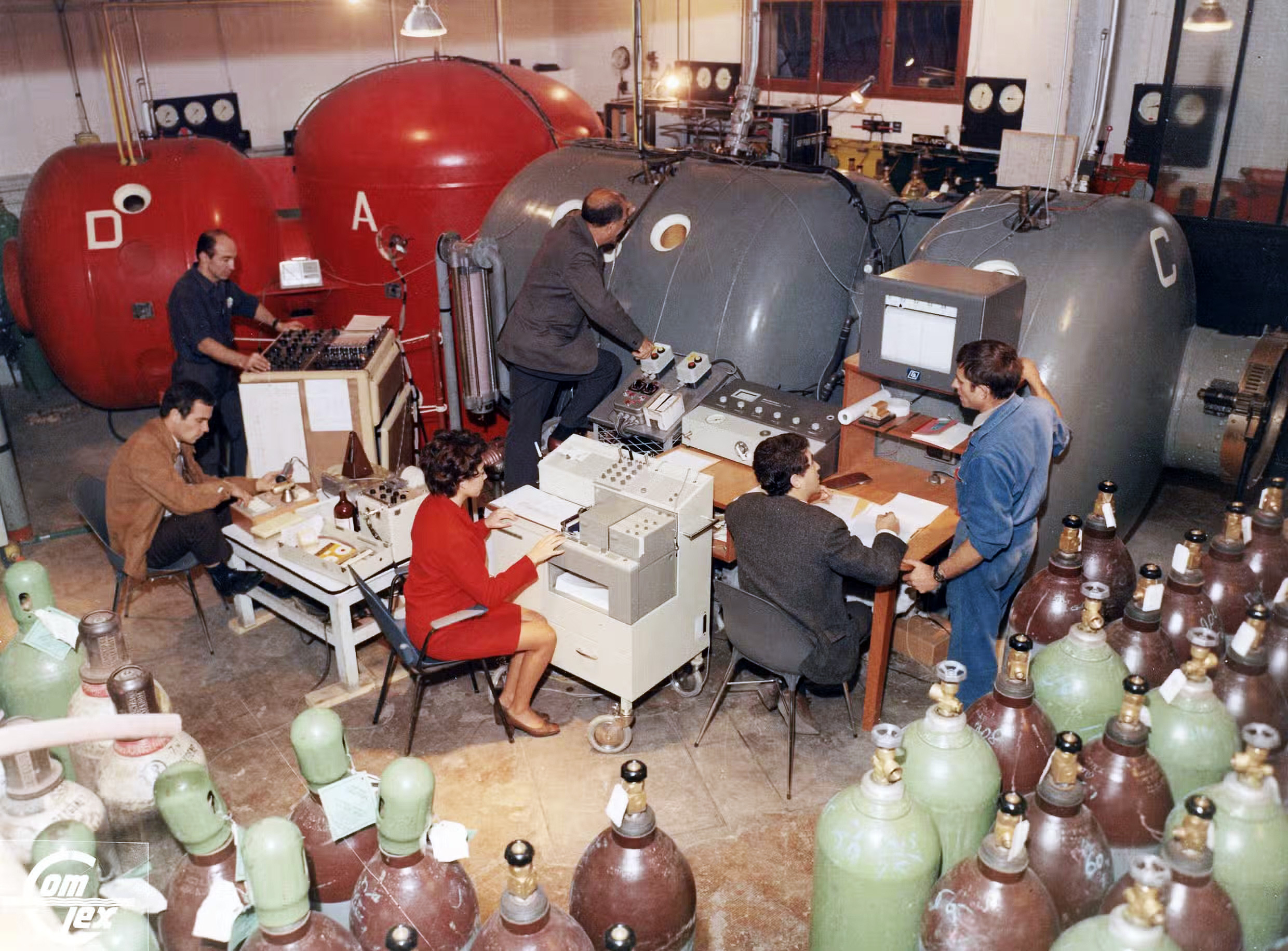
For some reason, the real testing date was omitted entirely in the Swiss newspaper articles from April 1968. The reports were formulated as if the test had just taken place. The question is, why was this information published so late, just days before the Sub 300 ‘Conquistador’ was presented at the Basle Watch Fair of 1968? Was it part of the advertising campaign? Anyhow, the next picture is truly profound as it shows Claude Wesly exiting the Comex decompression chamber on November 28, 1967, after nine days at a pressure equivalent to a depth of 279 ft/85 m, with daily two hour excursions to 393 ft/120 m, and four days of decompression. Clearly visible on his wrist, the Doxa Sub 300 valve protoype with the signature orange dial.

In a 2004 interview, which was discussed in my 2020 article on the Doxa helium release valve, Doxa’s former head of product development, Urs Alois Eschle, claimed that Claude Wesly had tested the Doxa with helium release valve during Jacques Cousteau’s 30 days expedition to the Red Sea (Précontinent 2/Conshelfs 2) in 1963. As I explained in my article, this made little sense. At the time of the interview, Mr. Eschle was probably already older and must have confused the dates. Of course, in 1963, the Doxa Sub 300 with its signature double scale bezel had not yet been developed. The watch was only presented at the Basel Fair in 1967, and probably developed the year before. In the same interview, Eschle said the Doxa Sub 300 ‘Conquistador’, which incorporated the helium release valve, was introduced to the market in 1969. According to newly discovered information, however, the new model was actually launched one year earlier at the Basle Watch Fair in 1968, which took place between April 20 and 30.
Sources
• Premiers Flashes, Europa Star Asia, Issue 105, 2/6 (watchlibrary.org)
• Doxa ‘Sub 300 T Conquistador | 1968, Swisstime press release (watchlibrary.org)
Think about it, while Rolex was still in the early testing phase, Doxa was already introducing the Sub 300 ‘Conquistador’ to the market. Interestingly, by 1969, there was no word of the watch in the press, and neither was there in 1970, as if the model had suddenly vanished from the face of the earth.
So what happened? Fact is, only a handful examples are known today. The most plausible explanation is that Rolex claimed their right to the idea and forced Doxa to withdraw the Sub 300 ‘Conquistador’ from the market. In 2004, Mr. Eschle claimed the helium release valve patent was shared with Rolex. However, if that had been the case, Doxa would have continued to sell their watch and, more importantly, further develop it. In an ad said to be from 1968, Doxa stated their helium release valve was patented (à valve à hélium brevetée). I can imagine they tried to patent the idea shortly before the Basle Watch Fair in April 1968, but the Swiss patent office rejected the request as an application for the very same idea had already been filed by Rolex.
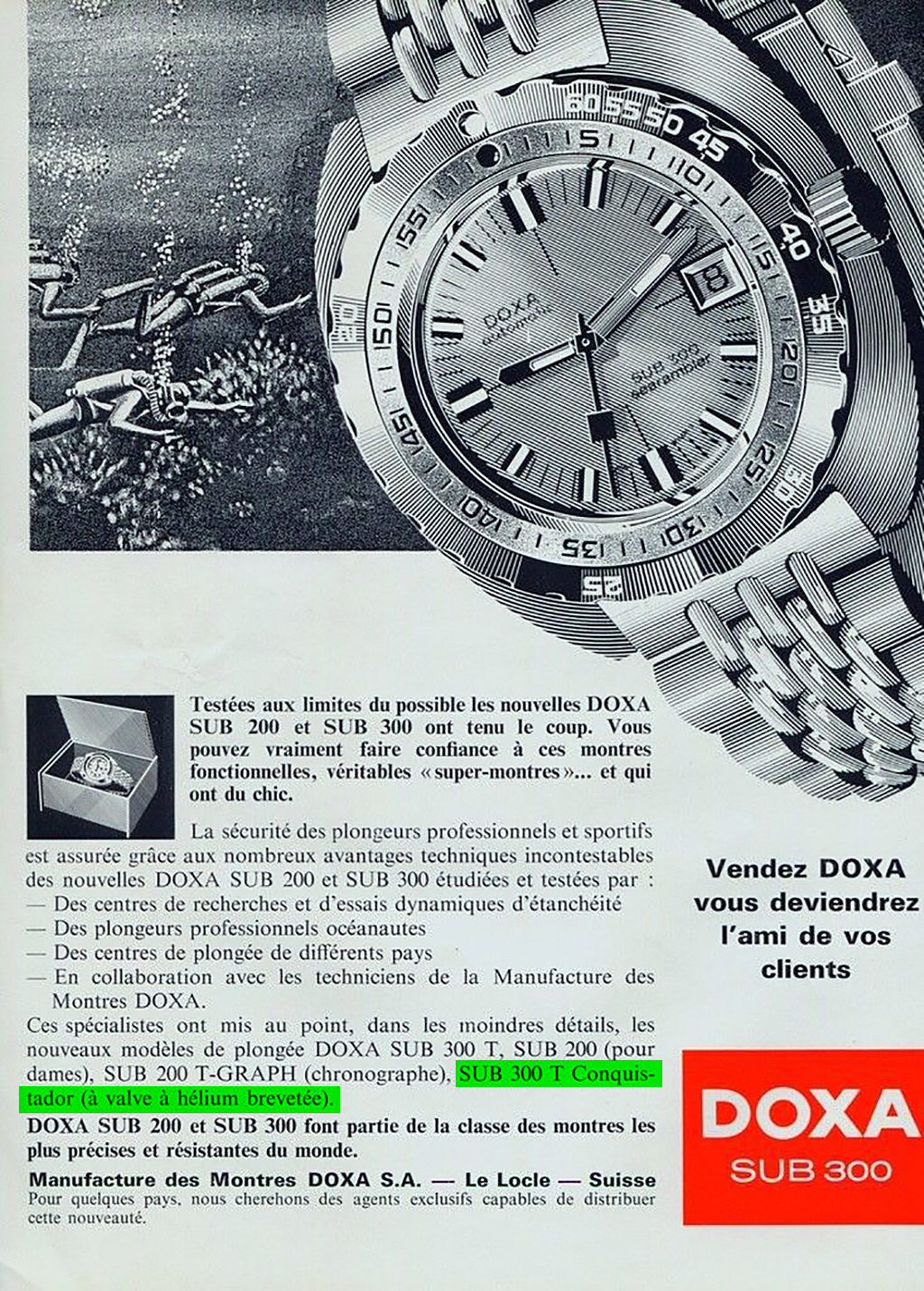
To conclude, an interesting observation worth sharing is how the Doxa valve evolved from the prototype stage to the serial product.

While the valve is visible in the front view on both the prototype (left) and the watch that was presented at the Basle Watch Fair in 1968 (center) on the left-hand side of the case, it is only visible in the side view on the final version.

Another interesting observation is that Doxa’s valve was more sophisticated that Rolex’s first, very primitive version, and was probably copied by Rolex for their second generation valve introduced with the Sea-Dweller Ref. 16660 in 1978, but that is discussed in my first article on the Doxa helium release valve, which I invite you to read.
Read more: The Doxa HRV
Thoughts
As with many other innovations and achievements falsely attributed to Rolex, the helium release valve was also not first introduced by the Genevean company. If anything, Rolex’s glory is to a big part the result of supercharged marketing hot air. Having a working prototype by November 15, 1967, makes clear that Doxa was way ahead of the game. Rolex filed their patent application on November 6, 1967, just 9 days prior to Doxa’s test. The concept for Rolex’s valve reached the Genevean company via an American diver named T. Walker Lloyd, who had heard of the idea during a conversation with U.S. Navy SEALAB Aquanaut Bob Barth. My understanding is that T. Walker Lloyd approached Rolex around the fall of 1967, and that the patent application was filed immediately without developing a prototype first, almost in a rushed way if you look at the primitive nature of Rolex’s valve concept. Tests were only conducted in late February/early March 1968, more than three months after Doxa. Given the new timeline that results from this relevation, and the fact that back then all these pioneer divers were in contact with each other, is it far-fetched to think that maybe Bob Barth heard of the valve, and that Doxa was working on a prototype, from his diver buddy Claude Wesly? I do not think so. If we look at was was written about the valve in the widely flawed Rolex Submariner book by watch industry hack Nicholas Foulkes, the origins of the Rolex valve is a black hole. No mention of Barth, nor Lloyd, and of course nothing about Doxa. Why Eschle talked about a shared patent remains a mystery. Somehow I am getting the vibe Rolex knew exactly what Doxa was working on, and rushed to file the patent application to snatch the idea from the competitor.
Thank you for your interest!
 Vintage Rolex and other iconic timepieces under the loupe at Perezcope
Thank you for your outstanding article and this fascinating history.
Trigger me to buy a Doxa Sub! – Joss Beaumont
LikeLike
Glad to see another article. It’s been a minute.
LikeLike
Owning both Doxa and Panerai, my sense is The Jenny Family tries to maintain the Doxa brand and value vs. Richemont finding ways to cut corners and boost profits. Thanks Jose.
LikeLike