
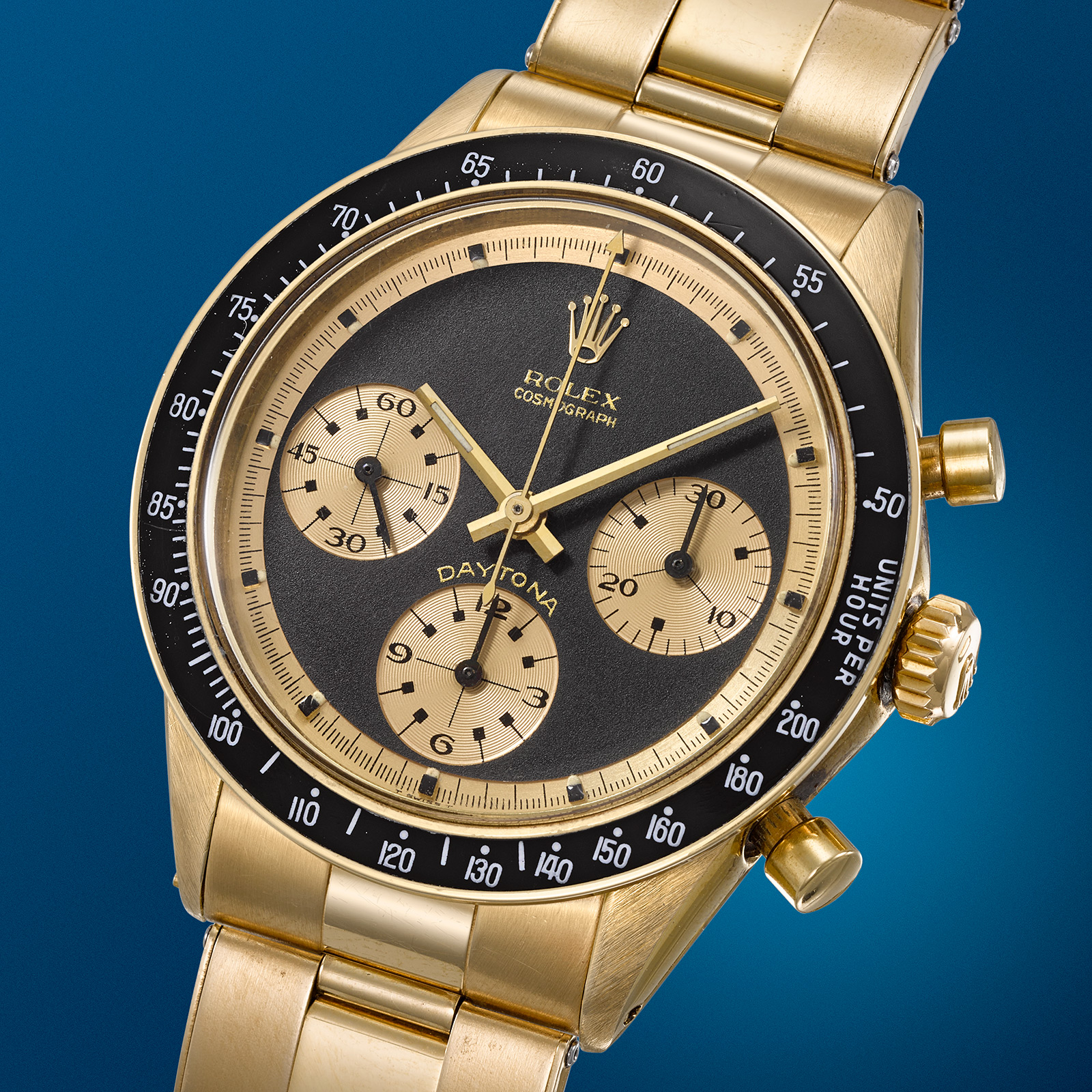
A Rolex Paul Newman Daytona ‘John Player Special Cherry’ (JPS Cherry) has never appeared at auction. Not in the past, nor in recent years, since they are known in the public sphere. For good reason. No serious auction house would accept such a risky consignment. The truth is, nobody really knows what ‘JPS Cherry’ dials are all about. Are they fake? Are they service dials? Are they a joke? After studying a bunch of ‘JPS Cherry’ dials in all their details, I can confidently say it is all of the above, but mostly a joke. And there are boxes full of them, in a drawer at the Swiss dial maker Singer. The watch specialists at Sotheby’s Hong Kong must be really desperate for wanting to unload this obviously made-up watch onto unsuspecting, super-wealthy collectors for an estimate of 1.5 to 3.5 million dollars. For starters, the bezel is fake, and the true nature of the ‘JPS Cherry’ will reveal itself once the details come to light. As for the consignor, I am sorry for having to write this article, but prospective buyers need to know what this watch is all about.
Update April 25, 2026
Yesterday, I had a phone call with the former head of Rolex’s Atelier de Restauration. He confirmed that the ‘JPS Cherry’ dials were service/replacement dials made by Jean Singer & Cie SA in 1995. I posted this update on my Instagram stories before the auction took place. Despite having learned the true nature of the dial and that the watch had a fake Mk1 bezel, Sotheby’s went ahead with the sale. The estimate for this lot was HKD 12,000,000 – 28,000,000 (USD 1.5 – 3.5 million). The watch fetched a hammer price of only HKD 9,000,000, totaling HKD 11,520,000 (USD 1.47 million) including fees. Not even the low estimate. The gavel came down quickly; in less than 30 seconds, it was done. Sam Hines, for whom I lost all respect after this episode, did not wait for further bids as he would normally do. It looked orchestrated. As for the gullible buyer—if there was one to begin with—it sure appears someone did not get the memo.
LOT 2400 – Rolex Cosmograph Daytona ‘Paul Newman John Player Special Cherry’, Reference 6264, 2802702
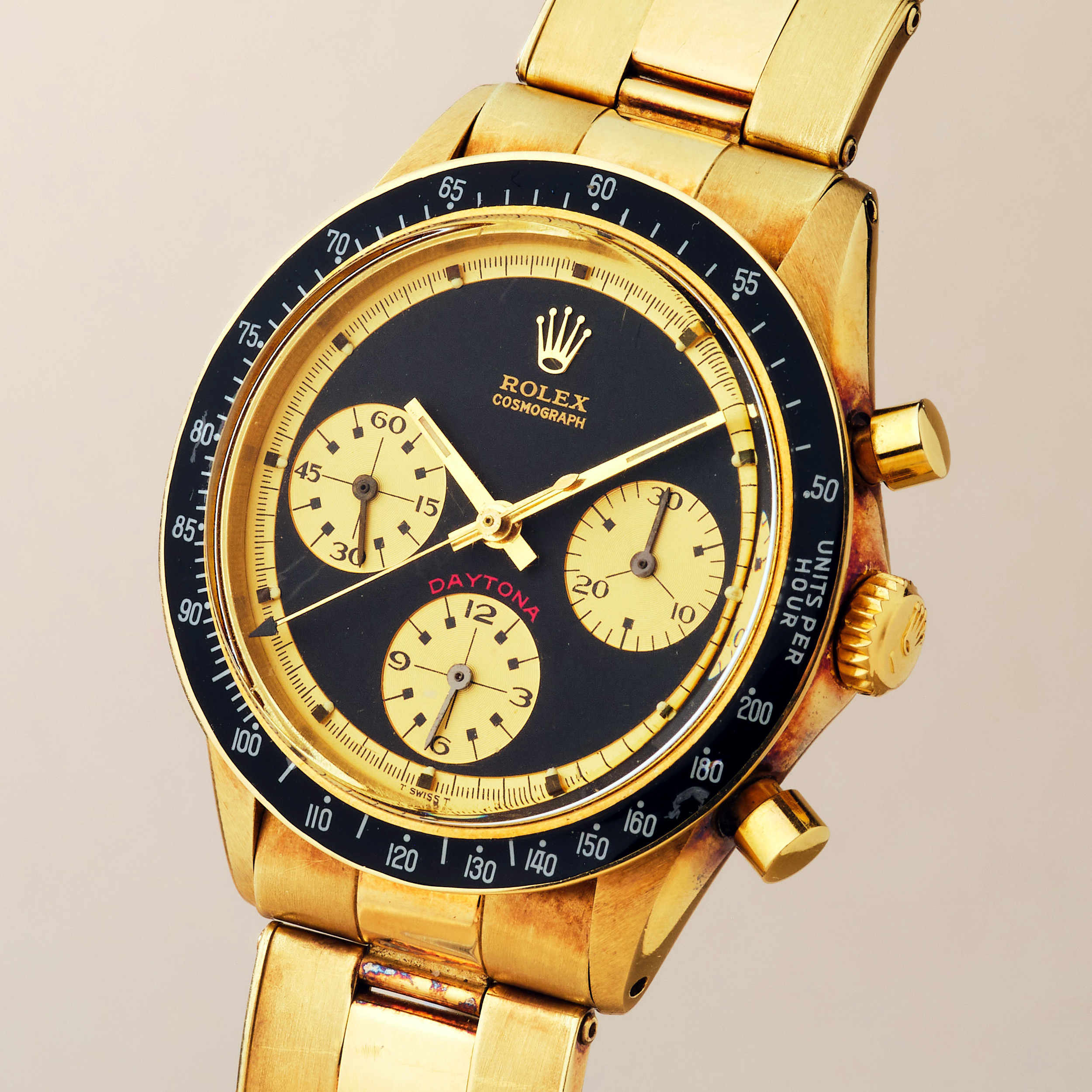
Auction link: Lot 2400 – Rolex Cosmograph Daytona Paul Newman John Player Special, Ref. 6264 (sothebys.com)
First things first. What is a Rolex Paul Newman Daytona ‘John Player Special Cherry’ (JPS Cherry)? It is a gold Cosmograph Daytona featuring the highly coveted ‘Paul Newman dial’, nicknamed after American actor Paul Newman, who wore a stainless steel example in the 1970s.

Also known as ‘exotic dial’, the dial is characterized by an Art Deco-style font, a contrasting outer minute track, and subdials with square-topped ‘lollipop’ markers. Just recently, Rolex paid tribute to the ‘Paul Newman dial’ with the release of the ‘Le Mans’ Daytona in 18k white gold and 18k yellow gold.
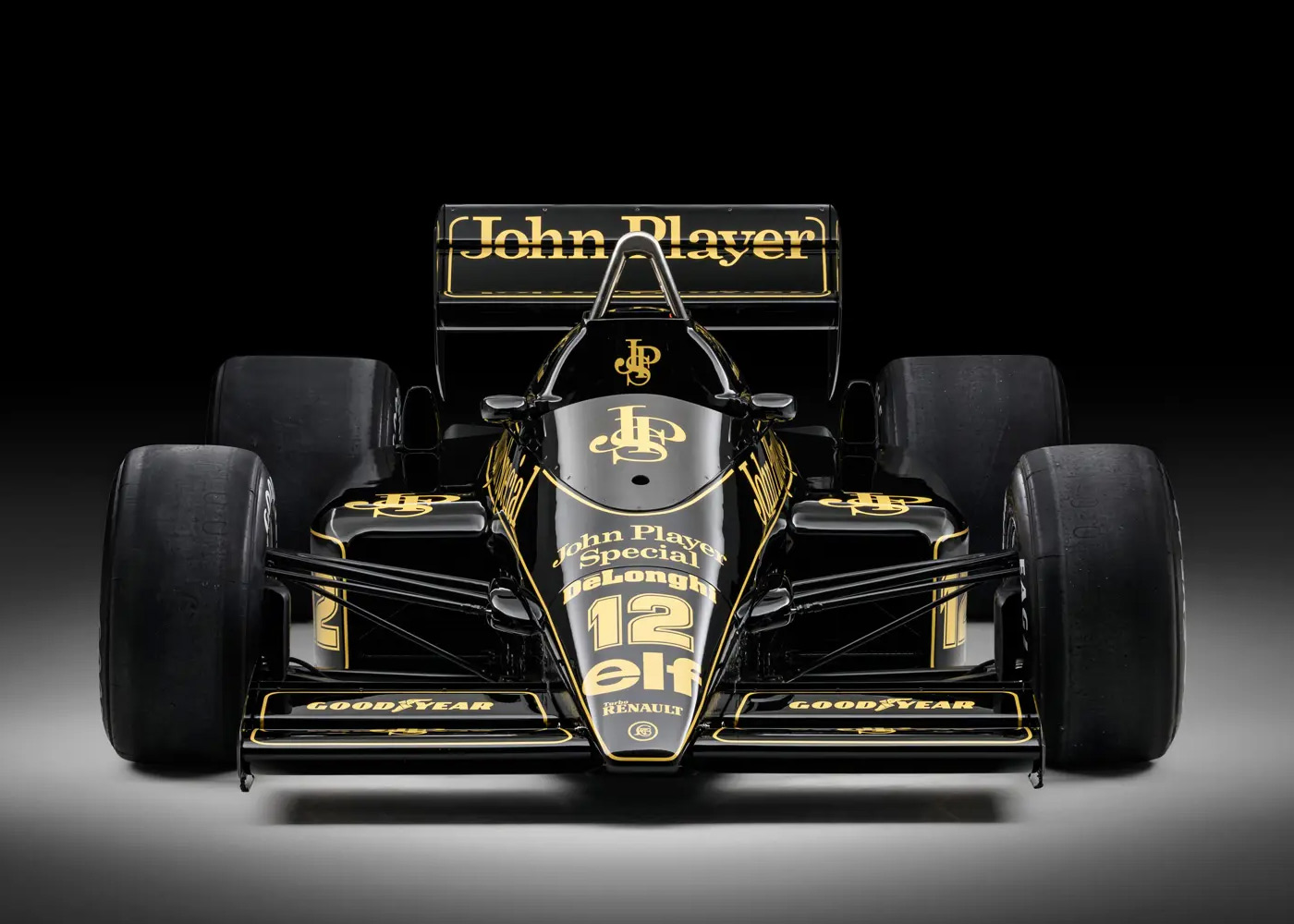
The ‘John Player Special’ version of the dial can be found on gold pump pusher Daytonas with either 14k or 18k gold cases. The nickname ‘John Player Special’ or ‘JPS’ was coined by British watch dealer Tom Bolt, aka WatchGuru (IG: @watchguru_), as the colours correspond to the iconic black and gold of the Formula 1 Lotus cars of the 1970s and 1980s which were sponsored by the cigarette brand John Player Special.
A Fake Bezel
With the origin story of the nickname covered, let’s dive right in. The Mk 1 bezel of the present watch is an elaborate fake. As shown in the comparison below, there are some obvious flaws.
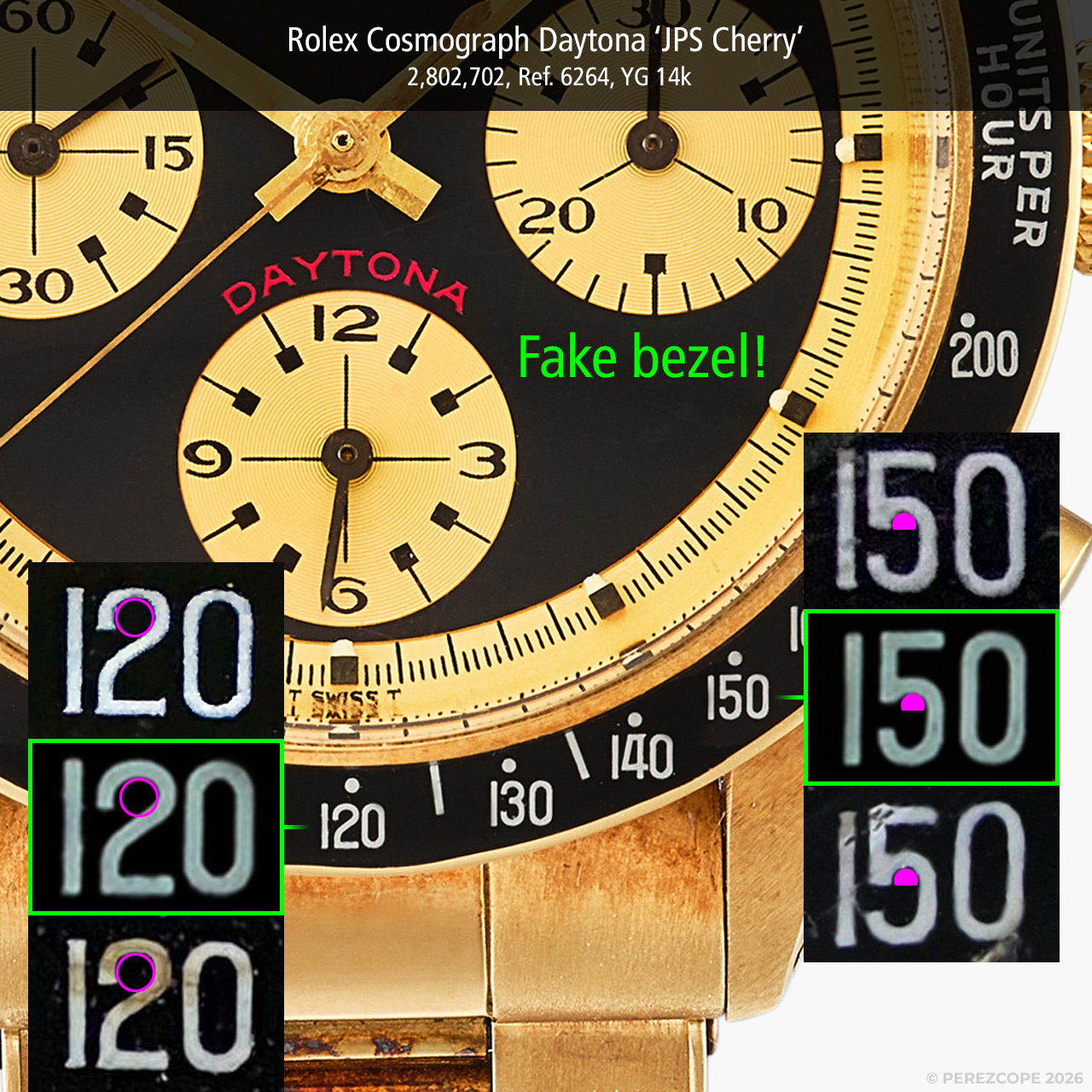
I am not going to point out all the errors to avoid giving counterfeiters too much information, but there is one particular detail that immediately exposes this bezel as a fake. If you know, you know. Having said that, let us now explore the timeline and the interesting details of ‘JPS Cherry’ dials.
What is a ‘JPS Cherry’ Dial?
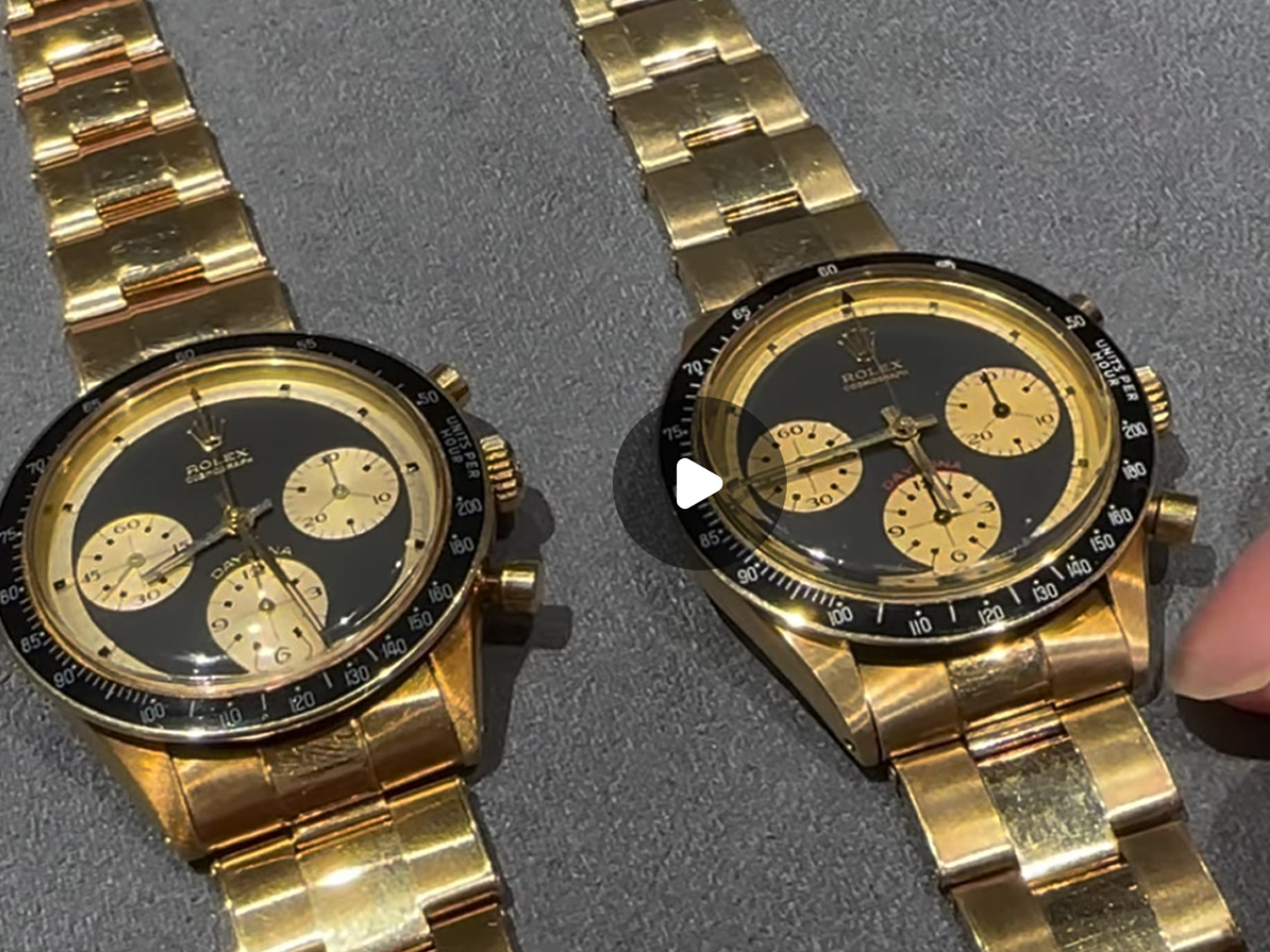
In 2016/2017, American dealer Bob Maron found a curious variant of the ‘JPS’ dial. Instead of the usual gold-printed ‘Daytona’ above the subdial at 6 o’clock, the newly discovered variant featured a red-printed ‘Daytona’, as shown in the comparison below.
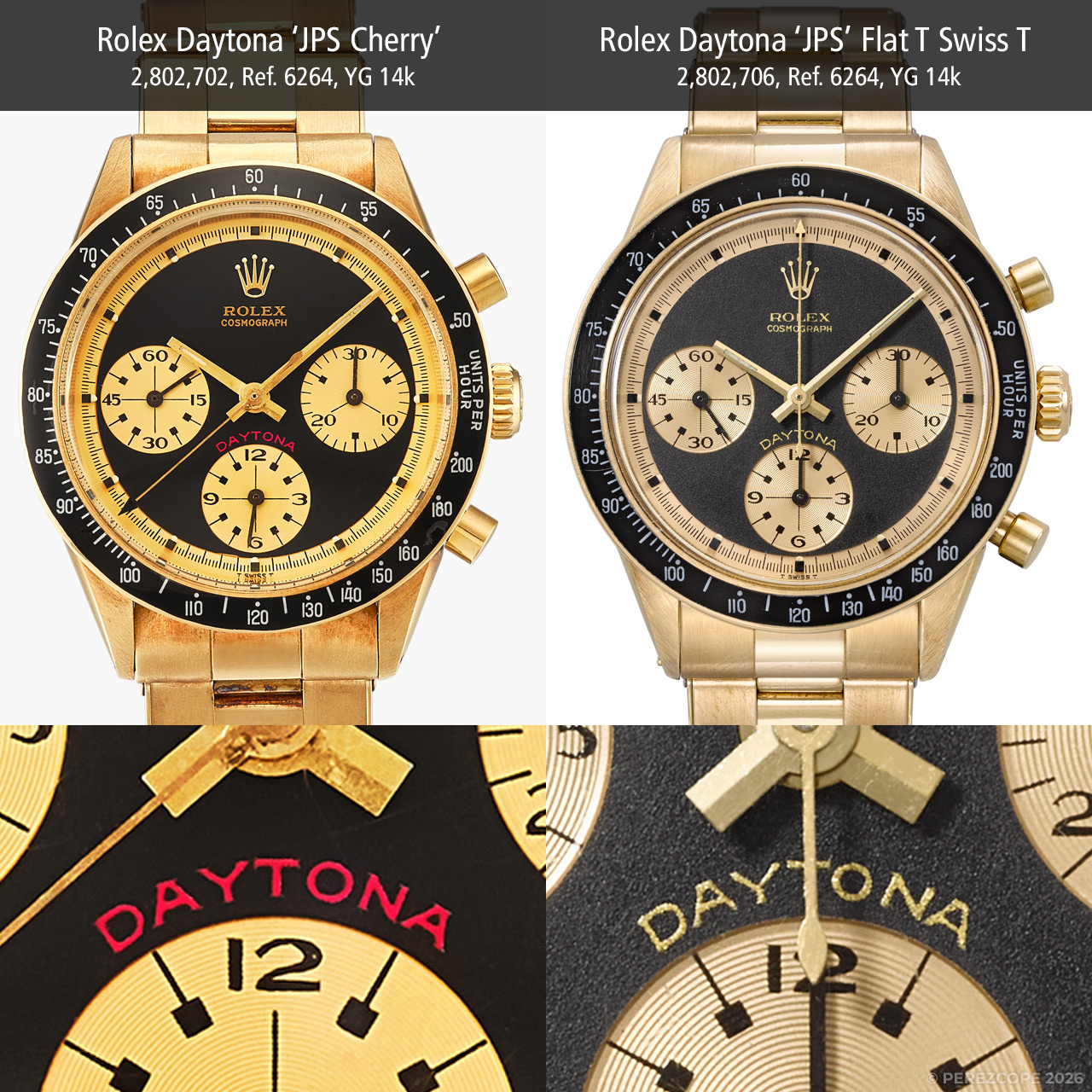
As the comparison suggests, the subdials and the outer minute track of the ‘JPS Cherry’ are a different colour than the correct ‘JPS’ dial with ultra rare flat T Swiss T found in this case number range. In a video published by Sotheby’s watch specialist Carl Chen on Instagram (see screenshot below), the difference is well visible. Some people call the ‘JPS Cherry’ an inverted ‘Lemon’, as the colour is apparently very similar when viewed next to each other. What is also visible in this screenshot is that the subdials and outer track of the standard JPS are more metallic-looking, which is the very attribute responsible for the ‘John Player Special’ moniker.
Coming back to its discovery around ten years ago, the ‘JPS Cherry’ dial was actually known since at least 2007, when a group of Italian watch enthusiasts was invited to visit the famous dial factory Jean Singer & Cie SA in La Chaux-de-Fonds, Switzerland. Stefano Mazzariol, prominent watch dealer and owner of the super useful Mazzariol Library, documented the trip. During the tour, the Italians were shown drawers full of service dials, many of which were ‘Paul Newman’ dials. Packed in boxes à 27 pieces each.
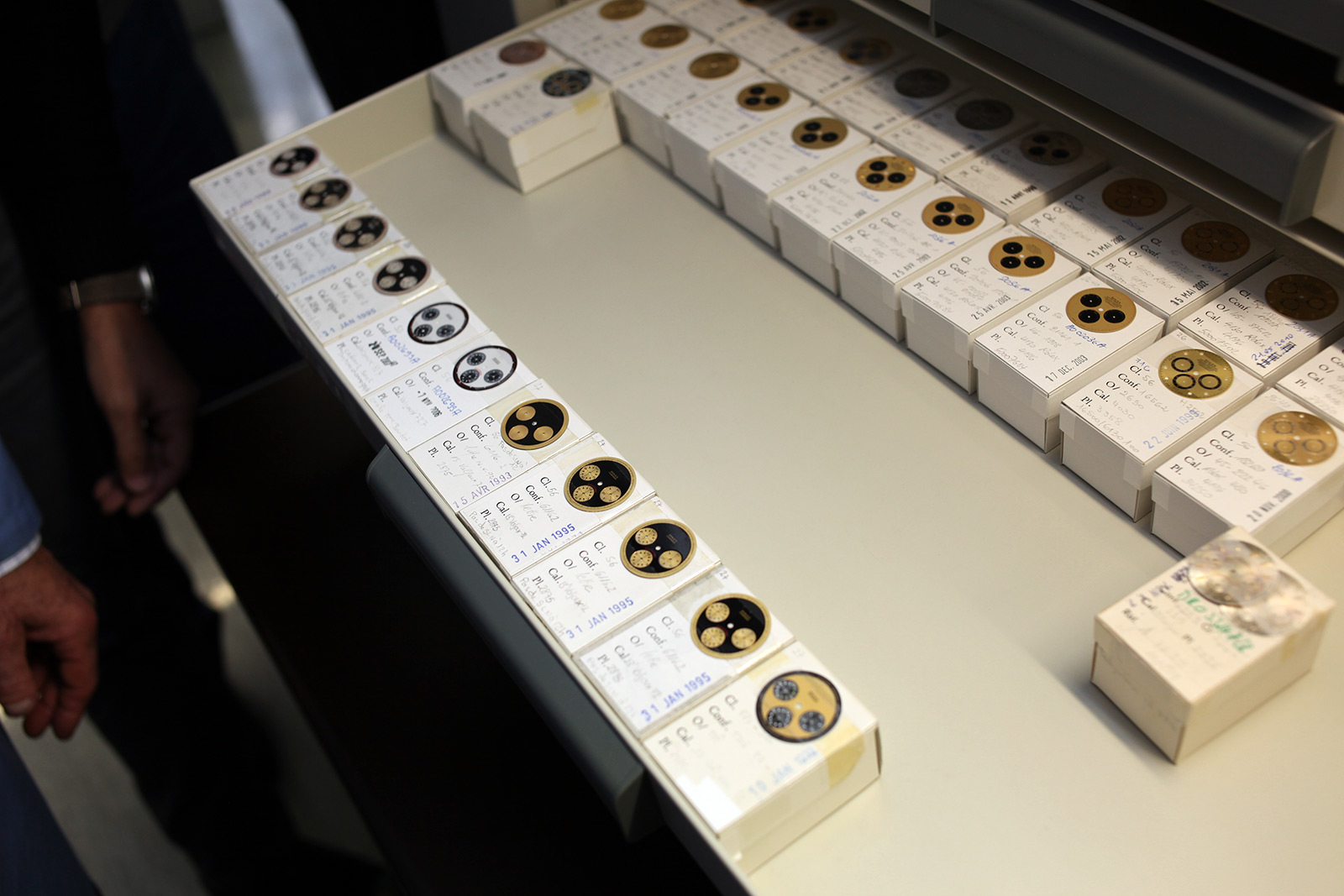
Let us go closer. Note the production dates on the boxes. Note also what is handwritten at the bottom of some of the labels. “Pas de SLN à 12h.” French for ‘no Super LumiNova at 12 o’clock.’ Interesting! ‘Paul Newman’ dials do not feature a luminous dot at 12 o’clock.
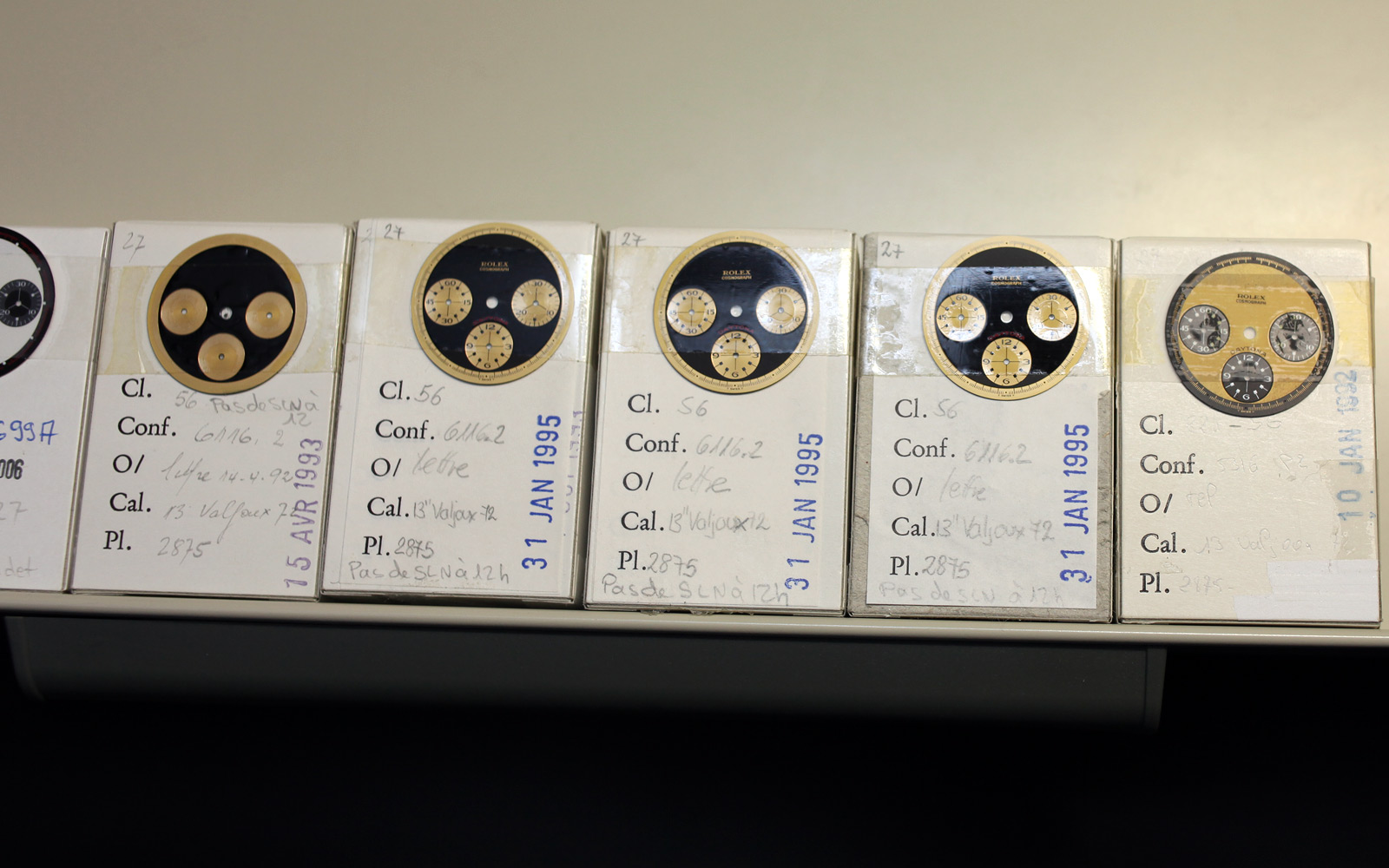
If we zoom in a bit more, voila! This is without a doubt a ‘JPS Cherry’ dial! And when was it made? Check the date. January 31, 1995. There were three boxes full of ‘JPS Cherry’ dials at Jean Singer & Cie SA at the time. Note that these dials were unfinished. The applied hour markers and Rolex crown were missing. Keep this in mind for later.
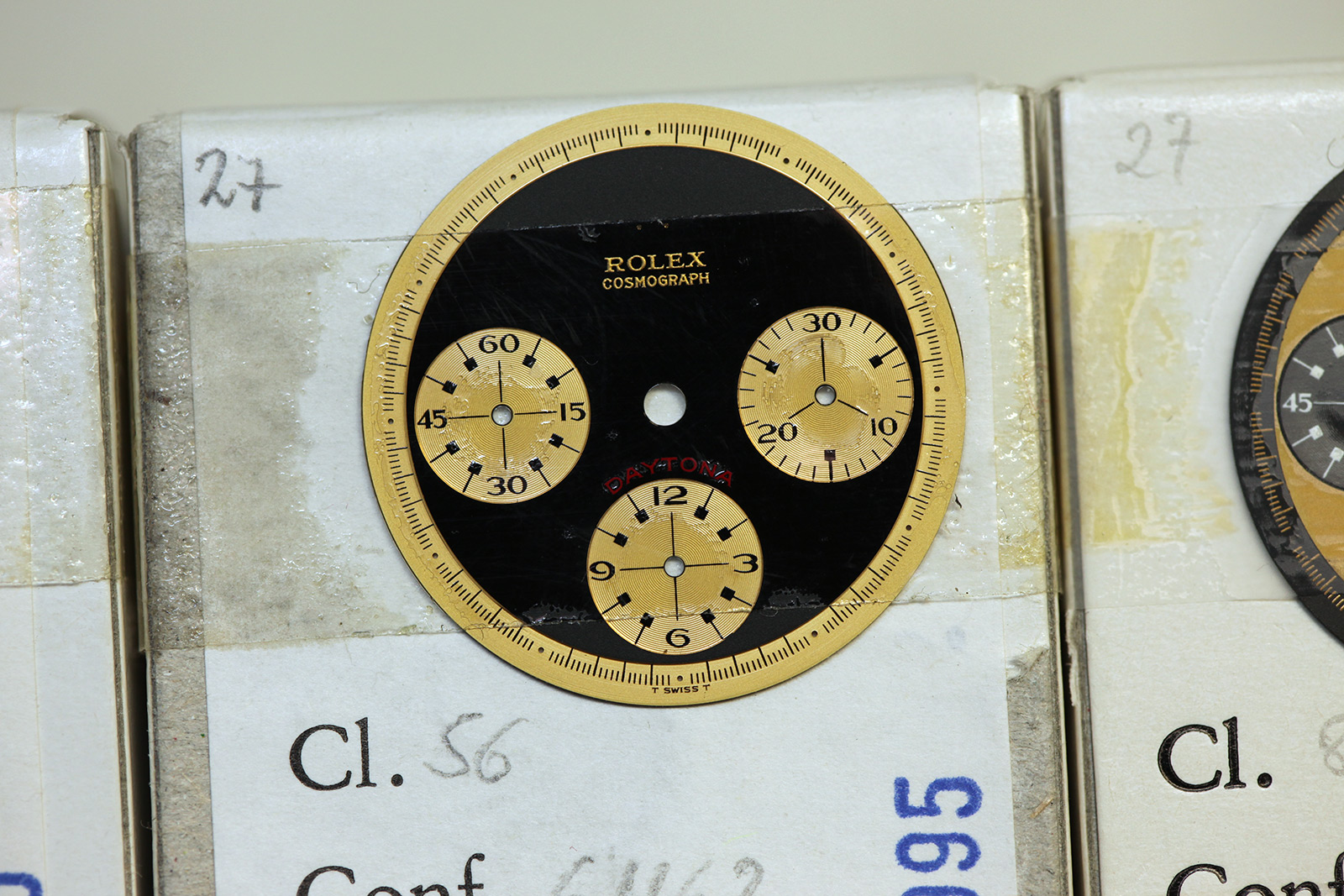
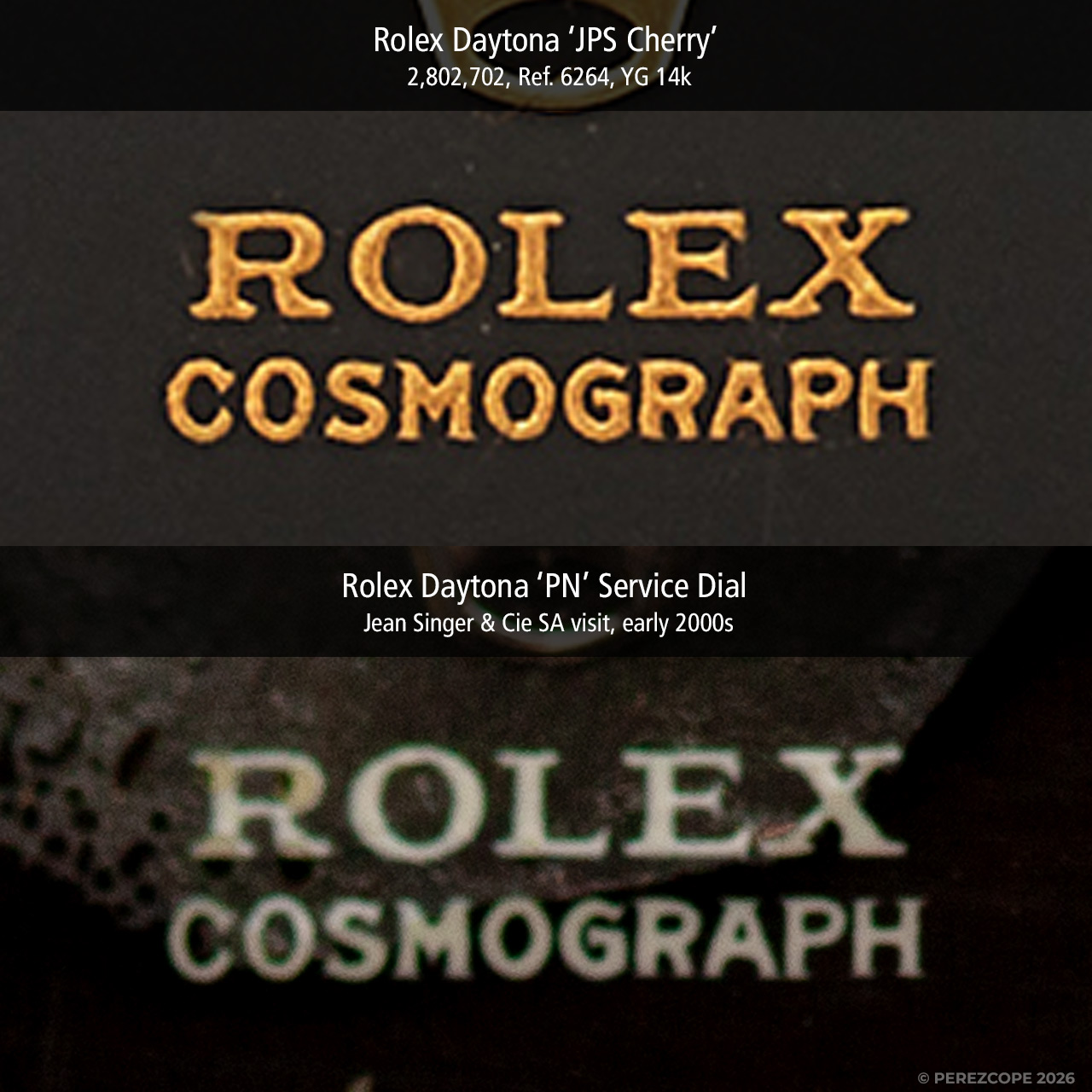
There can be no doubt that this is the same dial type. Everything matches, down to the E in Rolex with the longer bottom arm.
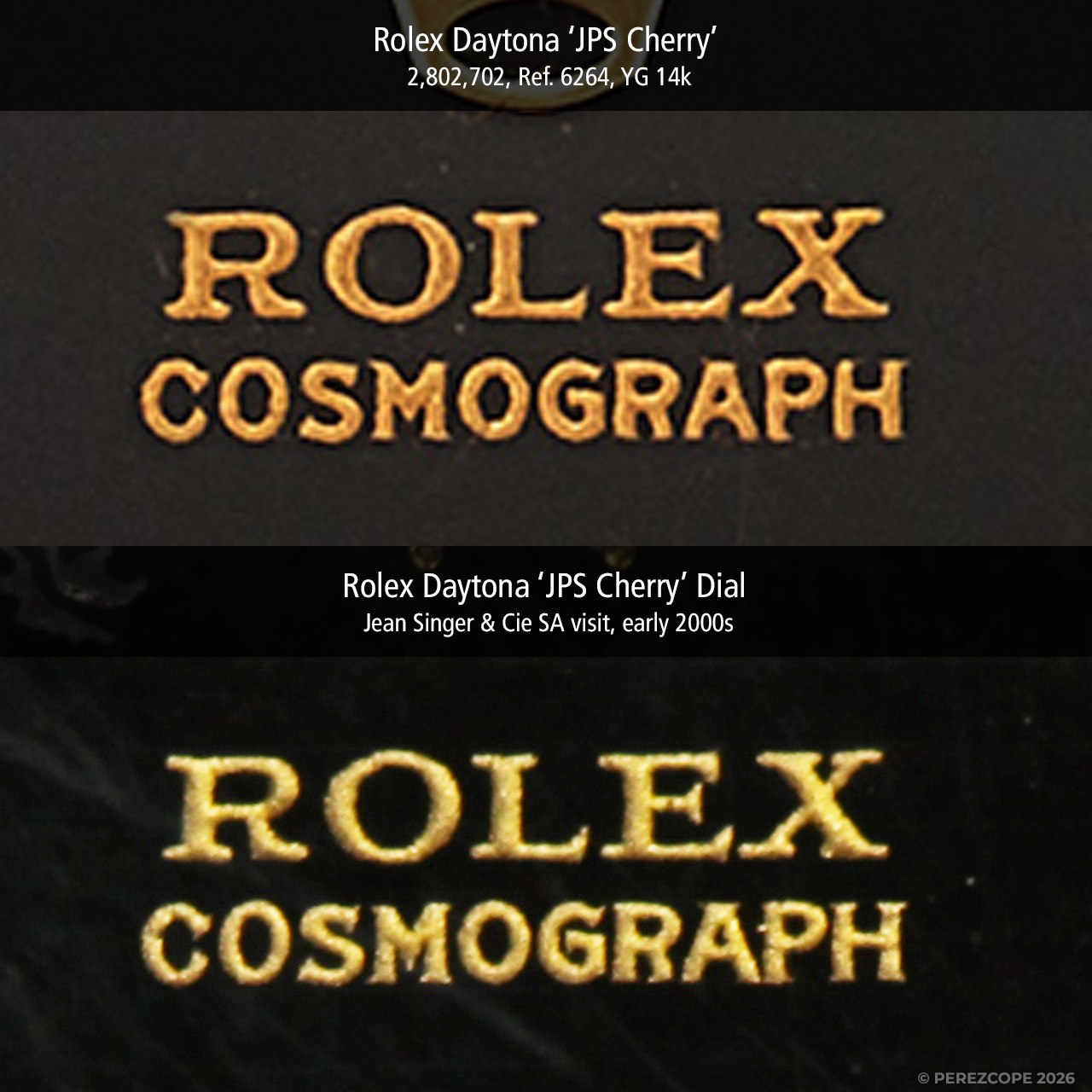
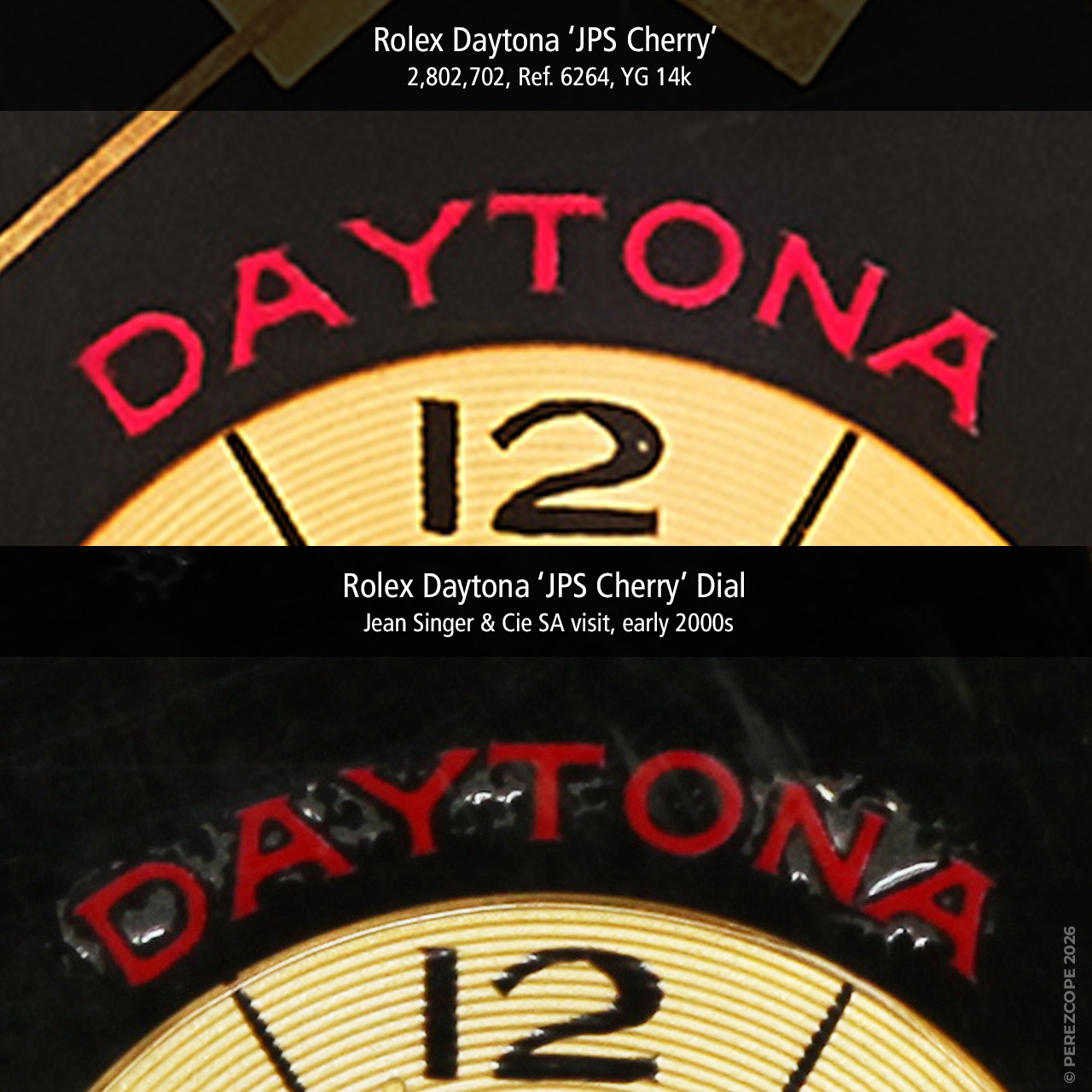
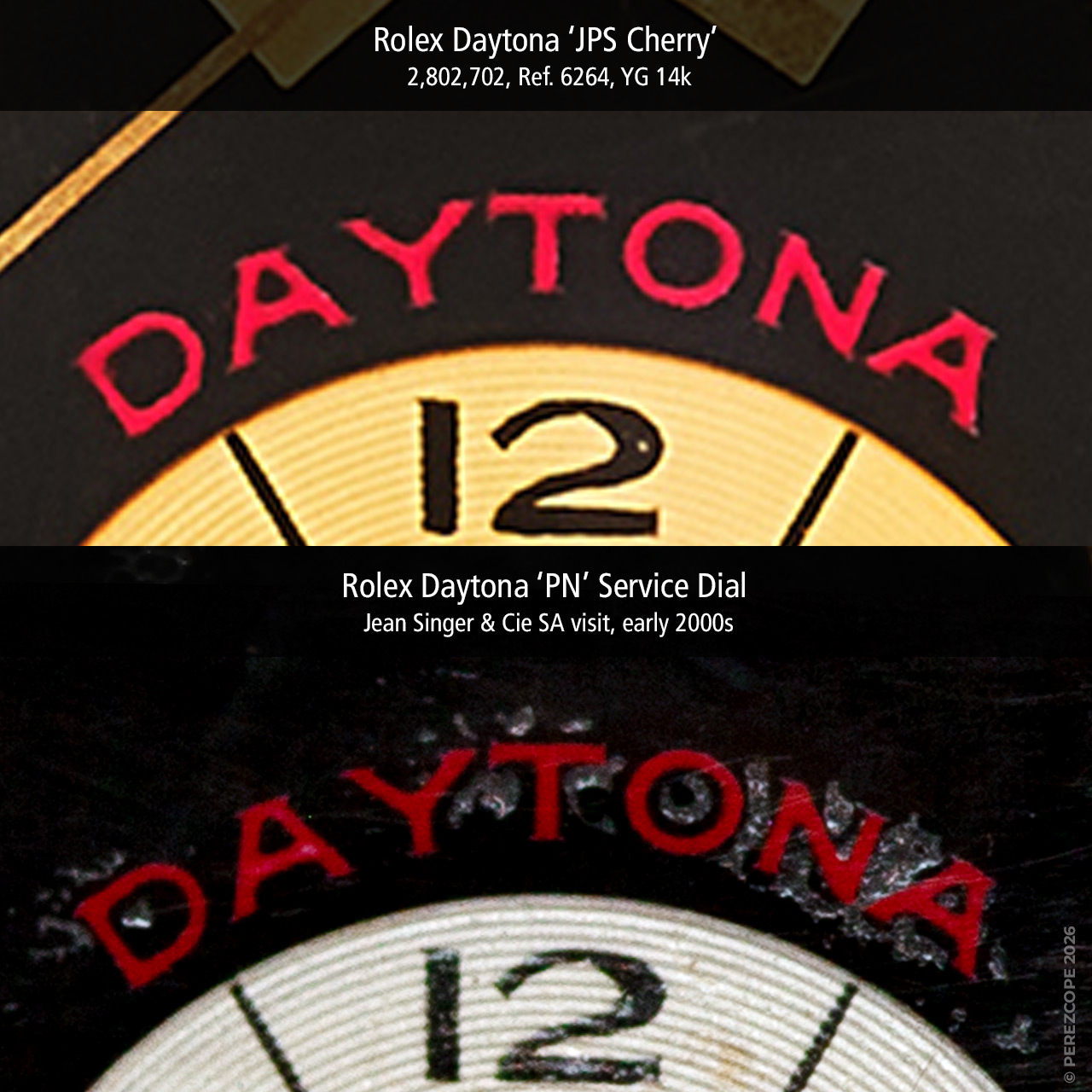
The ‘Daytona’ print is also a perfect match, including the weird spacing between the A and the Y of ‘Daytona’.
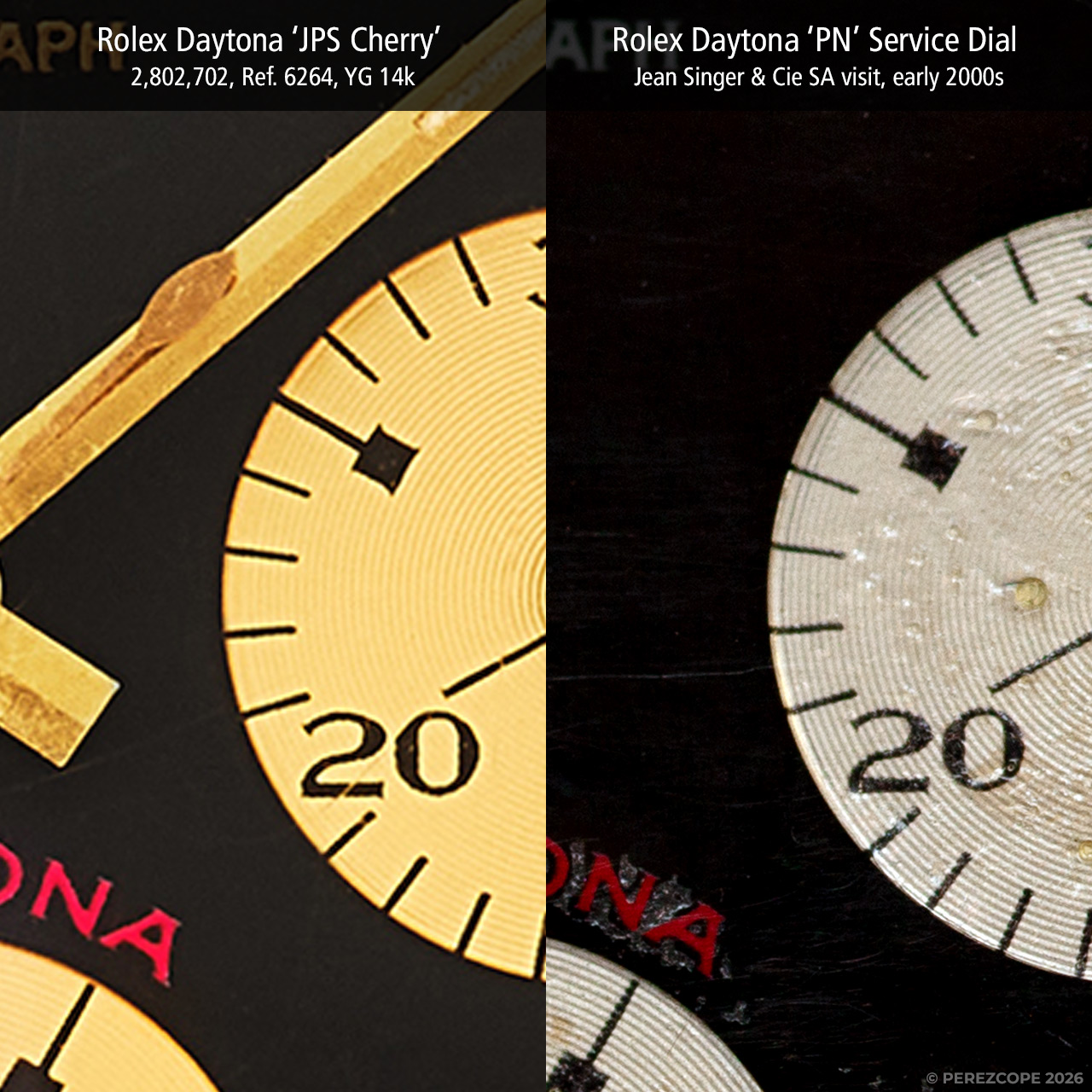
In the late 1960s, Rolex introduced Paul Newman dials that featured a slightly different-shaped 2 in the 30-minute subdial at 3 o’clock. However, some dials retained the old 2.
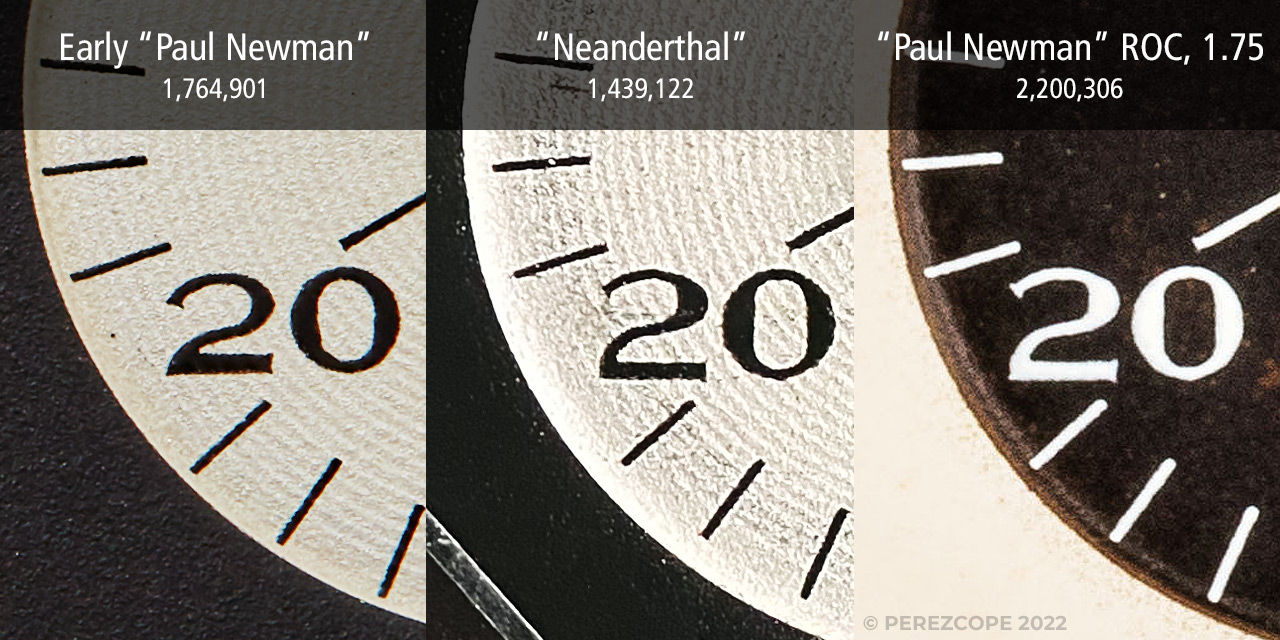
Both the present ‘JPS Cherry’ and the dial seen at Singer feature the 2 of 20 with the new shape.
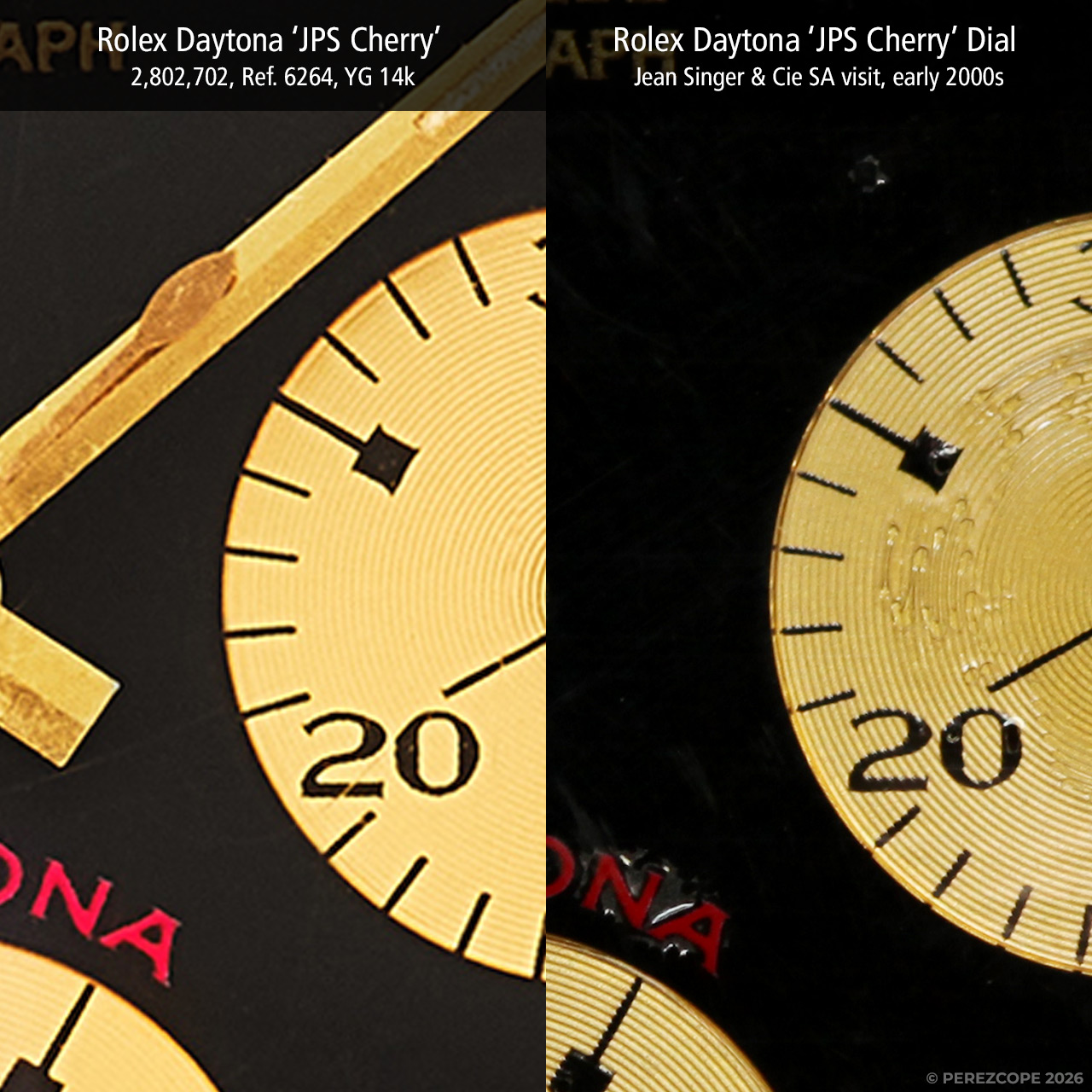
Now, Sotheby’s referred to the factory visit in their auction catalogue and even published some low-resolution versions of the above pictures:
“Rarely seen publicly, the JPS cherry has only occasionally featured in reference books and online archives. Further research shows that some 20+ years ago a small group of early vintage Rolex collectors were afforded a tour of the Singer factory, and images from that trip included an example of the JPS cherry within Singers own archives.”
However, nowhere in Sotheby’s catalogue essay is it mentioned that the dials seen at Singer were actually service dials. Sotheby’s also published a picture of the dial’s back. A comparison with a correct ‘JPS’ dial with flat T Swiss T, found only 5 case numbers away, and other dials with earlier and later case numbers shows that the Singer punch is considerably smaller. It is certainly not period-correct.
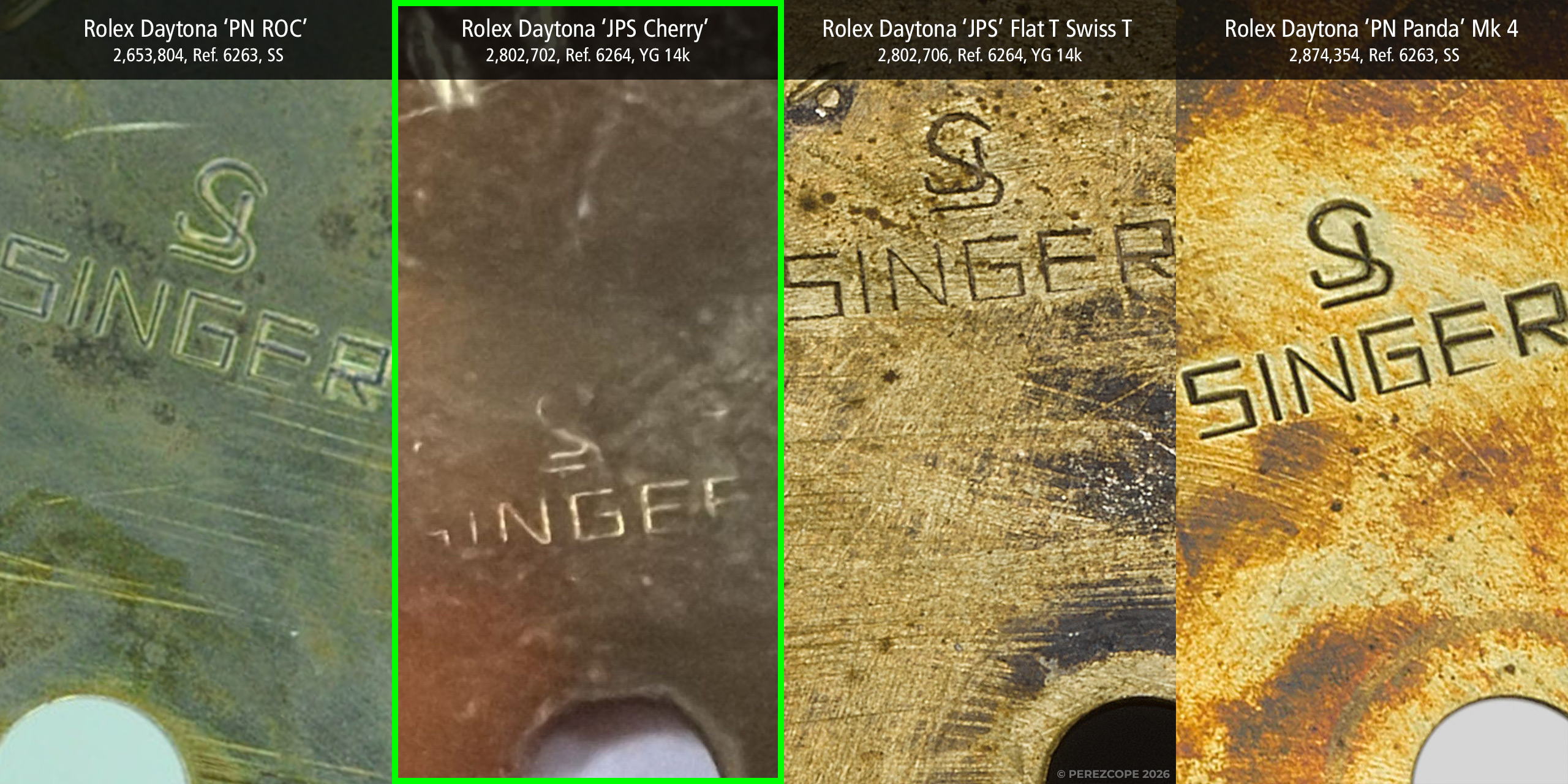
The quality of Sotheby’s picture was so bad that I had to request a better one for this investigation. On the third attempt, they finally managed to provide a so-so image of the punch.
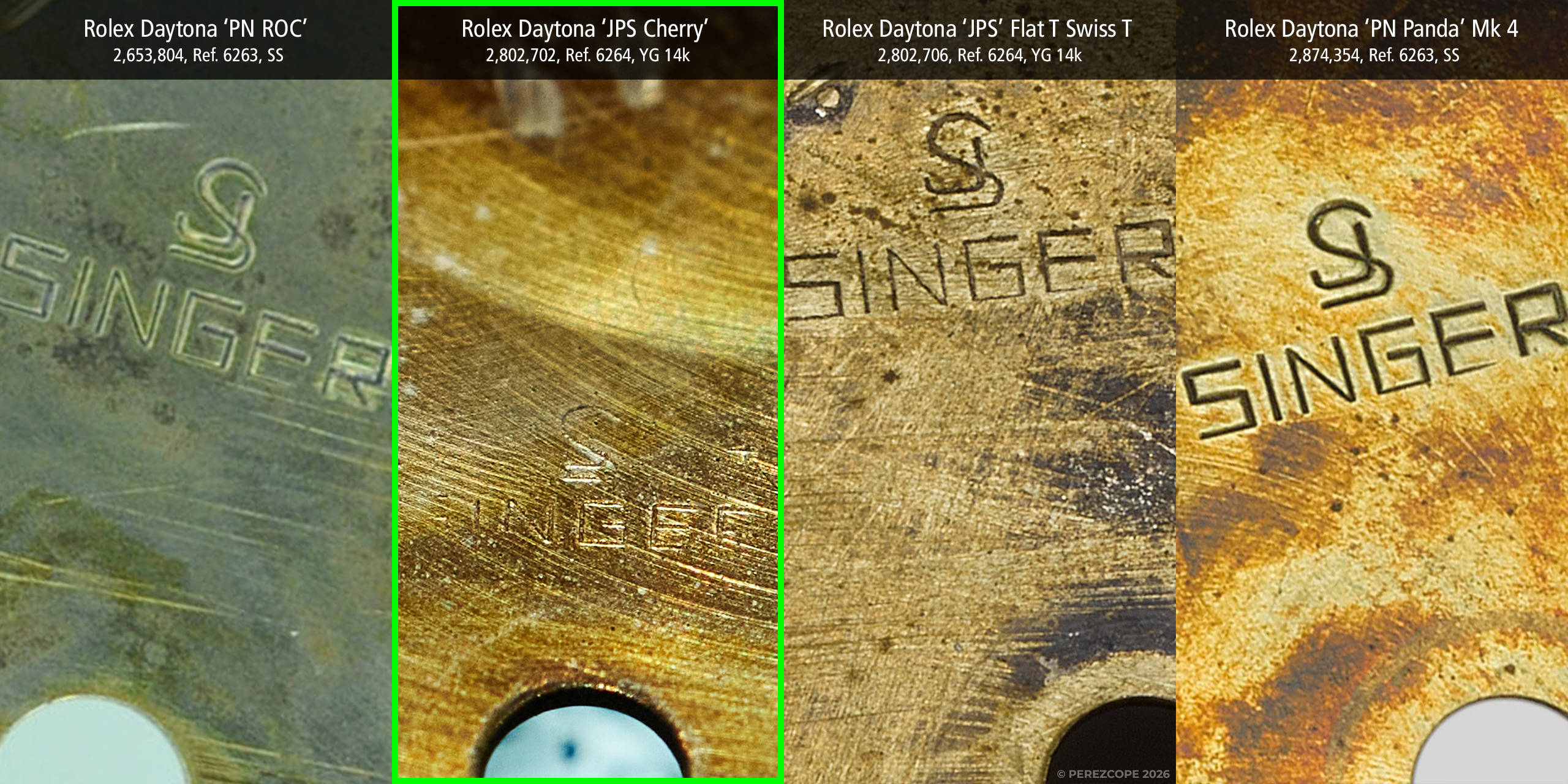
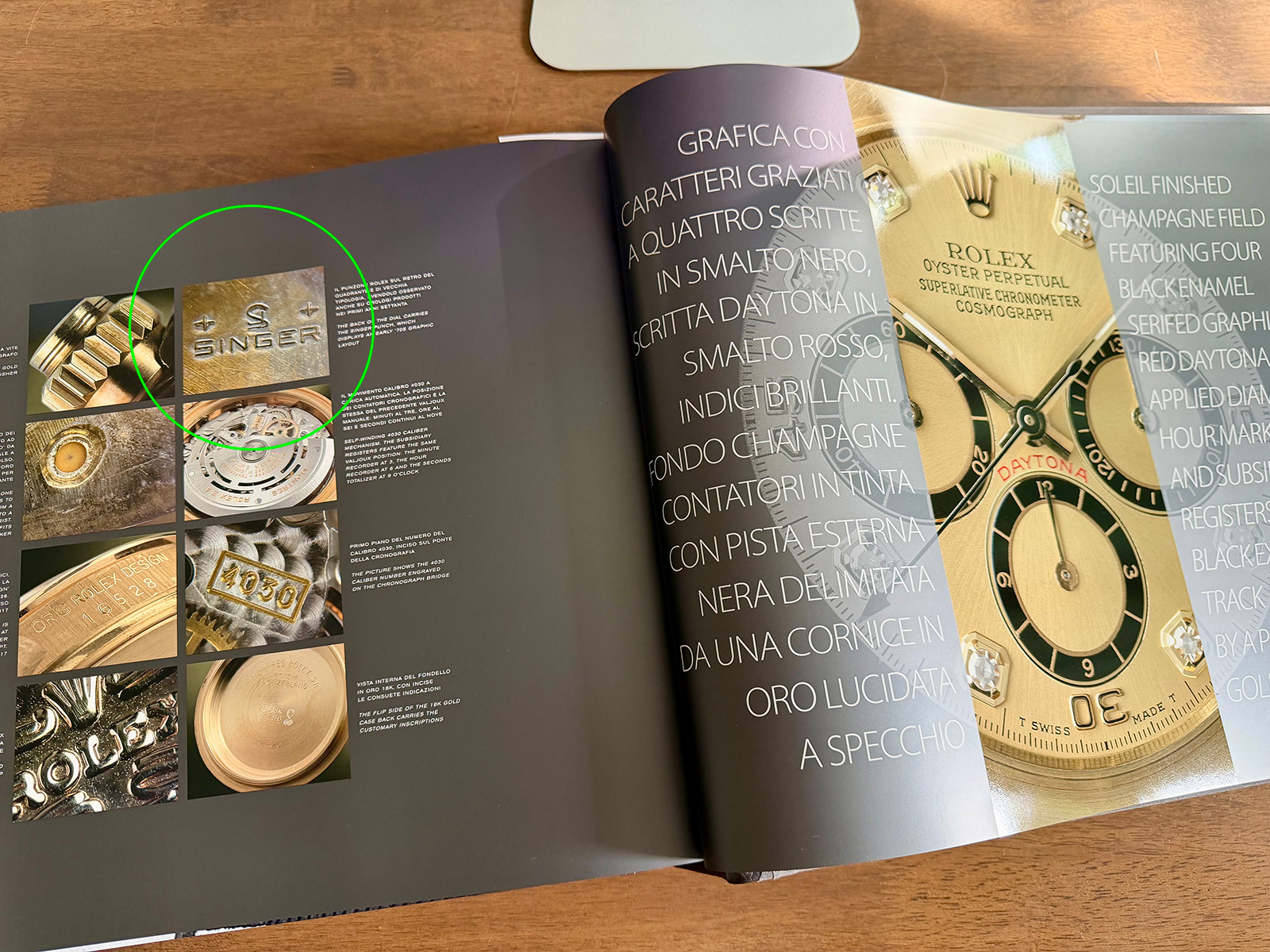
Thanks to this new image, it is now clear what kind of punch it is. The stamp is not well-defined, probably due to a worn out punch, but it is real, with two plus signs to the left and right of the SJ monogram. It can be found on dials from 1973 onwards and was used until well into the 1990s. It is important to note that this type of stamp has never appeared on Paul Newman dials other than the ‘JPS Cherry’. In Pucci Papaleo’s book Ultimate Rolex Daytona, on page 578, this same stamp appears on a Zenith Daytona Ref. 16528 with a champagne dial and stones from the early 1990s.
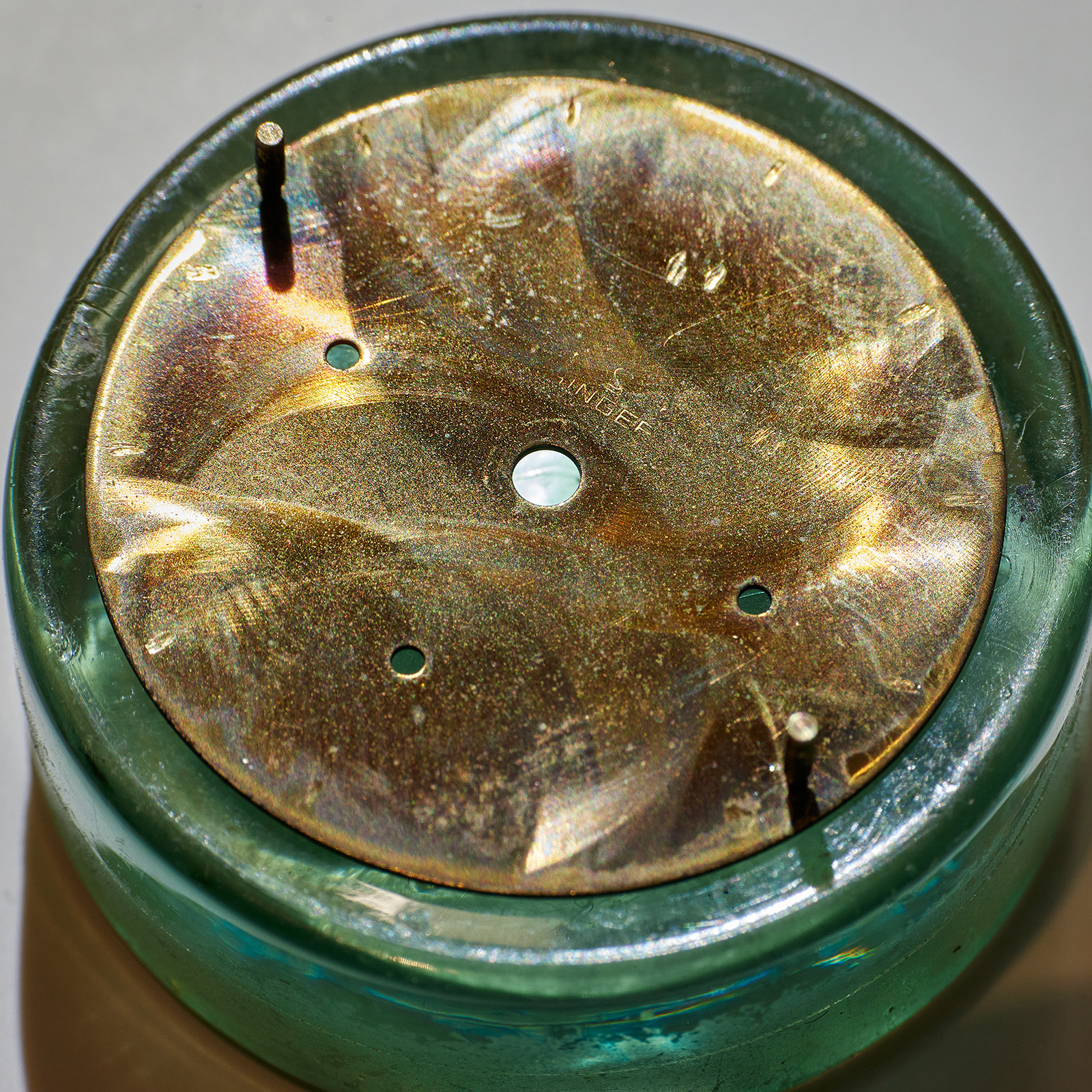
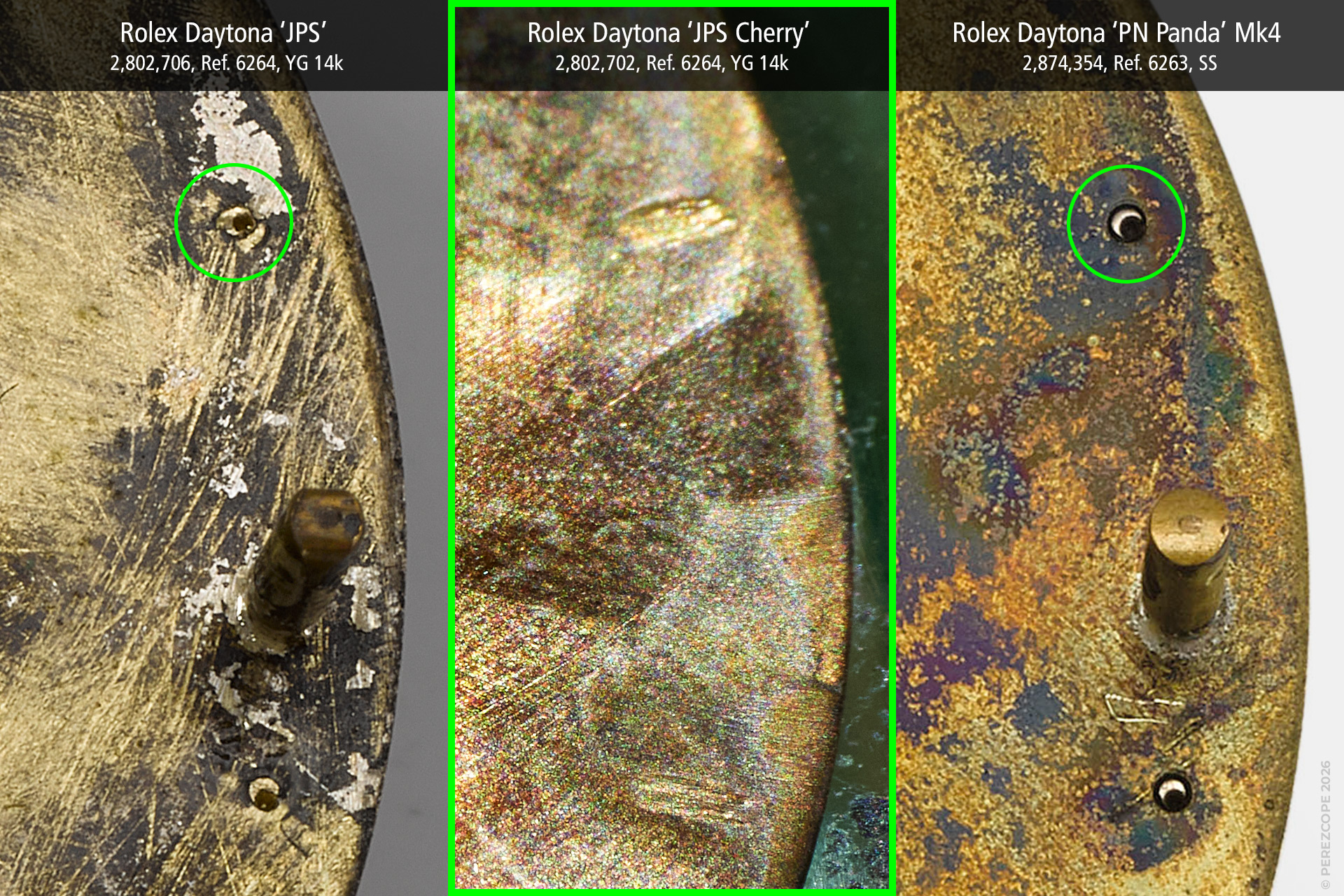
Another important detail to consider on the back of the dial is how the hour markers are attached. The following picture shows that on the present dial, the protruding hour marker pins that go through the dial plate were ground down with a rotary tool, in a rather rough way.
The comparison below shows that, in contrast, on period-correct dials, Singer fixed the pins with great precision and cleanliness.
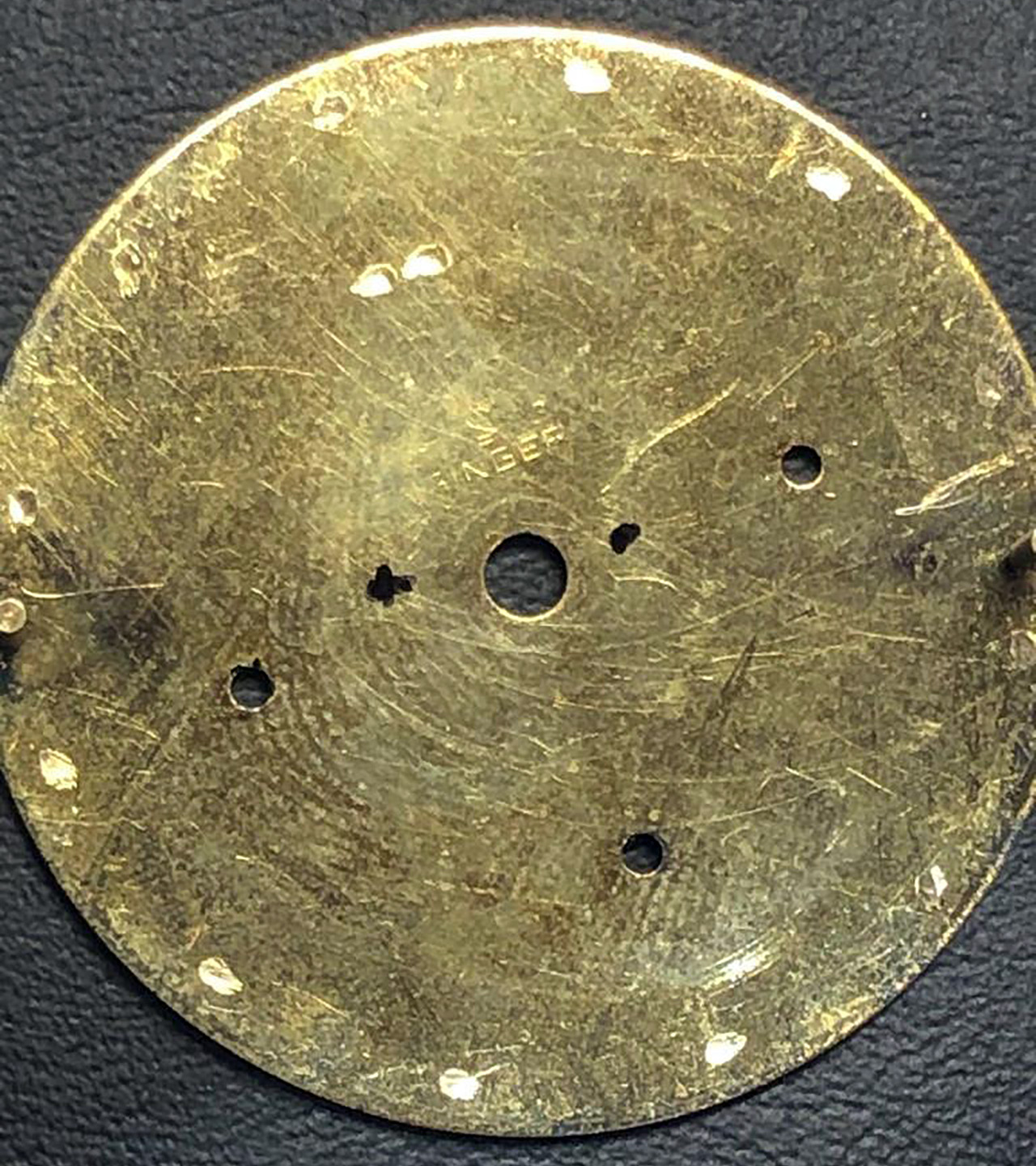
Remember that the ‘JPS Cherry’ dials seen at Jean Singer & Cie SA in 2007 were unfinished? Bob Maron sent me a picture of the back of one of the ‘JPS Cherry’ dials he found. On that dial, the hour markers are attached even more messily than on the present watch. One would expect these dials to have been produced in one go and finished in the same way.
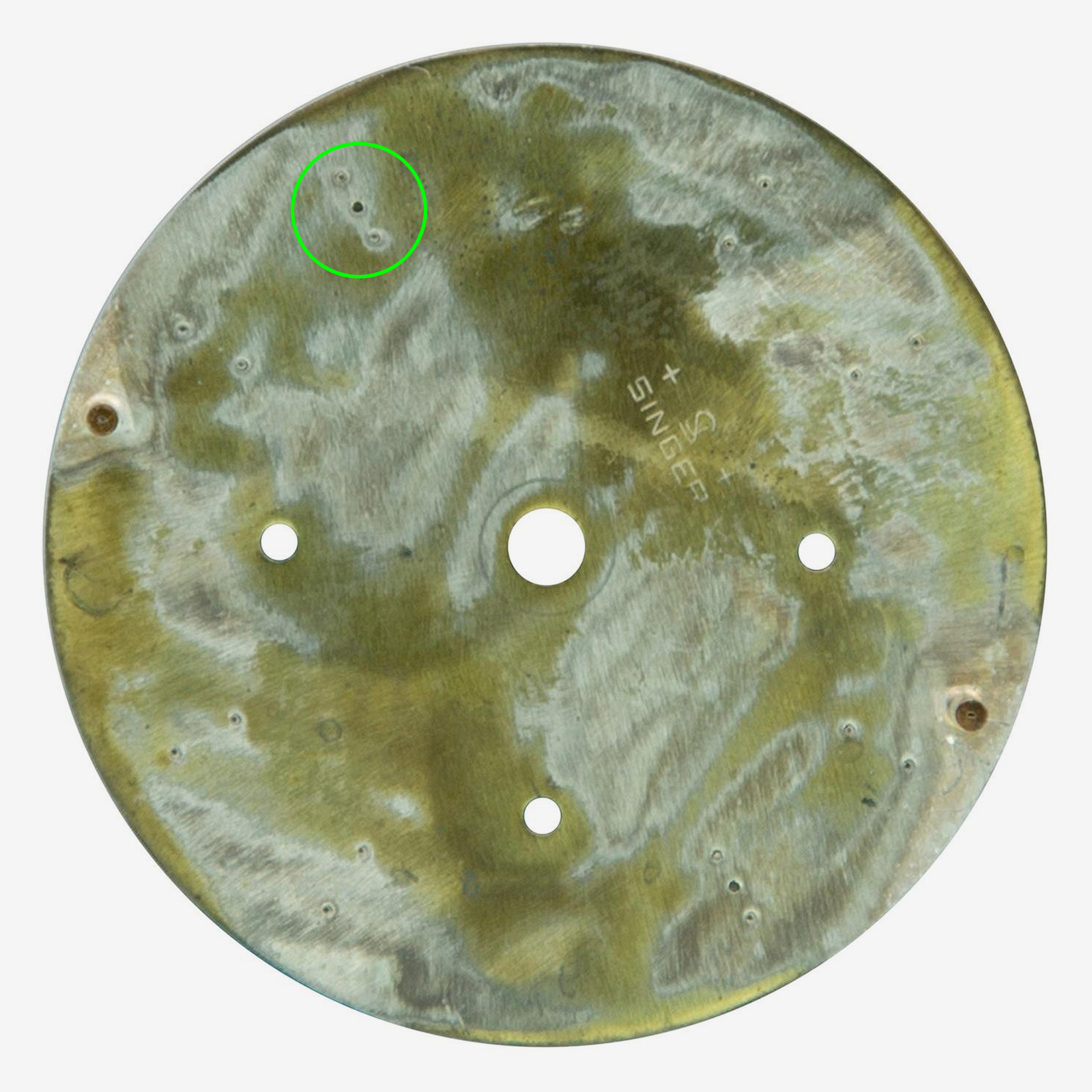
The next picture shows a ‘Big Red’ Sigma dial from around 1977. The Singer stamp with the two plus signs is the same as on the present watch, but more well-defined. The hour marker attachment follows the same pattern as shown in the comparison above. Precise and clean, not ground down and rough.
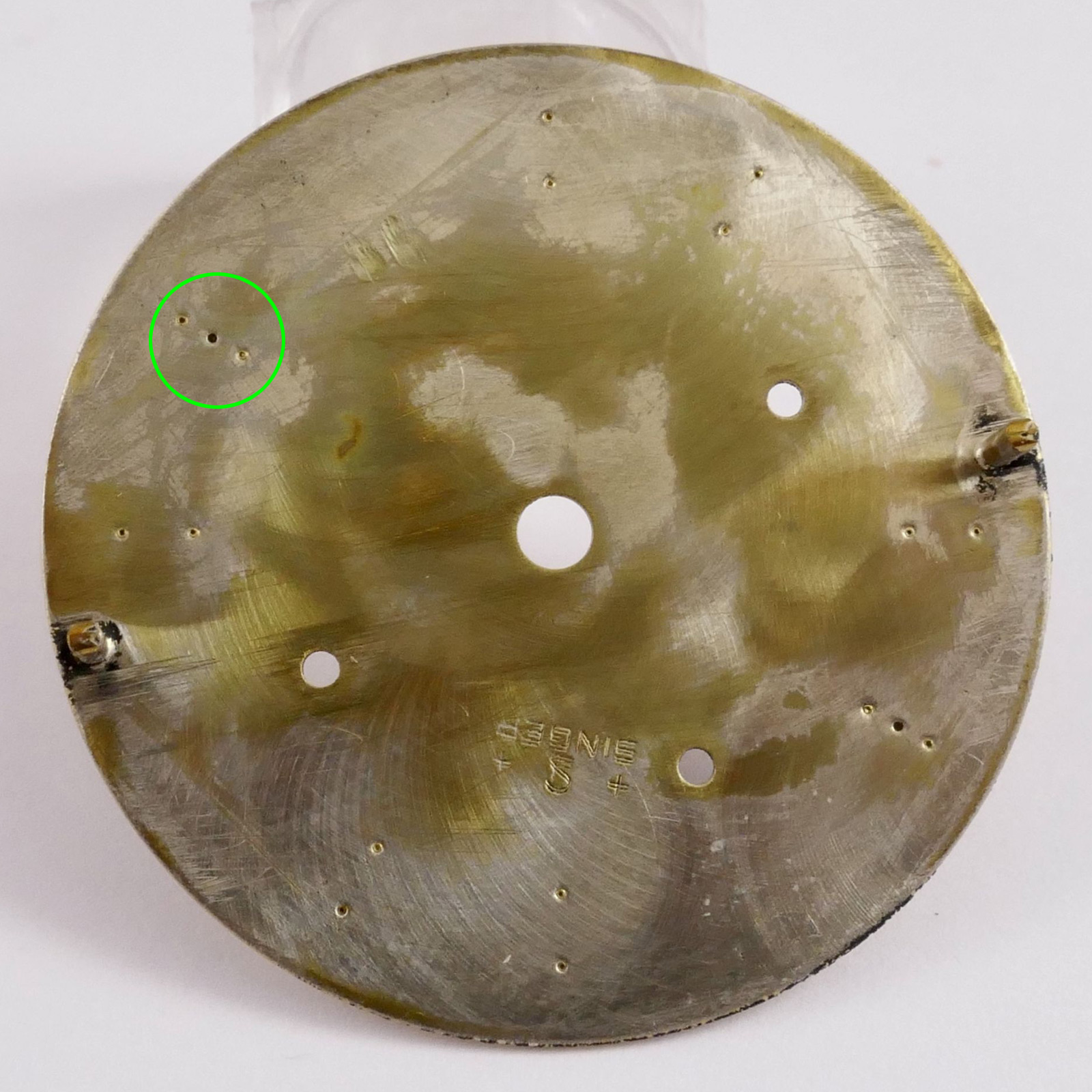
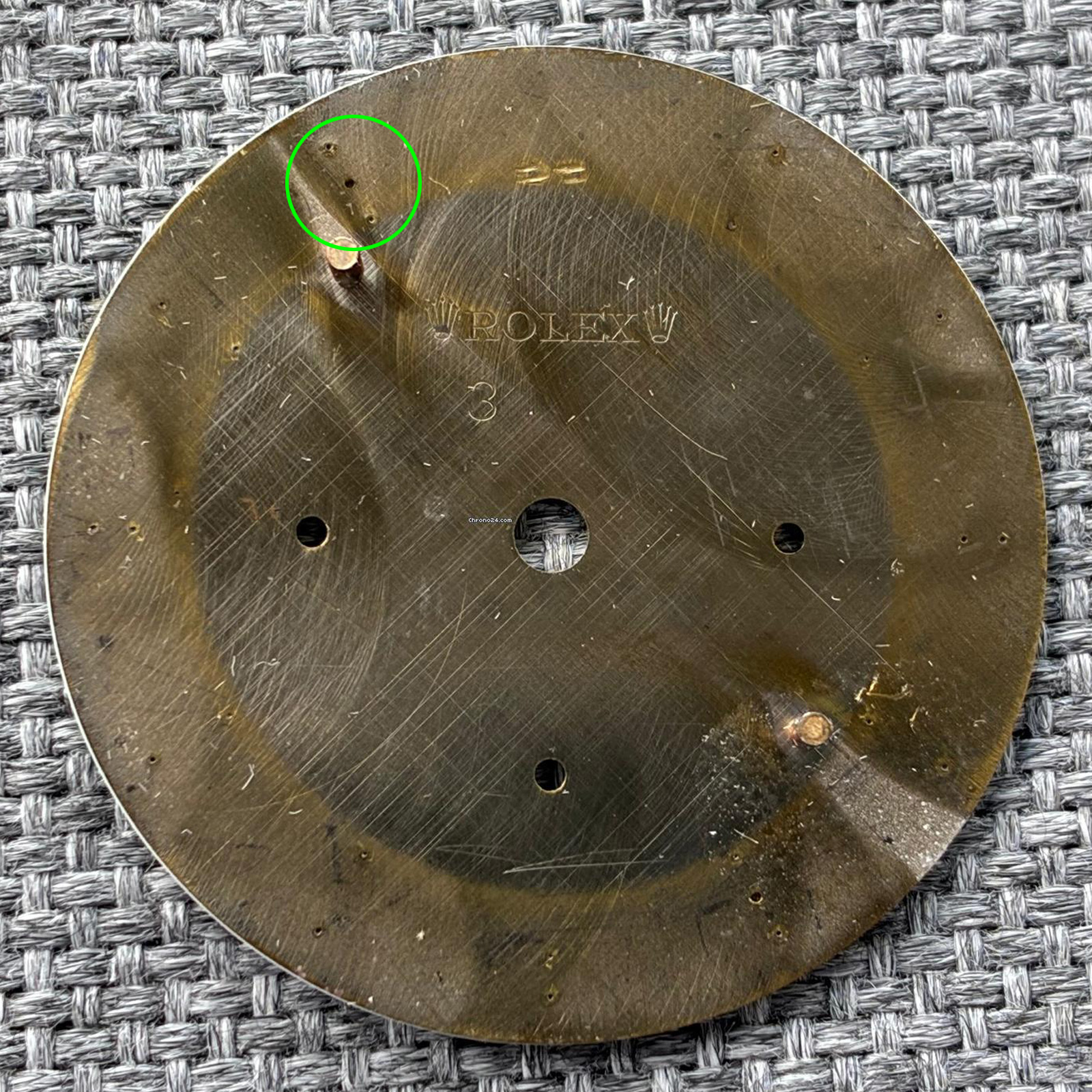
On late 1970s ‘Superlative Chronometer Officially Certified’ gold dials for Ref. 6263/6265, featuring the same Singer punch with two plus signs, the hour markers are attached in a similarly meticulous way—no signs of grinding, except for the applied Rolex crown, where it is normal.
The last series of ‘Superlative Chronometer Officially Certified’ gold dials for Ref. 6263/6265 from the late 1980s feature the same details. The only difference is that the Singer markings changed.
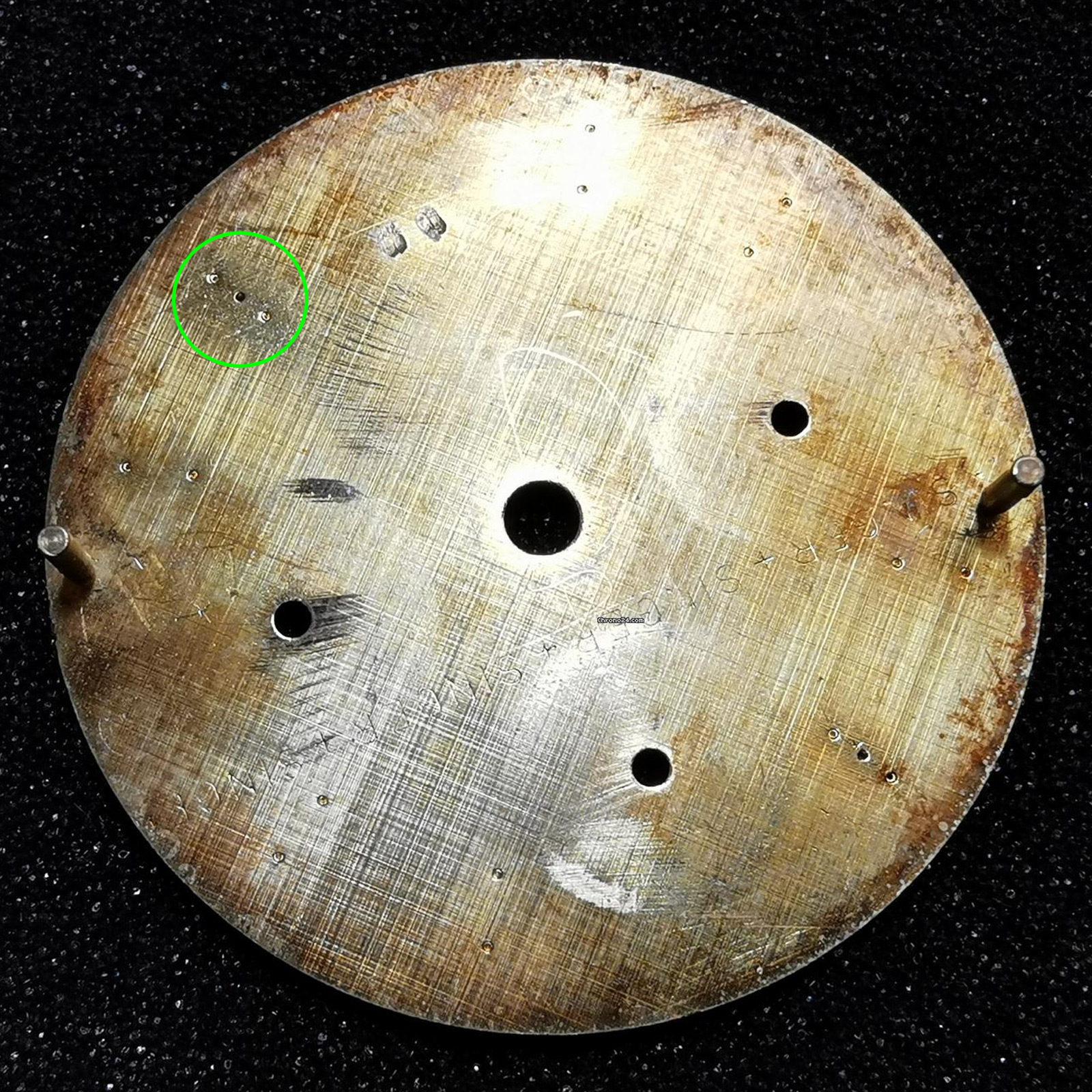
Even on later service dials with the small red ‘Daytona’ over the 6 o’clock subdial, the attachment of the hour markers is carried out in typical Singer perfection.
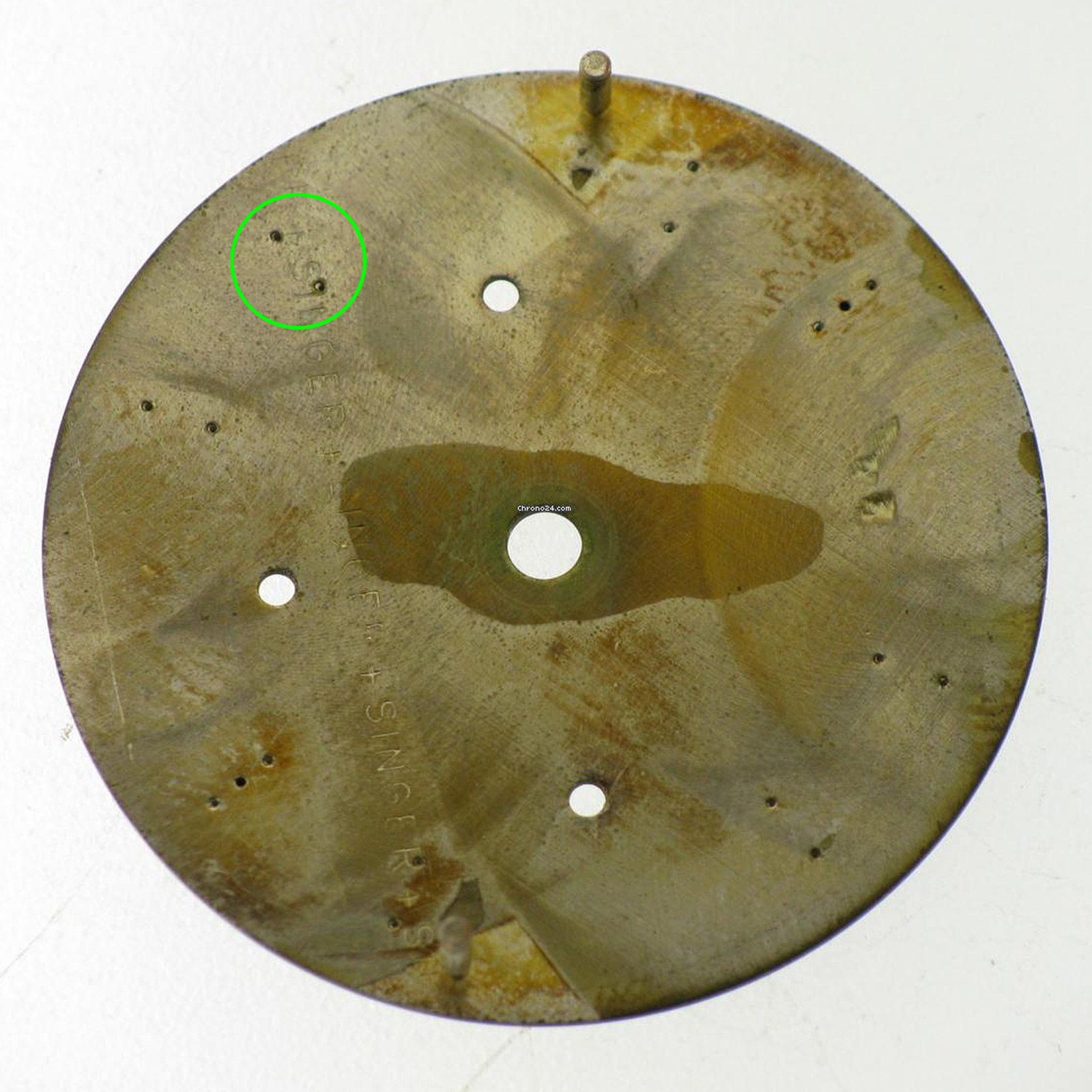
These important details show that the present ‘JPS Cherry’ dial is unlikely to have been produced in the 1970s or 1980s, as Singer did not work like that at the time. In addition, and this is important, we know that the Singer stamp with the two plus signs was used well into the 1990s, as evidenced by its depiction in Pucci’s book.
The first time a similarly messy work with ground-down hour marker pins can be found on Daytona dials is on early ‘Zenith’ Daytona watches of Ref. 16520/16523/16528 featuring the so-called ‘Floating Cosmograph’ print and the inverted 6 in the subdial at 6 o’clock. These dials were produced in the late 1980s.
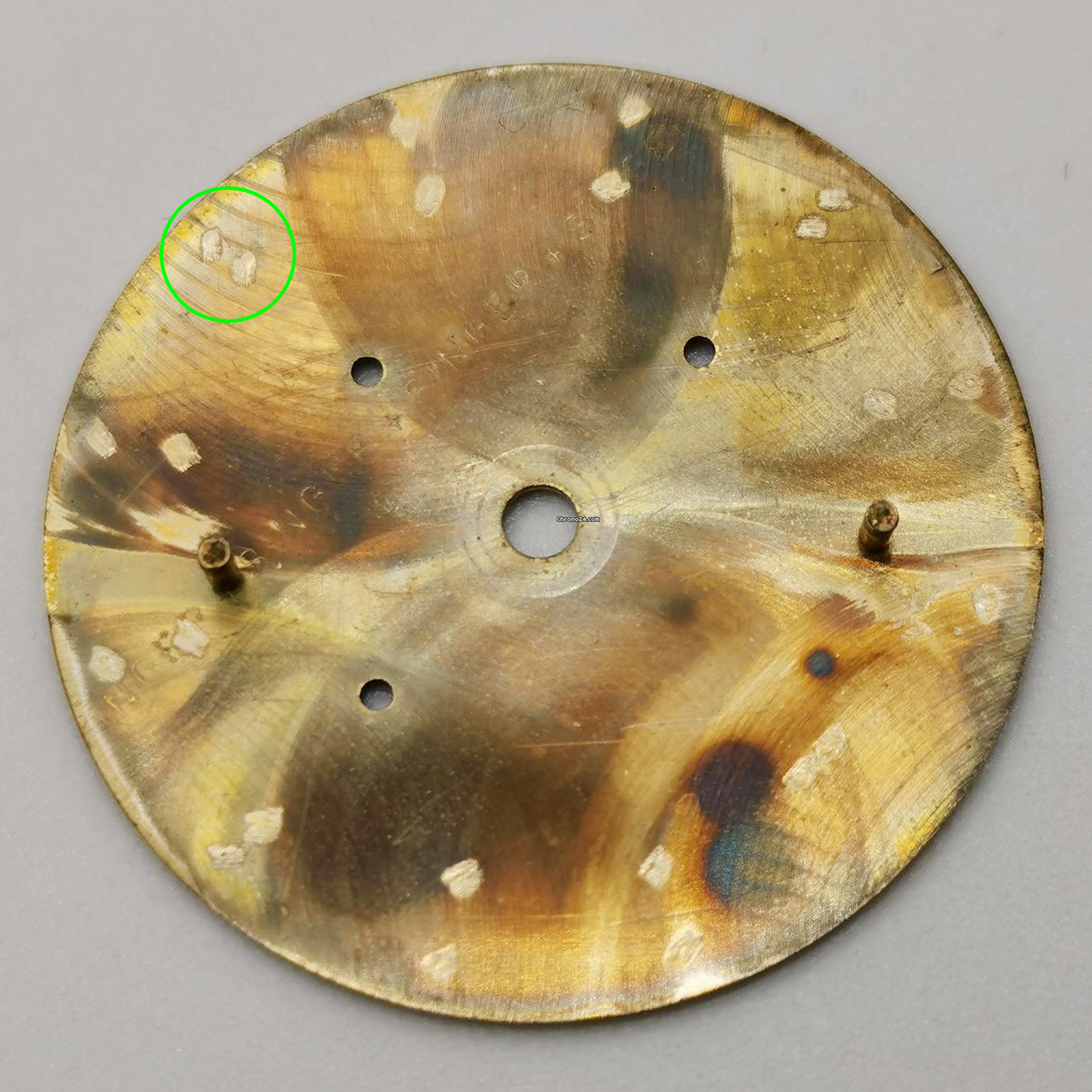
However, with the introduction of a more modern dial with a correctly oriented 6 in the subdial at 6 o’clock and square-type subdial fonts, the ground-down hour marker pins disappeared again. These new dials no longer featured a Singer stamp, but a Rolex one.
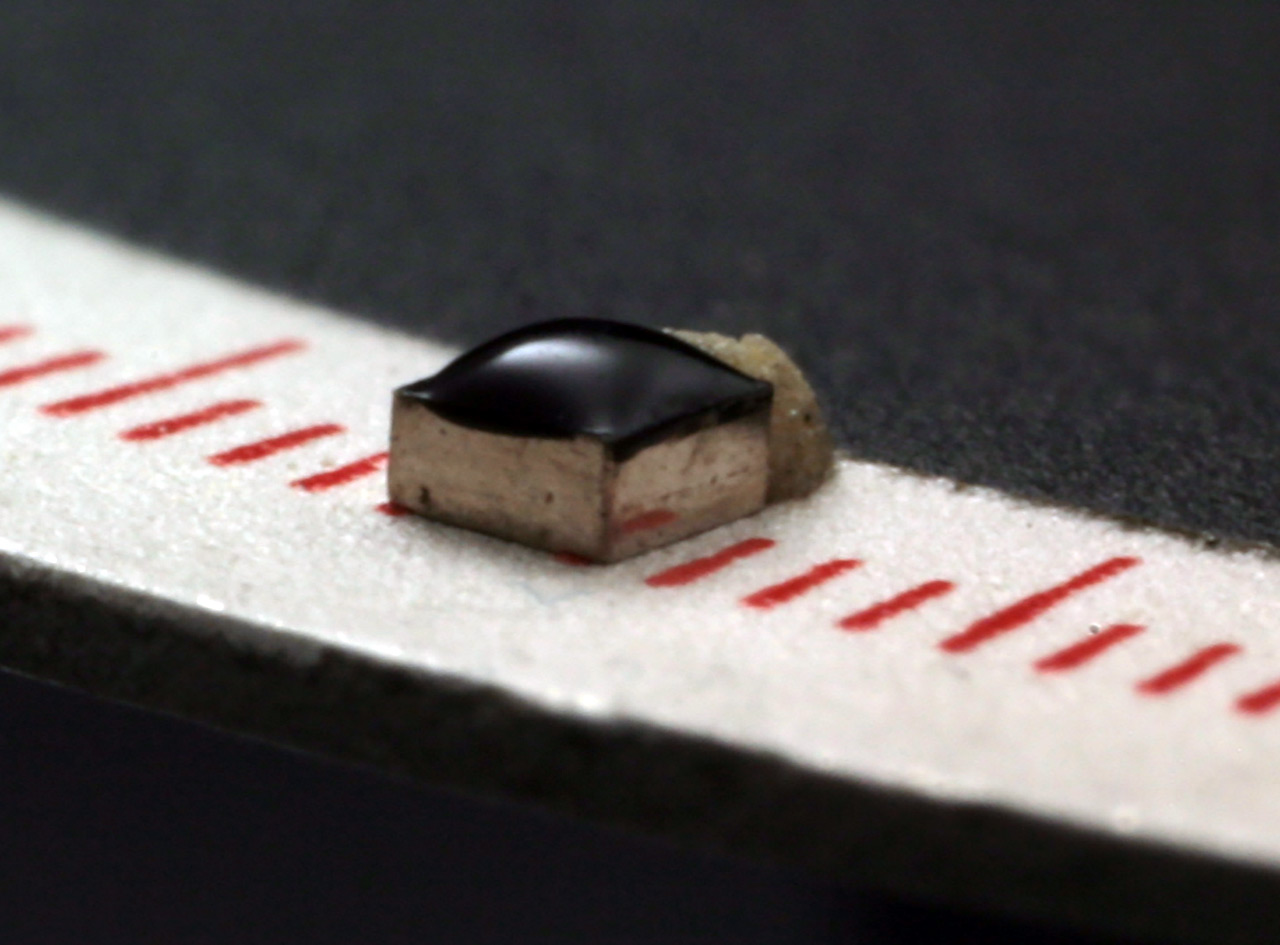
Another interesting observation is that the top of the hour markers on the present ‘JPS Cherry’ is not painted in the same fashion as usual. As the comparison below shows, there is usually a thick black colour blob on the hour markers of these dials. In contrast, on the present watch, the black colour appears very thin and flat.
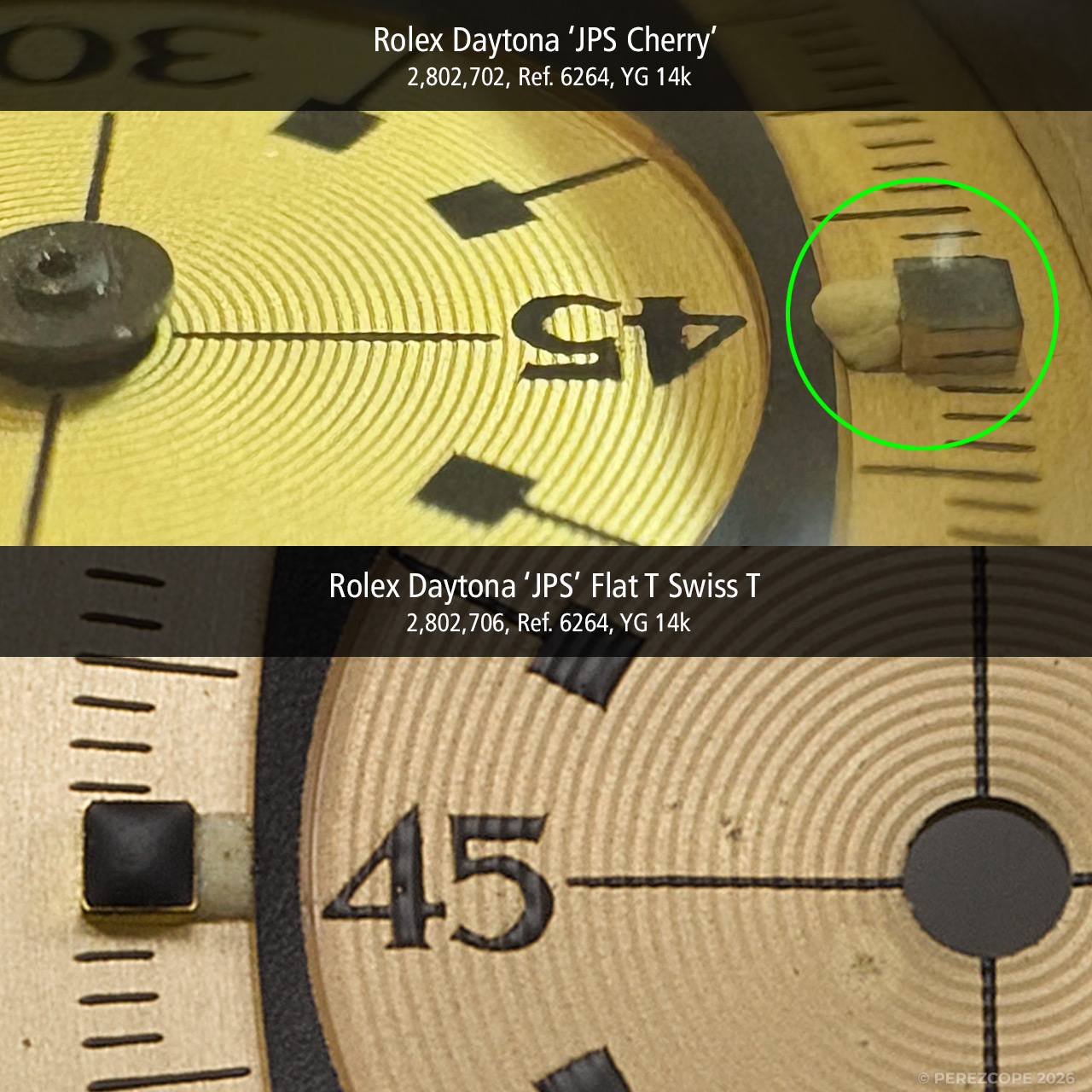
The black paint on the hour markers can be quite raised.
In the past, some people have claimed the ‘JPS Cherry’ cannot possibly be a service dial because the ‘Rolex Cosmograph’ and ‘Daytona’ print is the same as on standard ‘Cherry’ non-Paul Newman dials found in Ref. 6262/6264. This is absolutely not true and is easily disproven by the comparison below. One look at the E of Rolex suffices to see that the logo is not the same. The bottom arm of the E is considerably longer than the arm at the top. Furthermore, note the weird spacing between the A and Y of Daytona, and the differently shaped As that are narrower at the top.
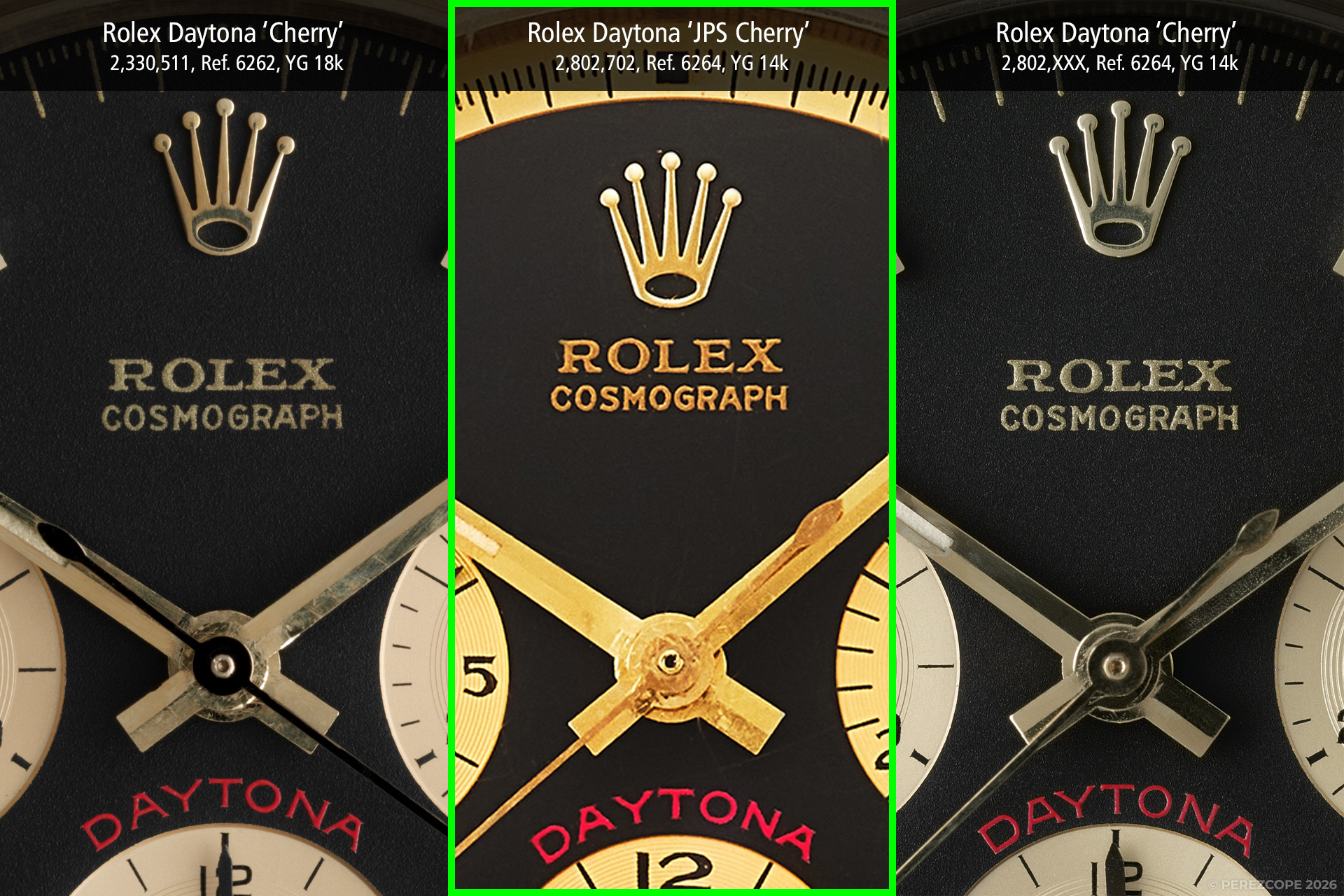
Another detail often cited regarding ‘JPS Cherry’ dials is that the Daytona print is misaligned. The distance to the subdial at 6 o’clock is smaller at the D than at the A at the end. On standard ‘Cherry’ dials, it is nearly perfect.
The Stainless Steel ‘Cherry’
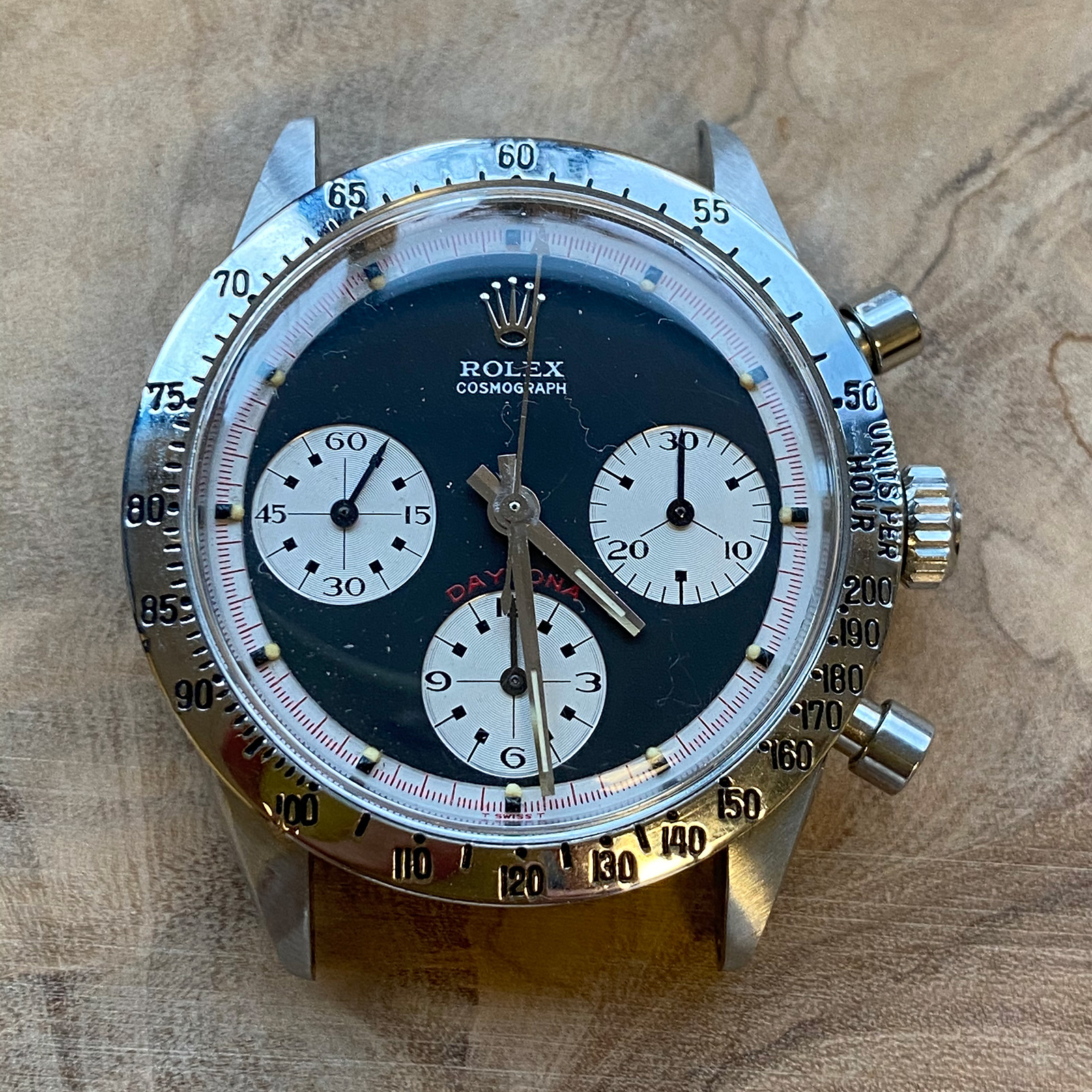
Unbeknownst to most, there is also a stainless steel version of the ‘JPS Cherry’ dial featuring the exact same graphics. I came across this dial on numerous occasions while authenticating watches for auction houses. Since they are known to be service dials, these watches were always rejected. Stefano Mazzariol photographed this type of dial during his visit of the Jean Singer & Cie SA factory.
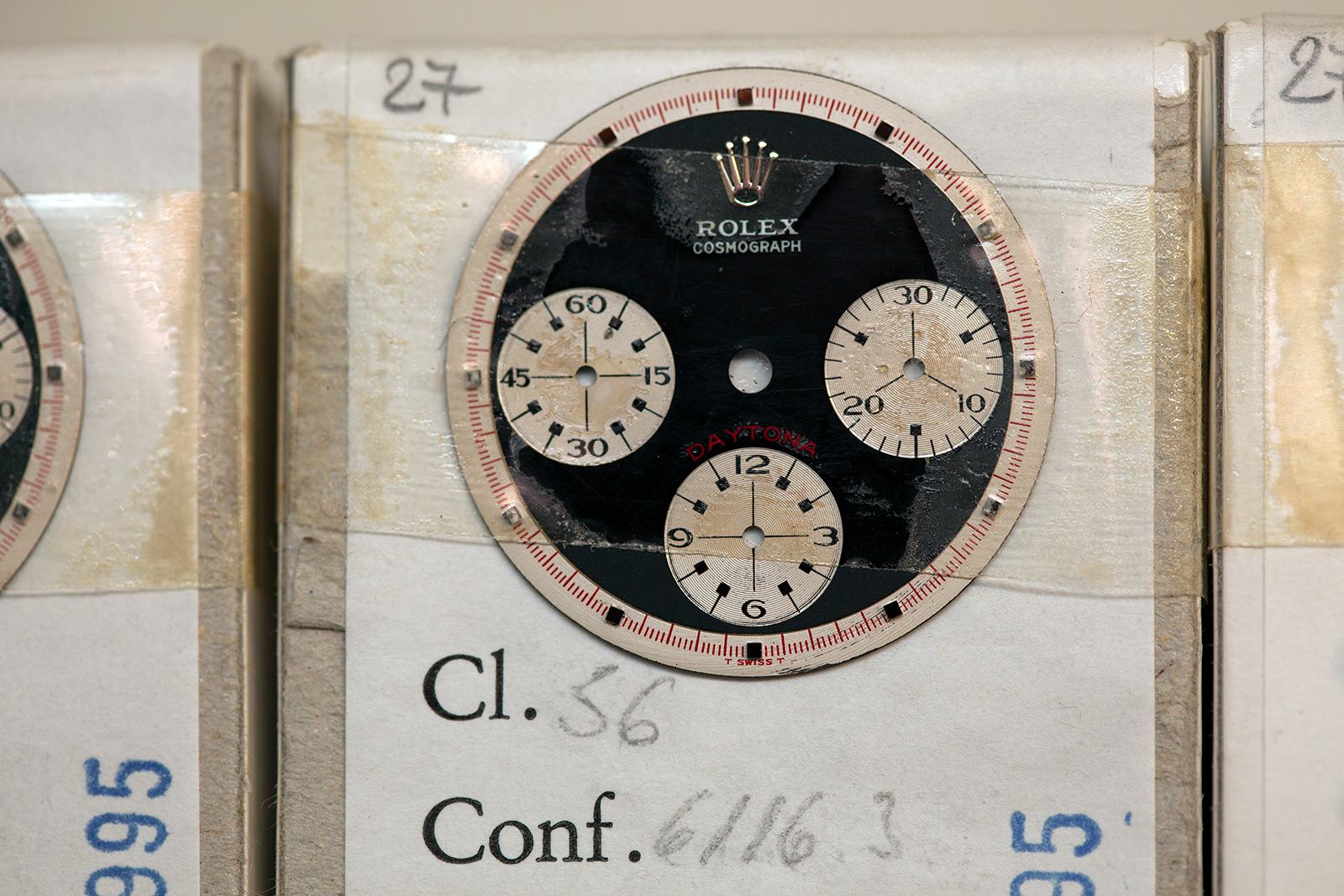
The graphics are identical. Same E of Rolex with the longer bottom arm.
The ‘Daytona’ print matches perfectly as well.
As with the ‘JPS Cherry’, the Paul Newman service dial features the 2 of 20 in the 30-minute subdial with the slightly different shape.
The picture below shows one of the watches found with a ‘Paul Newman’ service dial. At first glance the dial might be confused for a Mk2 dial. However, the shape of the 2 in 20 in the 30-minute subdial makes clear it is a different type.
To conclude, Ref. 6264 in the 2.8 million range has only one correct ‘John Player Special’ dial in my opinion. It features the same graphics as the highly coveted ‘Lemon’ dial, including the flat T Swiss T, and is ultra rare. Collectors have not picked up on this yet. Any other JPS dial in this range is simply wrong.
Thoughts
Numerous details of the ‘JPS Cherry’ dial do not match the standard production from the era. The dial features different graphics and a different gold hue of the subdials and the minute track. The lume colour is almost white when it should have turned cream. The way the hour markers are attached from the back looks messy, almost home-made. The missing thick black colour blob on the hour markers is weird, especially since it is present on the for this case number range correct ‘JPS’ dial with flat T Swiss T for this case number range. The crowning detail, of course, is the fake bezel, which went undetected by Sotheby’s “watch specialists”. I have been in touch with Sam Hines and Carl Chen of the Sotheby’s watch department for the past ten days. Although they have graciously provided all the pictures I requested, I find it odd that, for a company that has previously paid for my horological investigative work, they have not once asked for my opinion on this watch.
Taking all of the above into consideration, the ‘JPS Cherry’ dial is not a period-correct dial but a service dial made in the mid-1990s as per box label seen in the pictures of the Jean Singer & Cie SA factory visit from 2007. For the case number range of the present watch, I can only see a ‘JPS’ with flat T Swiss T as acceptable from a collector’s perspective.
Now, regarding values. For such pieces, it is always subjective and down to interpretation. According to fresh horological narratives currently being implemented by the forthcoming Watch Schools educational platform, of which I am a proud part, although the present watch was not born as now seen, it still should have some value due to its cool aesthetics. Though the appropriate value is for the market to decide, it must be derived within the parameters of full transparency regarding its current configuration. I hope this article helped with that.
Thank you for your interest.
 Vintage Rolex and other iconic timepieces under the loupe at Perezcope
Great stuff – looks open and shut service dial fluff-up like the 6238 all silver watch. Both should be service dial watch values in my book !!
LikeLike
Thank you for this fantastic research! 👍🏻
LikeLike
pardon my ignorance but what is the JPS cherry dial than? Service dial that should have never been released? Singer’s interpretation of Daytona dial that was not accepted by Rolex? Why they were produced in early 90’s?
LikeLike
Or better yet, WHY is there even a JPS “Cherry” service dial?? Was is a decision of Rolex or Singer independently?
LikeLike
Good question!
LikeLike
Shameful. Thank you for pointing out the obvious issues and thank you for your continued work.
This is clearly fraud covered by legal disclaimers.
LikeLike
Great forensic work Jose, and thank you for introducing more transparency in the watch world, 1 case at the time. Btw, this watch was previously sold by Amsterdam Vintage Watches as a “Museum Piece”. If you look at the dial, hands and bezel, its the same 2.802.702. Agree with your perspective, still a great watch, just a matter of correct valuation & integrity.
https://amsterdamvintagewatches.com/shop/rolex-daytona-6264-john-player-special-cherry/
LikeLike
I was wondering why didn’t Hodinkee (or the watch media) ever invite you for a podcast or interview?
then I remembered if they invite you, their narrative of promoting fake watches falls apart. Everyone wins in fake watches other than the customer. No one wants to pay you for the research because they won’t make their cut.
LikeLike